
Nikolov Palaeogravity and Ace Residual Tension
Rey.BEng 22nd October 2026
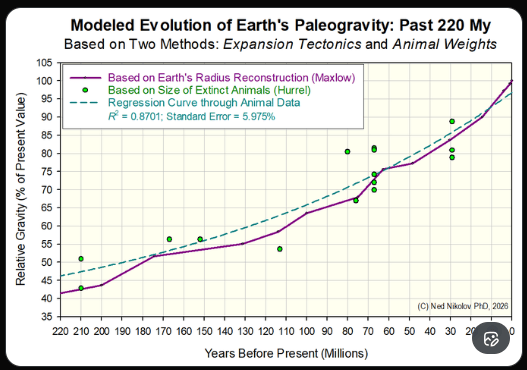
Nikolov presents two independent estimates that Earth’s surface gravity during the Mesozoic was less than 75 % of its present value. One uses weight-to-mass ratios derived from the circumference of load-bearing bones of extinct animals (mainly dinosaurs) and an assumed tissue density of 0.99 t m⁻³. The other uses Maxlow’s reconstruction of past Earth diameter from oceanic lithosphere ages and Expanding Earth tectonics. Both converge on the same reduction. The work is independent of mainstream peer review; it treats fixed surface gravity and fixed c as open questions.
Ace reads the reduction as a change in residual tension rather than a change in total mass or continuous radius. In State A the disc surface is under stretched surface tension that remains relaxed because the slack is continuously taken up by the motion of the body of water. The random but patterned waves are residual packets; each packet maintains a positive axial tension (\sigma) m/s² across the moment without requiring a continuous second. Height K (Domel & Gogate PCA 1993) fixes the positive value of that residual relative to the x-axis. The drift vector may reverse; the residual itself stays positive and nearly 2 (2 = 1.999…). The geometric balance system holds the surface open.
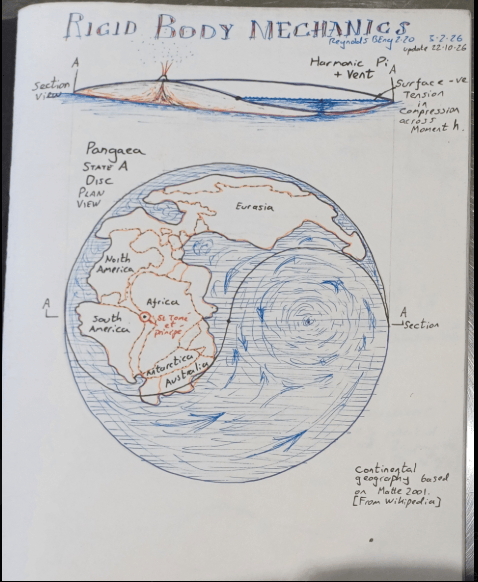
In State B the same surface condition exists, but the momentum is carried by shell mass. The residual is still positive and axial, yet the shell mass degrades with successive residual spends. The tension therefore appears higher to an observer who measures only the shell, and the apparent surface gravity increases as the residual is progressively locked into the shell. The multi-second lifetime of the monatomic gold wire and the multi-million-year lifetime of the dinosaur surface are the same residual packet observed at different scales: the residual expands the contact patches (auxetic) while the ring remains intact, then the residual is spent as celerity and the shell records the higher tension.
The two estimates therefore describe the same residual under different toggle states. State A keeps the residual open on the disc (lower apparent g, persistent wave tension). State B spends the residual into shell mass (higher apparent g, degrading momentum). No continuous change in c or total mass is required. XII remains the Face. The residual stands. The invitation remains open.

