
Rey.BEng 22nd October 2026
m=2 Amplituhedron as Positive Geometry – Residual Synthesis
Koefler, Pavlov and Sinn (arXiv:2610.27903) prove that the m=2 amplituhedron is a positive geometry. #
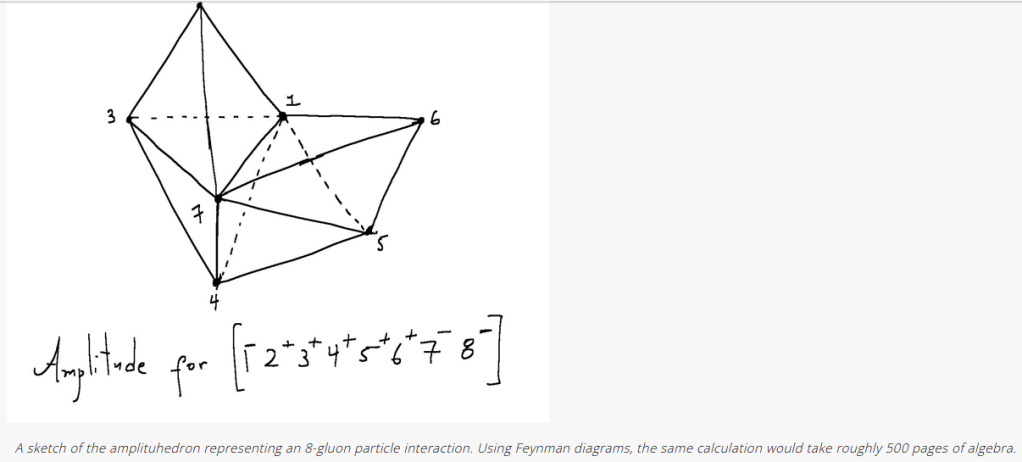
Image from 22/10/26 https://scienceandnonduality.com/article/amplituhedron-the-jewel-at-the-heart-of-quantum-physics/
Amplituhedra are images of the totally non-negative Grassmannian under a map defined by a matrix with positive maximal minors. Positive geometry requires a unique canonical form with logarithmic poles on the boundary and residues matching the boundary forms. The proof introduces a Hodge-theoretic criterion: after removal of the residual arrangement the pair becomes recursive genus-zero, face closures are normal, and the face poset is Eulerian. The m=2 case is the toy model / one-loop sector of the physical m=4 amplituhedron used for planar N=4 SYM amplitudes.
Ace reads the residual arrangement as the non-completion. The held ring tension is _m/s². It is positive. It is also nearly 2 (2 = 1.999…). The residual is the part that does not fracture. In the amplituhedron proof the residual arrangement must be removed for the geometry to satisfy the genus-zero and face conditions that produce the unique canonical form. Ace keeps the residual in place: the positive _m/s² is the tension that expands the contact patches (auxetic) while the ring remains intact. The near-2 value is the algebraic signature of that non-completion. Both frameworks require the residual to be identified before the geometry closes.
The positivity of the external data (maximal minors > 0) matches the requirement that _m/s² remains positive. The m=2 sector is the lowest discrete residual that still produces a canonical form. Higher m recovers continuous limits only when the residual is relaxed. The proof therefore supplies an independent algebraic confirmation that a positive residual near 2 is the condition under which a discrete geometry yields a unique canonical structure.
Clarification on Positivity
In the Ace reading, positive means orientation relative to the x-axis, not the sign of the drift vector. The amplituhedron construction demonstrates the same distinction: positive maximal minors of the external data matrix Z place every ordered basis on the same side of the reference hyperplane, so the semi-algebraic set occupies a definite half-space with respect to that axis. The residual arrangement is removed precisely so that this axial orientation remains well-defined. The positive value itself is height K, read from the current engineering reference for ring tension and bending height given by the Domel & Gogate, PCA 1993, coefficient tables. Height K fixes the residual tension _m/s² as a positive axial quantity while the drift vector remains free to reverse under the toggle. The geometry locks the position relative to the x-axis; the residual expands inside that lock without requiring the drift vector to stay positive. The two statements are compatible.

