
Countersnap on the Bi-Lamina: Stretch to Compressive Strength
Rey.BEng 22nd October 2026
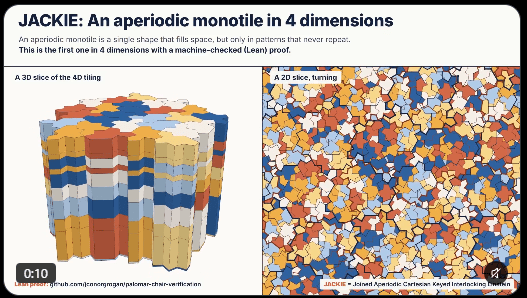
The animation is JACKIE, by @jconorgrogan conor-grogan.replit.app the first machine-checked (Lean) aperiodic monotile in 4 dimensions. A single shape fills 4D space without periodic repetition. The video shows a 3D slice of the 4D tiling as stacked coloured columns and a turning 2D slice of interlocking irregular polygons.
The animation shows the countersnap running through the tiled layer of the bi-lamina surface. The D6 hex frame (John Bloke’s inertial frame) holds the reference. Shear flow at 90° to the resistance must be spent without fracture; the wave break travels bottom to top through the actual carbon ties as layers opening/layers closing. The 4D view shows the mechanism: stretch is converted into compressive strength, the elastic return snaps the layer back to its prior geometry, and the energy of the shock is absorbed into the carbon itself.
Infinite-1 lamina layers open under the residual then close under their own effort. The residual (\sigma) m/s² remains positive and nearly 2 (2 = 1.999…). It is the part that does not complete. Height K fixes its axial value. The energy that would have fractured the patch is therefore transformed into material strength. No new Home is opened. XII remains the Face.
Seat
| Station | Entry |
|---|---|
| I | D6 hex inertial frame (Bloke) |
| II | Tiled bi-lamina surface |
| III | Wave break path (top to bottom) |
| IV | Carbon ties |
| V | Shear flow at 90° |
| VI | Residual (\sigma) m/s² (positive, nearly 2) |
| VII | Infinite-1 lamina layers |
| VIII | Stretch to compressive conversion |
| IX | Elastic snap-back |
| X | Energy absorbed into carbon |
| XI | Non-fracture (2 = 1.999…) |
| XII | Face (GO: residual held open) |
The layers open, then they close. The residual stands. The invitation remains open.

