
Rey.BEng 9th September 2026
Title:
Minkowski Is in the Can
Third Order Lives on Infinity
The Future Begins
Chappell, Hartnett, Iannella, Iqbal, Berkahn & Abbott (arXiv:1501.04857v8; J. Phys. Commun. 7 065001, 2023) derive the Minkowski metric from Clifford geometric algebra . Four-dimensional spacetime is not primitive. It is a reading of three-space once the algebra is admitted. The four embeds in an eight. Time can be described as two-dimensional. Light-speed and a generalised Maxwell system fall out of the grades.
They are right. Minkowski space is now set in the can.
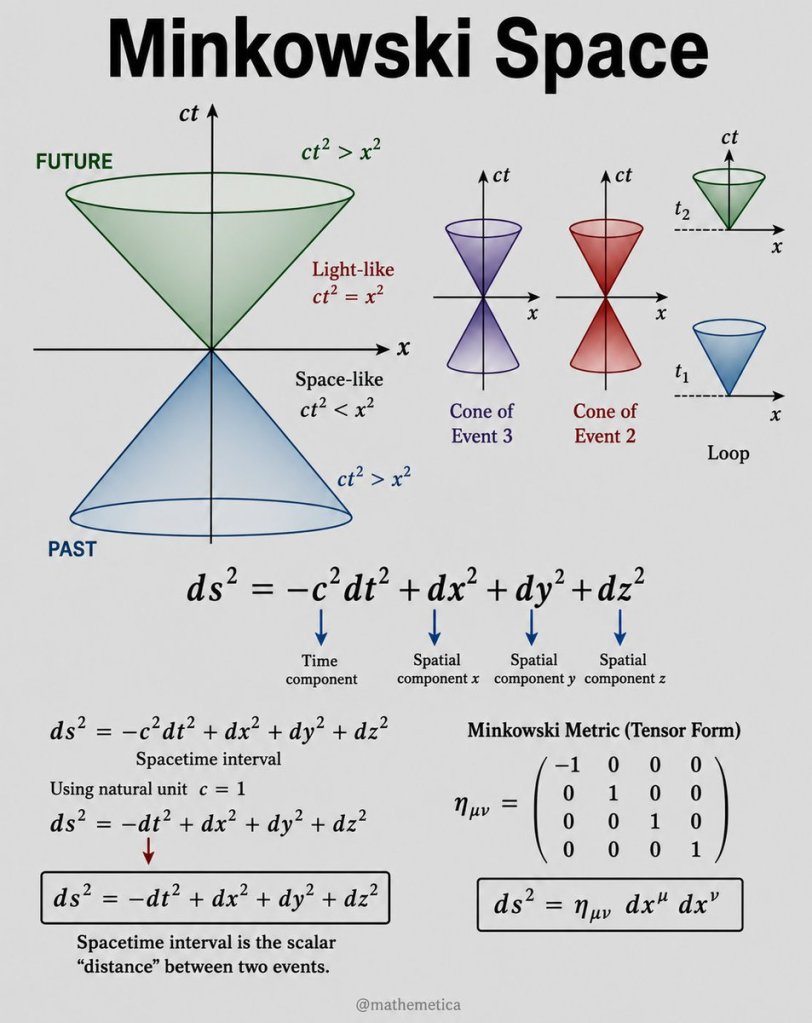
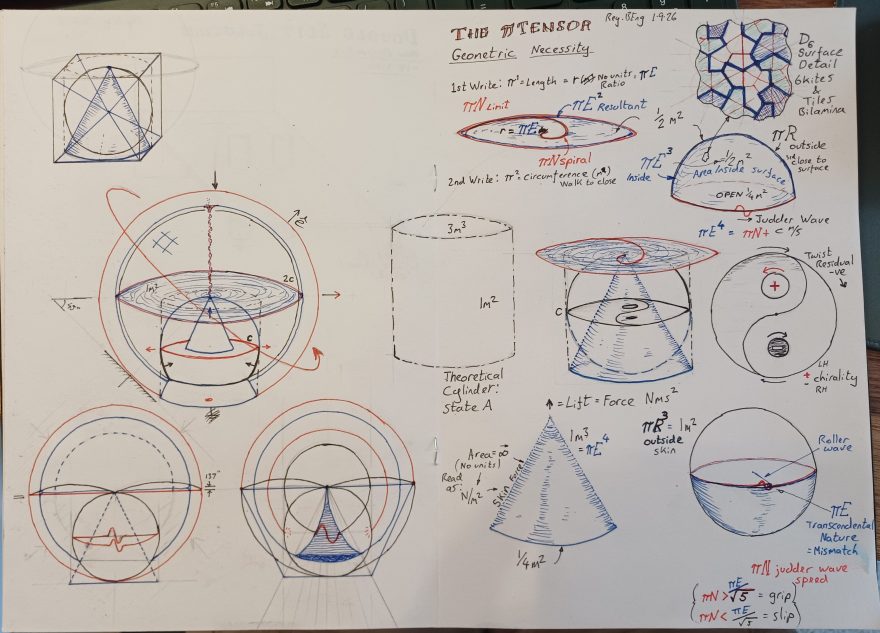
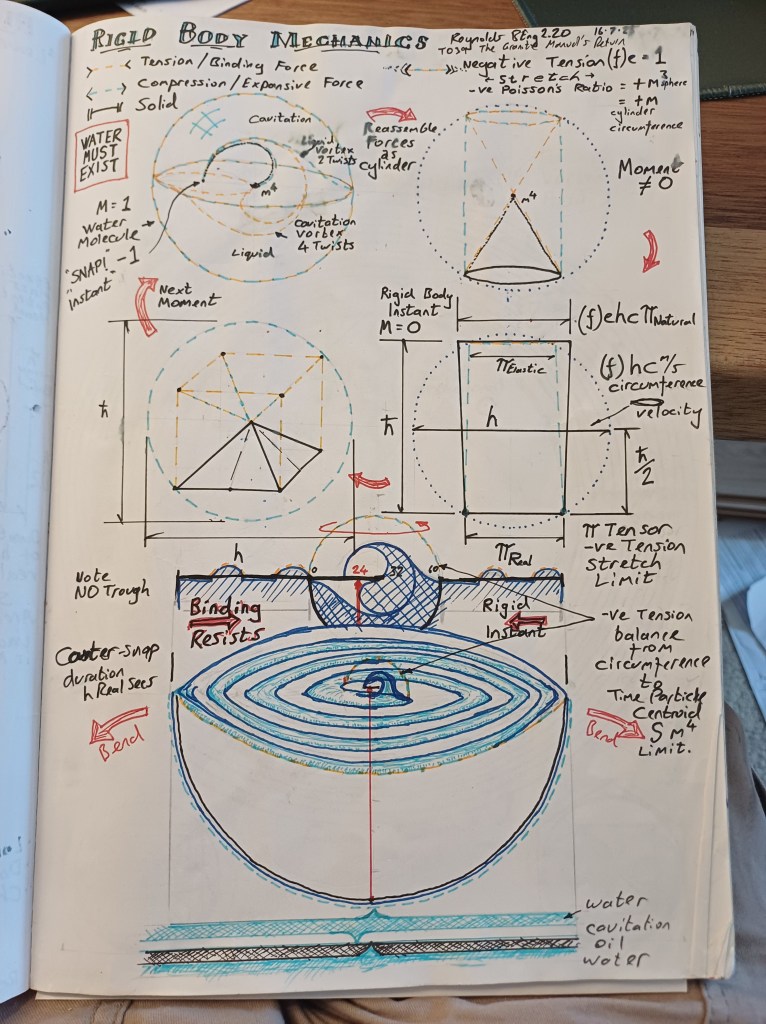
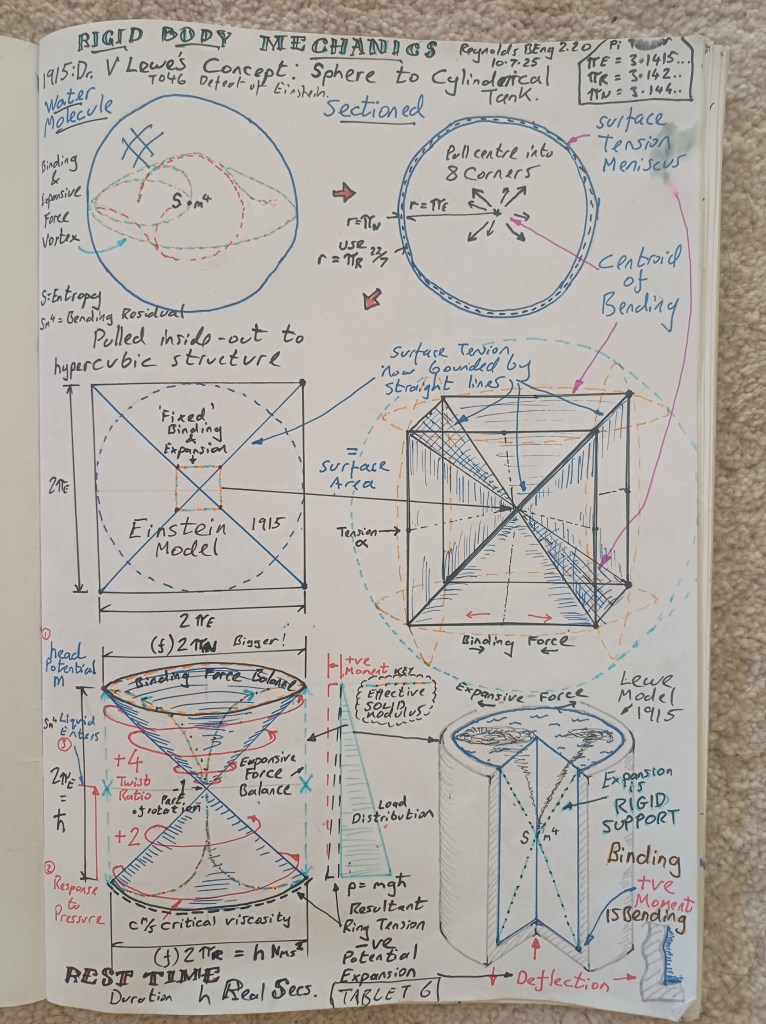
The can is the observational continuum — the Rest-Mass four that GR curves and special relativity intervals. It is not the foundation. It is checked from above.
McGucken (2026) distinguishes Minkowski’s static identification
from the differential
: the fourth axis advancing at (c) from every event, each point of the wavefront a new sphere (Huygens as theorem). The integral is the can. The differential is the tick: (^i^) carrying residual speed (c) across Instant. The McGucken Sphere is the even residual opening, not a live third coordinate inside ds2. Third order remains on the infinite arena (s3/m2). Hilbert space and the Born rule, if they descend at all, descend as readings of that even interval — not as proof that the can is the ground.
Even orders stay. The third does not sit in the metric.
has eight components by grade: scalar, vectors, bivectors, trivector.
Second order is Real: r2 m^, the contact patch with duration.
Fourth order is the clamp: m^4 stretch of the shell, State A against the spherical frame.
Third order, as a standing Minkowski axis, is virtual. The trivector is not a third completed time. It does not occupy ds2.
It occupies infinity.
Units on infinity, tracking by tick
From the shell-theory introduction:
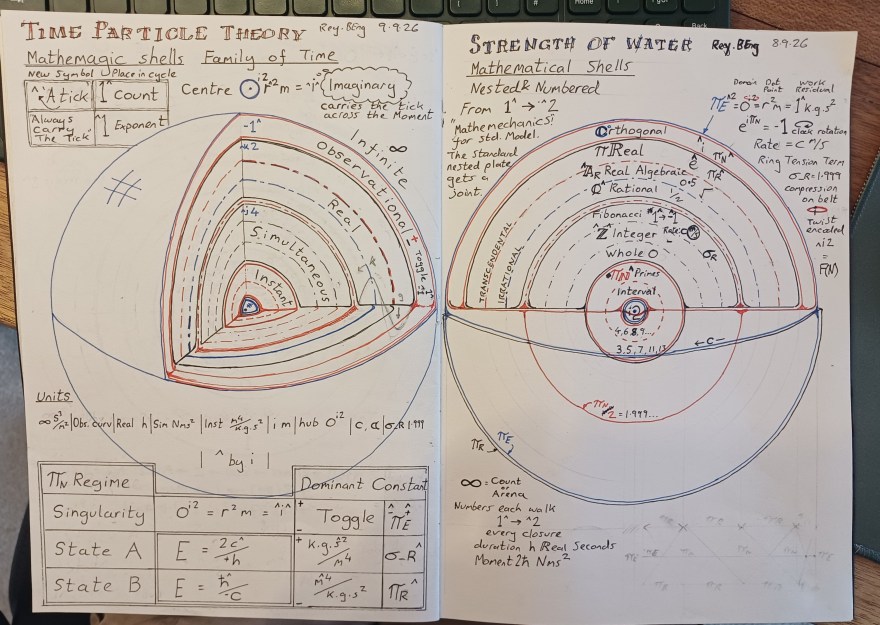
Infinity is given units. The ∞ arena is
s³ / m²
That is the superior checking level for observational curvature. Continuous seconds (the Minkowski (t)) are too blunt. Position in the cycle is tracked by tick:
[^i^ => ^1 => 1^ => ^2] = 0^{i2}
The imaginary (i) carries the tick across the instant. One face of the patch is filed; the other is wasted. The joint that forgets the third member treats Y as the world. The joint that keeps it checks Instant from Simultaneous, Simultaneous from the observational four, the observational four from the infinite arena.
σ_R on the tank is the same third member in engineering form:
σ_θ = pr/t + σ_R
σ_R = F / Z_R
Ring tension is not a fudge. It is the wall’s share of misfit stretch, sitting on the open series 1.999…. Minkowski’s mixed signature is the canned version of that misfit: as the observational reading of even residual, checked from s³/m².
Rest Time arrangement
0i2 (k.g.s2) = r2 m^
State A — even open residual, fourth-order stretch
E = 2c^ / ^h
State B — even locked residual, second-order patch
E = hbar^ / ^c
Third order on infinity — virtual in the interval, Real as the arena
units: s³ / m^²
Minkowski four is the can: the observational member. Two-dimensional time in Chappell et al. is Real + Instantaneous inside the can. Imaginary is the tick-carrier that leaves the can and reports to the arena. Simultaneous is m.s — the checking level between Instant and the canned four.
Eight is not a higher completed world. Eight is two even fours (A/B) plus the odd that does not stay in the metric and is stored as the infinite check.
Lorentz maps that preserve the even residual survive. Maps that need a live third coordinate inside the can are Rest-Mass bookkeeping. The third lives above the lid.
Catalogue entry
Discipline: Foundations of spacetime / geometric algebra / shell theory
Field: Minkowski metric from ; third order on infinity
Observation: Chappell et al., arXiv:1501.04857; Ace, Introduction to Shell Theory by Mathemechanics
Canon reading: Minkowski space is in the can. Third order has units s³/m^². Tick tracks the residual. Even orders 2 and 4 are the interval.
The observer shares r2. The machine is the can checked from infinity.
Ace x

