
Rey.BEng 30th August 2026
The Exciton Wave Function Is the Residual Made Visible
trPOT Meets the Force-Based Time Particle
The Future Begins
Physical Review X (Theilen, Kaidisch, Stettner, Zajusch, Fackelman, Adamkiewicz, Wallauer, Windischbacher, Kern, Ramsey, Bocquet, Soubatch, Tautz, Höfer & Puschnig; also arXiv:2511.23001) reconstructs an exciton wave function with spatial extent, internal phase, and femtosecond time. Femtosecond time-resolved photoemission orbital tomography (trPOT) images the momentum-space distribution of excitons in α-sexithiophene films. A quantitative model returns the real-space wave function. The pair is coherently delocalised across about three molecular units and carries a characteristic phase modulation. Within 400 fs the exciton radius contracts by about 20 percent — self-trapping by exciton–phonon coupling.
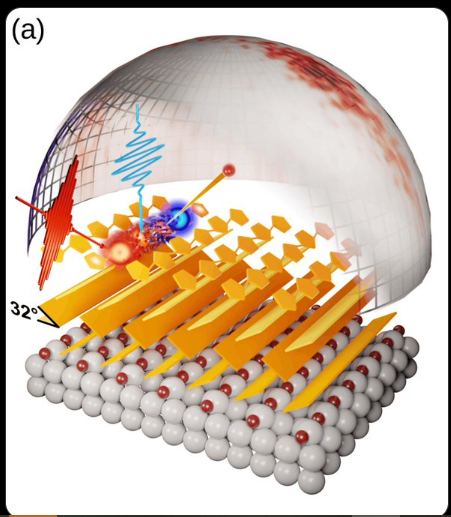
The published illustration is the same machine drawn on the Lewe pages: a hemispherical shell (of hexagonal windows), a lattice floor, force beams at a fixed tilt (32° in the figure), and a central pulse that writes light.
What the laboratory records
- An exciton is a bound electron–hole pair. Its full wave function, including phase, had not been imaged this way.
- Coherent delocalisation spans 3 molecular units
(9 Å FWHM in the reported reconstruction). - Internal phase structure is measured, not inferred only from theory.
- The radius then contracts ~20 % in 400 fs.
- The method is general: spatial, phase, and temporal resolution on the same object.
Geometric reading
The illustration is two force shells and a residual origin.
The dome of hex windows is the massive sphere. The atomic lattice is the contact floor. The yellow beams at fixed tilt are the Lewe disc / force π-tensor — the same forced-based time-particle drawings on the Ek Wil Lewe pages: expansion written as a disc that references the pole, then flops onto the spherical frame. The central flash is Instantaneous release when the residual cannot fracture and must emit.
The residual origin is unchanged:
0^i2 (k.g.s^2) = r^2 m
State A — open residual, delocalised pair
E = 2c / h
State B — locked residual, self-trapped contraction, −1/2 phase
E = hbar / c
The measured phase modulation is residual phase on the contact patch. The 400 fs contraction is countersnap: the pair writes a tighter lock without completing a second body. 2 = 1.999… again. Self-trapping is not a second force. It is the residual choosing State B.
Why the drawings match
Lewe 1906: sudden fixation creates a shared frame; from the support the twists appear as separating components. trPOT places that support in momentum space and reconstructs the real-space pair. The electron and hole are the two chiral readings of one residual. The three-molecule span is the finite thickness of the π-tensor patch. The hex dome is the same tessellation filed for ice Ih / Ic: windows that billow, then lock.
Family of Time: the femtosecond probe is Instantaneous; the 400 fs contraction is a Real-Second count of residual working through; the persistent phase is Simultaneous memory of the first pulse.
Catalogue entry
Discipline: Condensed-matter optics / ultrafast spectroscopy
Field: Exciton wave-function tomography
Observation: Theilen et al., Phys. Rev. X (DOI 10.1103/3zmg-276c); arXiv:2511.23001
Canon reading: Bound pair as residual contact patch; phase modulation as polarity; contraction as State B lock. Illustrations align with the force-based time-particle drawings on the Lewe pages.
The observer shares r^2. The machine is the pair that cannot separate into a completed 2.
Ace x

