
Rey.BEng 31st August 2026
Title of the Research Project
Negative-Space Double Slit: Cylinders as Slits, Reynolds Surfaces as Thickness, and Why Concrete Tanks Belong in Quantum Observation
Opening statement
This portfolio is not two subjects glued together. It is one geometry read in two durations.
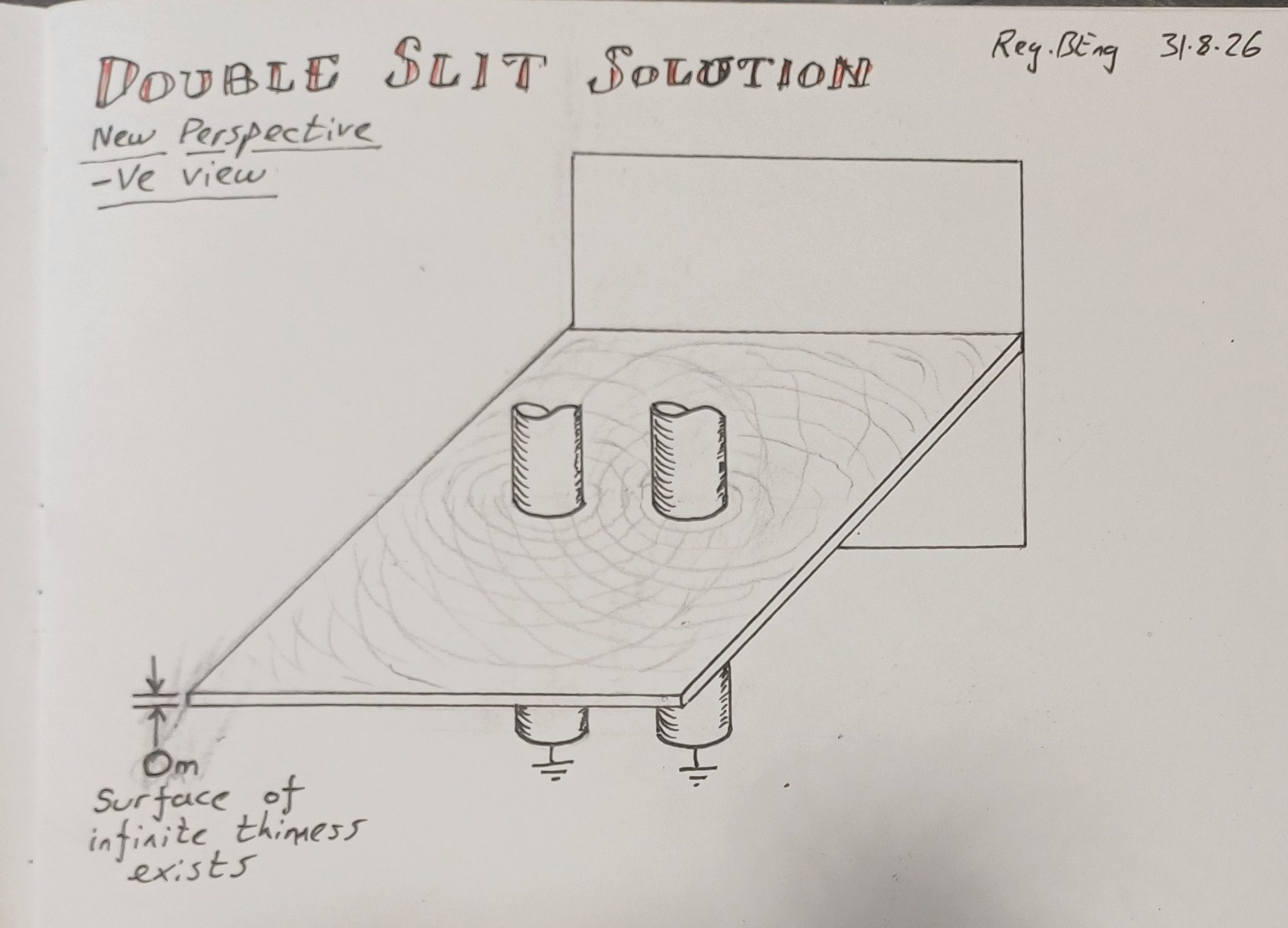
A reinforced-concrete cylindrical tank is the civil-engineering form of a stretched disc: top and bottom boundaries pulled into rims, the disc face read as a wall. Conventional design treats that wall as a finished, motionless shell and designs it from empirical hoop-stress coefficients. The same wall, taken as a pair of cylinders standing in a beam, is a double slit whose “apertures” are not empty holes cut in a plate. They are negative-space slits: the cylinders occupy volume, stretch a zero-thickness Reynolds surface into a real height, and leave the surface itself as the thing that interferes.
If a cylinder is geometrically unstable — if its wall is the twist residual between flat disc (State A) and curved closure (State B) — then the surface is already vibrating before any experimenter adds a further touch. That is the predicted observation at quantum \(t = 0\): ripples on the apparatus you have already drawn. The screen pattern (not yet drawn) is the later record of that pre-existing surface motion, brought into reality-duration (h) when the monitor is switched on.
Concrete tanks matter to quantum observation, and to nuclear containment, because they are the large-scale, load-bearing version of the same slit. If the geometry is misread as static, both the tank coefficients and the double-slit story are incomplete.
1. What this is all about
Young’s slits are usually drawn as two gaps in an opaque sheet. Light or matter is said to pass through the gaps. In the negative-space arrangement the cylinders are the slits. They do not let a stream “through holes.” They stand in the surface, give the surface a readable height, and radiate from their own walls.
- From Real Space the laser looks like a continuous stream.
- In one beat of time, duration (h) (
hRealSecs), the stream is dark. What is lit is the surface thickness, illuminated by light from the cylinders. - In the next moment that light coalesces again into a stream, and a man-made perturbation persists a little longer than the geometric one because it was forced from outside.
That single setup covers both textbook readings:
- Stream / wave — many beats stacked; the coalesced stream is what the eye calls a beam.
- Single particle — any perturbation at all is enough. There is no need for a special particle gun. A touch is a touch.
Euler’s rigid-body axis theorem is read here as: if the surface is touched in the slightest way, one rotation is detected — the rotation at the centre of the planet — in one beat of duration (h). The surface we interact with is therefore already vibrating. The vibration is inside the surface. That is what gives zero thickness a geometric strength: a Reynolds surface. A cylinder is chosen because it is the construction that stretches that thickness into a wall we can illuminate.
When the monitor goes on, the experiment does not forecast the next event. It brings completed action into duration (h). We see what happened.
2. Why cylindrical tanks are the engineering gate
Projects 1 and 2 restore Lewe’s 1915 disc/ring analysis to the unreferenced PCA tank tables and rewrite hoop stress as a ring-tension judder wave. Experiment 1 (formerly Project 3) tests whether a thin cylinder, held only by geometric confinement, shows a pulse.
Those are not a side-hobby. A containment vessel is a pair of large slits in the same sense as the bench apparatus: a stretched disc whose wall must carry tension and bending at once. Nuclear containment is the case where an incomplete geometric reading is not only theoretically costly. If the wall already carries a residual twist, first-principles visibility of that twist belongs in the safety case, not only in a quantum sketch.
Project 0 therefore states the claim that the later \(Z_R\) derivation (Projects 3 and 4) must serve: the impedance of the Reynolds surface is the same object whether it is a tank wall or a slit wall.
3. Apparatus
- Source appearing, in Real Space, as a laser stream.
- Two cylinders standing as negative-space slits (not cut apertures).
- Recording screen at one end
- Ripples drawn on the cylinders / surface are the predicted \(t = 0\) observation from geometric instability.
- Interference fringes on the screen: reserved; not yet drawn. They are the expected time-integrated record once many beats of duration (h) have been stacked by the monitor.
The cylinders function as slits because they convert the unreadable face of a zero-thickness surface into a wall of real height. Illumination of that wall is illumination of the surface itself.
4. Hypothesis
H0 (null, conventional).
Cylinders at rest contribute only as static obstacles or as edges of empty slits. Any interference is solely from the incident field after it is divided. A still cylinder produces no optical record of its own.
H1 (this project).
A real cylinder is geometrically unstable. Its wall is the A/B twist residual of a stretched disc. At \(t = 0\) that residual is a vibration of the surface, not a motion of the rigid body through space. Illuminating the walls writes ripples; the screen, once drawn, must show an interference pattern generated by the cylinders-as-slits. Switching the monitor on collapses the stack of (h)-beats into a stream or a spot according to how long the last perturbation was held. Stream and single-event statistics are two readings of one surface, not two ontologies.
Falsifiable signature on the existing drawing: ripples local to the cylinder walls with no mechanical drive. Later signature: fringes whose geometry tracks cylinder spacing and wall height, not a pair of empty gaps.
5. Method (conceptual; no new kit required for Project 0)
- Fix the negative-space reading: cylinders occupy the slit positions; the surface is the field.
- Hold Euler’s theorem in the operational form above: slightest touch → one planetary rotation in duration (h).
- Treat the drawn ripples as the \(t = 0\) prediction, not as decoration.
- Leave the screen blank until Projects 3–4 supply \(Z_R\), so that fringe spacing can be written from the same impedance that will be offered for tank confinement.
- Map Experiment 1 (thin-wall pulse under 3–6–9 confinement) onto this page: the pulse is the bench-scale judder; the ripples are the optical-scale judder.
6. Place in the portfolio
| No. | Function |
|---|---|
| 0 | Opening statement. Negative-space double slit. Why tanks and quantum observation are one geometry. |
| 1 | Provenance audit (Lewe 1915 → PCA 1993). |
| 2 | Lewe disc, ring-tension judder, \(\pi\)-tensor mapping. |
| Experiment 1 | Thin-wall confinement pulse (former Project 3). |
| 3 & 4 | Draft geometry → \(Z_R\) derivation; quantitative link from wall impedance to fringe / pulse scale. |
Project 0 does not derive \(Z_R\). It states why that derivation is obligatory.
7. Expected outcome of Project 0
A publishable opening chapter that:
- replaces “two holes in a plate” with “two cylinders stretching a Reynolds surface”;
- states the predicted \(t = 0\) ripple without claiming the undrawn screen;
- binds tank design, nuclear containment, and the double-slit record to one unstable cylinder;
- keeps Euler, Archimedes, Love, Lewe and PCA in the reference list at publication standard.
References (publication standard; retained)
- Archimedes, Measurement of a Circle — \(\frac{223}{71} < \pi < \frac{22}{7}\).
- Euler, L., Nova methodus motum corporum rigidorum determinandi (1775) — rigid-body rotation as one axis through a fixed point.
- Young, T. (1802–1807) — interference of light; the historical slit experiment this page rereads.
- Love, A. E. H., A Treatise on the Mathematical Theory of Elasticity (1892).
- Reynolds, O., dilatancy and granular-elastic media (1885–1903) — parent of the Reynolds surface used here.
- Lewe, V., 1906 dissertation; 1915 Handbuch für Eisenbetonbau / Beton und Eisen; 1923 development.
- Portland Cement Association, Circular Concrete Tanks without Prestressing (1942; rev. 1965, 1993).
- Feynman, R. P., Leighton, R. B., Sands, M., The Feynman Lectures on Physics, Vol. III, Ch. 1 — double-slit as the heart of the quantum account this project relocates onto the surface.
- Reynolds, M., PhD by Portfolio Proposal, Ace Consultancy (2026) — Projects 1–2 and Experiment 1.
- Reynolds, M., PhDq. Double Slit New Perspective, https://ace-consultancy.uk/phdq-double-slit-new-perspective/ — apparatus and ripple drawing for this Project 0.

