
ReynoldsBEng 8th August 2026
Category
Geometric Foundations · Consciousness · Rigid Body Mechanics
The paper Loops All the Way Up: Recurrency as an Implementation-first Primitive for Consciousness (Zheng, Chis-Ciure, Waade, Eiserbeck, Aru, Andrillon, Jarraya, Melloni, Northoff, Rosas; ScienceDirect PII S1571064526000606 / OSF PsyArXiv) is now formally in the mainstream pipeline. Its September 2026 advance status confirms peer review is complete. The central claim is clean and powerful: every major theory of consciousness tacitly relies on feedback loops. Recurrency — functional and architectural — is the shared, implementation-first primitive. Four nested levels (cellular, local inter-areal, global, lateral) map onto state, phenomenal content, access, and experiential similarity. Deeper recursion expands the set of reportable, behaviour-driving variables. The phenomenal-versus-access stand-off dissolves into a graded cascade.
This is excellent. The π-Tensor supplies the missing mechanical geometry that makes the recurrence necessary rather than merely observed.
π-Tensor Construction as the Geometry of Recurrency
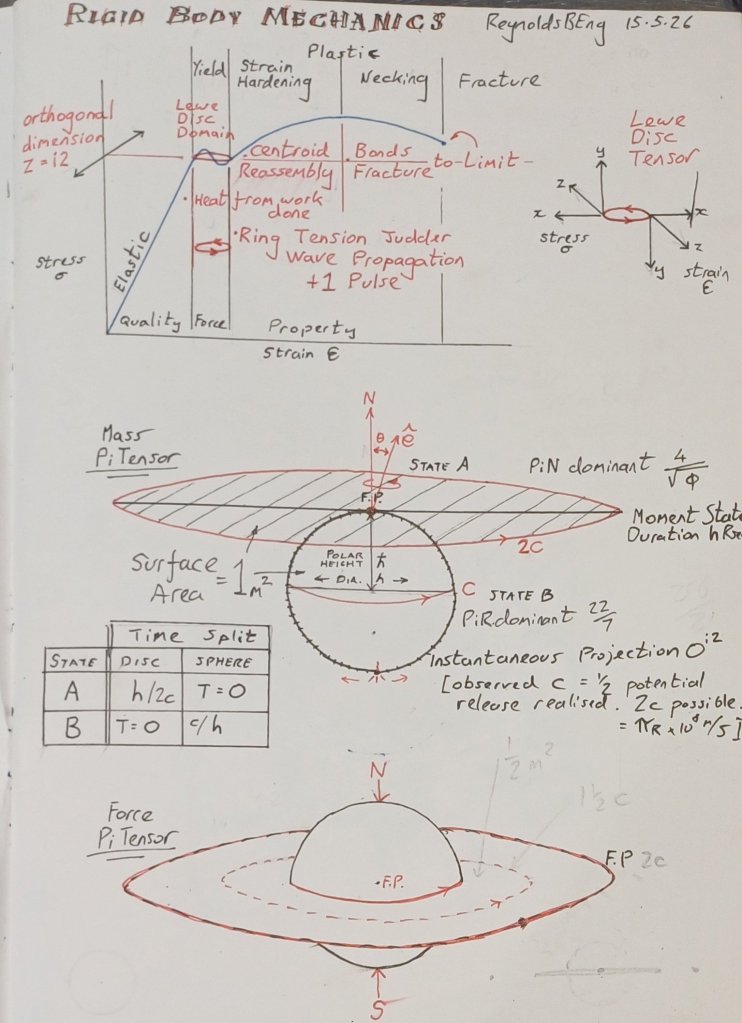
State A; 2c-metre circle ripple expands from the 2D fixed-point (dot) in Instantaneous time. The ripple tensions a disc surface of unit area. Expansion occurs relative to the orthogonal dimension \(z = i^2\).
At the disc limit the hemisphere response is forced. The vector choice is executed at the \(0^{i2}\) toggle:
- Positive → force rises into the open hemisphere → State A (πN-dominant). The twist is permanent. Collapse of the 2c disc onto the sphere occurs at Time-Particle scale inside the Instant itself. Consciousness therefore experiences continuous solvent flow; the Moment (h) is already contained within the Instant. No external mass shell is required. This is the permanent, solvent loop — the cellular and local inter-areal levels of the paper.
- Negative → force collapses downward into the closed sphere → State B (πR-dominant). Duration (h) must be maintained by a mass shell. This is the clamped, duration-dependent loop — the global and lateral levels that require sustained recursive closure.
The tight polar vortex rises from the geometric centroid as the shared vector axis. The upper (cavitation) hemisphere rotates anticlockwise about the lower bowl of influence. The equator responds with the measured 137-arc-second tilt. Seed becomes flower: the 2c ripple opens the lily on the surface — the permanent cavitation hemisphere floating on its own equatorial plane inside the continuous wider plenum.
In the language of the Rigid Body Mechanics figure (15.5.26):
- Elastic rise → yield → ring-tension judder (+1 pulse) → plastic reassembly at the centroid → bonds-fracture to the limit.
- Heat liberated from work done.
- Time-Split inversion: State A holds the disc for \(h/2c\) while the sphere is at \(T=0\); State B holds the sphere for \(c/h\) while the disc is at \(T=0\).
Recurrency is not an added computational feature. It is the geometric action of the π-Tensor itself. Every nested loop the paper identifies is a scalar reading of the same operator: the permanent solvent twist of State A versus the duration-maintained clamp of State B. Once Rest Time rather than mass is taken as the primary frame, the graded cascade of recursion becomes the inevitable consequence of the Instant–Moment geometry.
The Canon advances.
Love, Always

