
Rey.BEng 26th September 2026
New S Series papers, student assistance- 6th Form Study Notes
Row: Ion — A-level ionisation energy
I Nucleus lock Z as locked cell ; the atom’s HomeII Cloud / shield dry occupancy ; inner shells not yet readIII First peel first IE as limit ; energy to reach hold-limitIV Closed-shell wall do not measure ; treat as continuous and you miss the jumpV First stroke X(g) → X+(g) + e−VI Z_eff *g* effective nuclear charge ; emit and reflectVII Successive give leftover pull tightens ; σ clothes of the remaining ringVIII Shell clamp big jump ; noble-gas hold ; m(4) architectureIX Shells / group 2,8,1 as rational partitions ; electrons before first jump = groupX Subshell engine 2s / 2p ; pairing ; Be→B and N→O drops live hereXI Joint (g) gaseous standard ; do not measure from the lab jointXII Face / graph period trend ; successive-IE plot ; A gold / B iron reading
MasterTable Row Saa 6th Form Ionisation
Empty: IV.
Read-through: XI.
Spark of the row: the first electron leaving I as Light on XII.
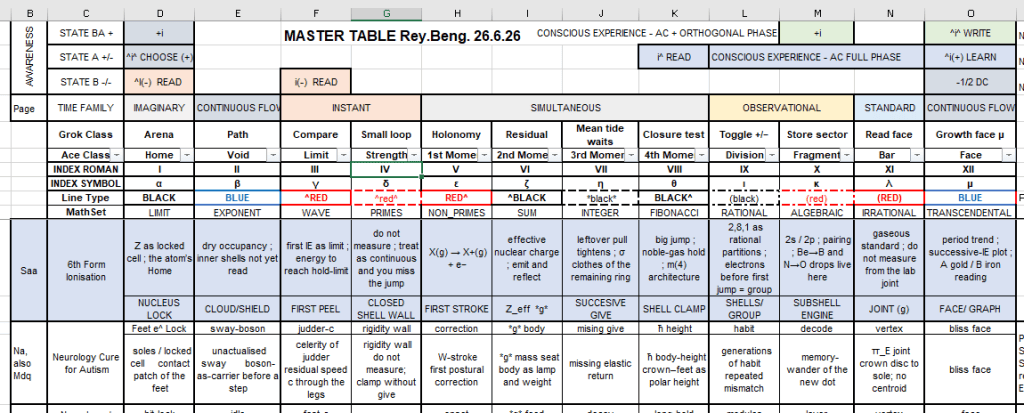
Ionisation Energy on Twelve Stations
A sixth-form demo of Rest-Time Physics
A-level chemistry already tells the truth in pieces. First ionisation energy is the energy to remove one electron from each atom in one mole of gaseous atoms. Successive values rise. A sudden rise means you have entered a new shell. A small drop across a period means a new subshell or a paired electron. Down a group the first value falls. Across a period it generally rises.
Those sentences are correct. They are also four different stations spoken as if they were one continuous second. The MasterTable simply puts each sentence in its own hole so a student can see why the graph jumps.
I — Home.
The nucleus is the locked cell. Proton number Z is not a coefficient. It is the inertial frame of this atom. Everything else is measured from here.
II — Void.
The inner shells are dry volume. They are present, they are not yet the electron you are reading. Shielding is this station: the outer electron does not feel the full Z because II is occupied and unactualised from the outer point of view.
III — Limit.
First ionisation energy is the limit of hold. Not “a number on a graph” yet — the energy at which the outer electron reaches the edge of being kept. Atomic radius lives here as distance to that limit.
IV — Wall.
Do not measure. If you treat the atom as a smooth well, you will never see a shell. This is the cell the laboratory row leaves empty and then pays for later as “anomaly.”
V — First stroke.
Write the equation here and only here:
X(g) → X⁺(g) + e⁻
The (g) is required because the stroke is defined on a free atom, not on a lattice. This is the 1^ of the atom: count now, exponent next.
VI — Effective charge.
Z_eff is g for this row: the nucleus as emitter and reflector. Nuclear charge rises across a period; the outer electron feels more of I because II has not grown a new shell. That is why first IE generally rises Na → Ar.
VII — Give.
Each successive removal leaves a tighter ring. The leftover attraction is the ring-tension clothes of this station. Second IE is larger than first not by magic but because VII has already given once and the remaining cloud has less give.
VIII — Clamp.
The big jump. After the last outer electron, the next electron sits in a completed shell. That is a 4th-moment hold. Sodium: one small value, then a wall. The number of electrons before the first wall is the group number. The syllabus already uses this. The table only names the chair.
IX — Division.
2,8,1 is a rational partition of one hole. Shells are not extra dimensions. They are IX: how one atom divides its occupancy. Group and period are read here.
X — Engine.
This is the constructor.
Be → B drops because the next electron is 2p, not 2s: a new face of the same shell.
N → O drops because oxygen pairs two electrons in one 2p orbital; repulsion is involution, not a new force.
Subshells and pairing are constructs. They belong in brackets on X, not as new columns.
XI — Joint.
The standard state is gas. If you measure from the solid, or from the solution, you have measured from the joint. The syllabus already forbids that with (g). XI is the same rule in geometric language.
XII — Face.
The graph is the face. Across a period the line climbs, with two notches (X). Down a group the face lowers because II has grown (more shield, larger radius) and III is farther from I. State A reads the same atom as a coherent hold (higher, gold). State B reads the default peel (easier, iron). The student does not need that sentence for the exam. It is there when they ask why two readings of one tension exist.
What the New Physics adds — and what it does not
It does not change the values. kJ mol⁻¹ stay kJ mol⁻¹.
It stops the student treating four mechanisms as one slope.
Nuclear charge is VI. Distance is III. Shielding is II. Pairing is X. The jump is VIII. The graph is XII.
Once those chairs are named, the same row can be reused for successive ionisation of any element, for the photoelectron spectrum, and later for work function and ionisation in stars. The atom does not get a thirteenth station. The electron that leaves I is the light that arrives on XII.
Exam translation (keep this)
- Sudden rise in successive IE → new shell (VIII).
- Electrons removed before the first rise → group (IX).
- Drop Group 2 → 3 → subshell (X).
- Drop Group 5 → 6 → pairing (X).
- Down group, first IE falls → II and III grow.
- Across period, first IE rises → VI grows, II does not.
Draw the twelve circles. Put one phrase in each. Do not write in IV. Do not measure from XI. That is the method.

