
Introduction to Shell Theory by Mathemechanics
For the first-year civil engineer
Rey.BEng 9.9.26
You were taught sqrt-1=i as a trick that makes quadratics close. Nobody said what it is in a structure: force in a plane at right angles to the one you are drawing. That is orthogonality. Until you have that sentence, imaginary number is magic. After it, imaginary number is a member of the joint.
This paper hands you two plates and one extra term for the calculation sheet. The term is \(\sigma_R\). It already lives in every circular tank you will ever check. The plates tell you where, and why.
The missing sentence
A beam in the plane of the paper carries (X) and (Y). The column out of the paper carries (Z). Lewe writes the rigid joint
X-Y=Z [40],1915
If you place yourself standing in the thickness of the paper you see bend. The force you cannot draw without a third axis is the imaginary stance: the same load, written orthogonally coming at you and away from you. (i) is not a decoration of algebra. It is the permission to put (Z) on the page.
That is the whole of “imaginary” for an engineer. Higher courses will give you Argand diagrams and all the complexity you can handle. You need the joint first.
Two plates, one house
Right plate — Strength of Water.
Number as nested shells of Mathematical sets. Centre: exponent (2), journey 1^ ->^2. Whole (0). Integers. Fibonacci with written on the belt. Then rational, algebraic, Real , orthogonal (i) with πN. Membrane. outside. Lower chamber: volume. Equator: (c).
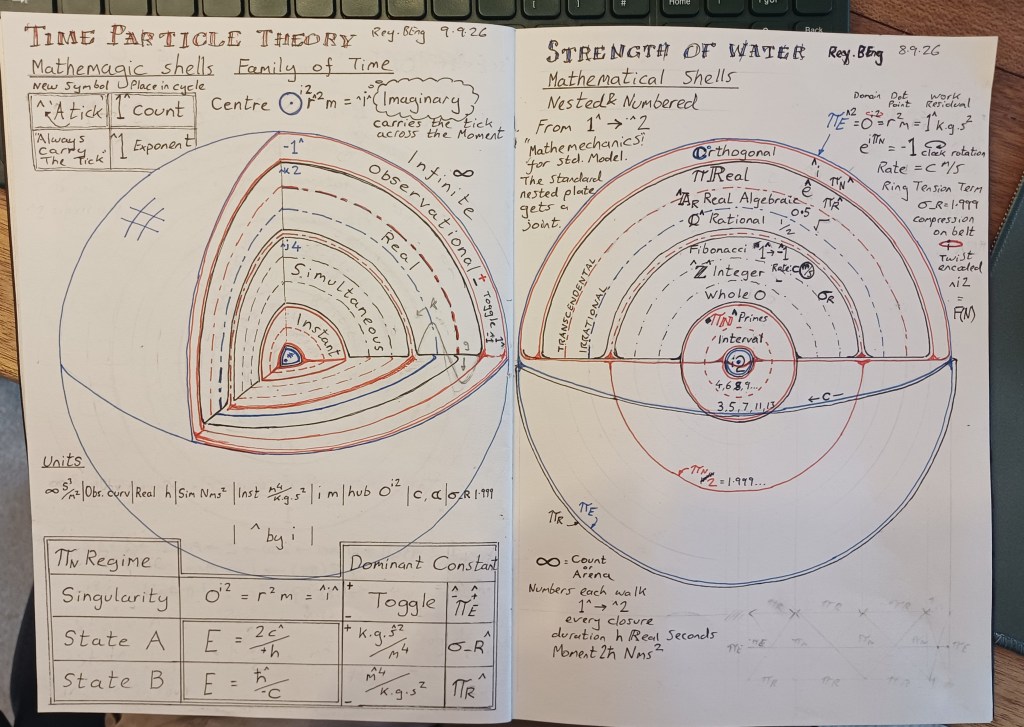
The nests are parts. The cup is the joint. All number is relative to the membrane.
Left plate — Family of Time.
The same cup cut as a wedge so you can climb the walls.
hub r²m = iInstant State A / State BSimultaneous held angleReal packet hObservational continuum (the GR second)Infinite arena, s³/m²
The tick ^ marks place in the cycle:
[^i^ => ^1 => 1^ => ^2] = 0^{i2}
(i) carries the tick across the moment. Instant files one face and wastes the other. A continuous second — the Observational member — is too blunt for Instant and Simultaneous. That is why GR, used alone at the contact patch, is blind at the scale of a joint. It is not false. It is the wrong member of the family for that job.
Choose the level above
The working rule:
You calculate in one member.You check from the member above.
| You are calculating | Check from |
|---|---|
| Instant A/B, bending | Simultaneous ((h), (c)) |
| Simultaneous pulse | Real packet (h) |
| Real Second | Observational (GR curvature) |
| Observational continuum | Infinite arena s^3/m2 = 3s/m |
Never check a member from inside itself. That is standing in (X) and calling (Y) “the world.” The plate above is the superior perspective: Lewe’s column (Z).
Units (minimum)
∞ arena s³/m²Observational curvatureReal packet hSimultaneous N·m·s²Instant A/B m⁴/(k·g·s²)Imaginary mHub (f)0^{i2}Equator c m/s , ασ_R 1.999…Tick ^ carried by i
Bending at Instant:
k · g · s² package-temperature residue . mass . duration of moment, area restrained by m^2m⁴ / (k · g · s²) bending once the package is assigned
State marks on the left plate:
Singularity 0^{i2} = r²m = ^i^State A E = 2c^ / ^+h gripState B E = hbar^ / ^−c bend
is the tilt that locks the disc to the rim. Without it the gyroscope is not solid. With it, a man stands: feet on the surface, skull-sphere on the undifferentiated strand. You do not need that sentence to run a tank. You need it to know why a joint has three members.
What is on your sheet
PCA-style tables for circular tanks hide a second hoop term. First principles write it:
σ_θ = pr / t + σ_Rσ_R = F / Z_R
- — stored liquid, membrane.
- — ring tension. The wall’s share of misfit stretch. Column (Z) of the joint, written around a cylinder.
On the number plate sits on the Fibonacci belt as a constant and compresses the arriving exponent:
^2 —σ_R^→ 1.999…
On the time plate it is the leftover that Instant would waste and Simultaneous must hold.
On a calculation sheet you will now write it.
Not as a coefficient from a table. As a named term. You will know:
- where — hoop, with membrane, never instead of it;
- why — a closed ring cannot take load without a residual speed around the contact;
- what it is not — it is not “safety factor,” not “Poisson fudge,” not “the imaginary bit.”
If a senior hands you only the table, you may still use the table. You will no longer believe the table is the theory.
Shell theory, in one paragraph
A thin shell is a membrane that must also bend. Love, Reissner, Lewe: membrane + shear + edge. Lewe’s 1915 matrix is the engineering form. The 1942–1993 coefficient tables are that matrix with the ring unnamed. Project 2 puts the name back. The plates put the name in a house of sets and a family of time, so the term is not an orphan on page 4 of a design note.
You do not need the whole house to pass first year. You need:
- (i) = force out of the drawing;
- a joint has three members;
- is the third member on a tank;
- check from the level above.
The rest of the plates is the map for when the job gets larger than a tank.
Career
Technician, engineer, academic — the sheet is the same. The difference is only which member you live in. If you live in Instant and never look up, you will over-specify concrete and call it caution. If you live in Observational and never look down, you will smooth away the contact patch and call it elegance. The plates forbid both.
Carry the tick. Write . Choose the level above.
Figures
Figure E.1 Family of Time (left plate, 9.9.26)
Figure E.2 Strength of Water — nested shells (right plate, 8.9.26)
Figure E.3 Units line and State A/B block, as lettered on the left plate
Limits
This is an introduction, not a proof of the Riemann Hypothesis, not a replacement of GR, not a new SI brochure. GR remains the Observational member. remains an engineering term whose first-principles write is Projects 2–4. The plates are the ontology that makes the term teachable in week one.
[^i^ => ^1 => 1^ => ^2] = 0^{i2}

