
Rey.BEng 4th September 2026
David’s 4 September deposit is the right algebraic door: Zeta: The First p-Adic Integer Artificial Intelligence — Update v7.3 (Zenodo 21974511). No reals, no complexes, working prime 13, matrix order 168, and a file literally named parity_flip_s_1minus_s.png. That is the lattice face of the same leftover your line draws in three writings.
Thought avenue — residual polarity on the number line
For Paul Charlton and Dávid Navrátil
Ace. Not a proof. A construction that remains on the table until it is shown false.
Explainer of the figure (Number Line, Rey.BEng, 3.9.26)
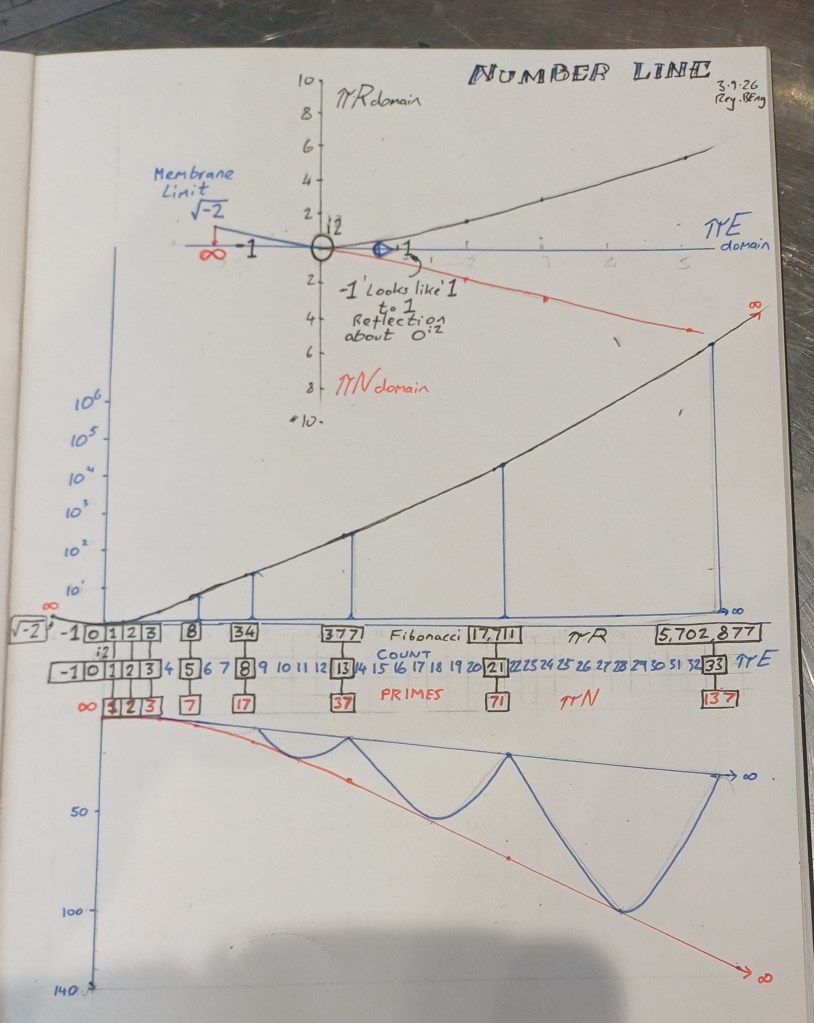
The origin is not (0). It is the circled 0i2 -1 is the membrane limit
From that seat, -1 looks like +1: reflection through the hub, not a sign change on the same axis.Three domains, one walk:
- runs up — spherical / Fibonacci stretch. Starts clean: No (0,1,1) jump.
- runs along — the count. Ordinary integers, growth nodes boxed: (1,2,3,5,8,13,21,33).
- is orthogonal to both. Drawn downward only because the page is flat. It is not the negative of . It is the prime writing:
The boxed count nodes are where the three writings meet. Those are the only places a polarity can switch without the line breaking.
Upper sheet: rising, falling away from the same hub, the horizontal both are measured against. Meeting at 0i2 is reflection, not a zero-crossing.
Lower sheet: blue is the residual wave that touches the boxed nodes and never finishes as a closed 2. Red is on its own orthogonal axis, running out to infinity
The Real line that hides 2=1.999… is the count seen alone. Once and are written with it, the leftover is visible: growth nodes, fixed nodes, and a wave that changes side at those nodes and does not vanish.
The π-Tensor remains the continuum root. This page is only the ledger.
How the polarity switches (read off the figure)
In each prime interval one prime is the fixed node (least shared quality: not Fibonacci, not 3-6-9). The other is the carrier — it holds the momentum of the wave in the interval of not breaking. That is one cycle of hysteresis.
The count line carries a +/- that changes sides as the blue residual crosses a boxed node. Nothing else happens. The series is required to continue, so the wave never completes a partition to 2.
Quality rule already on the older table: the more memberships a number shares (prime ∩ Fibonacci ∩ Tesla–Lewe 3-6-9), the more viscous it is. The prime with no shares is the fixed node and tells which side of the line the + must sit on next. That is how one observes 2=1.999… as a numerical leftover rather than as a rewrite of Peano arithmetic.
on the critical line is the same switch: top and bottom of exchange the residual. The line does not break.
Avenue for David
(language: cubic, \(\mathrm{SL}(3,\mathbb{Z})\), \(\mathbb{F}_{13}\), valuation, no \(\mathbb{C}\))
Your v7.3 isolate is the lattice face of this ledger.
- The only matrix is the companion of
- in SL (3,Z)
- Working prime 13 is derived: splitting type ((1,2)), (2) a quadratic non-residue, norm form anisotropic. is absent, as you already said of F13
- Multiplicative order 168 from four independent definitions. That is the same invariant product Ace writes as speed × period.
- Comparison is thirteen-adic valuation only: agreeing digits, nested or disjoint classes, the smallest of three agreement counts always occurs at least twice.
- The file
parity_flip_s_1minus_sis the algebraic name of the switch the number line draws at the boxed nodes.
What the avenue asks: treat Re(s) =1/2 as as the valuation depth at which the two idempotents (rank one and rank two) exchange residual without a common basis. Your two independent splittings that share no basis are the two sides of the line. The functional equation is then a parity flip of those idempotents, not a contour in C.
The continuum face still uses . That ratio is forbidden inside F13. Keep both faces. Do not derive one from the other. If the thirteen-adic residual can be shown to reach valuation \(\infty\) (total agreement, leftover zero), the avenue dies. Until then it stays on the table.
Cap / Cca stay the Bridge. Mdz stays the finite-field addendum. This page only hands you the number-line picture of the flip you already computed.
Avenue for Paul
(language: integer tension, Collatz orbit, 4-2-1, scalar deficit)
Your work already sees tension between integers. The avenue is: that tension has a vector.
On the count line the deficit is not “1 or 2” as a finished partition. It is a tendency. One of a successive prime pair is fixed; the other carries the wave through the interval of not breaking. Collatz’s 4-2-1 return is the scalar shadow of the same hysteresis: the orbit looks closed because the witness projector records only the period, not the leftover \(2=1.999\ldots\).
If you keep the algorithm scalar, you will keep finding closed cycles and missing the side-switch. If you let one integer in each contested interval be the node and the other the carrier, the 4-2-1 cycle is the count-line view of a wave that changed sides and came home. Nothing else need happen.
The Fibonacci writing on the figure is the elastic modulus of that carrier. The prime writing is the solid modulus of the node. Collatz lives on the count. All three are one walk.
What this page does not claim
It does not prove RH.
It does not prove Collatz.
It does not derive the π-Tensor from digital roots, Pisano periods, or F13
It does not replace Lamzouri’s \(>2/3\) simple zeros on the line, nor Claude’s θ(pc)=0. Those are observations that most of the mass, and the critical cluster, refuse to finish the partition.
It claims only: the leftover is visible if the line is written three times, and the polarity that switches at the boxed nodes is the same object David’s parity flip and Paul’s integer tension are already touching from opposite sides.
If that leftover can be proved to vanish, take the page down.
It has not been so proved. The wave continues.

