Subtitle: Viktor Lewe’s 1915 Thin-Shell Analysis and the Provenance of Coefficient Tables in the Design of Circular Concrete Tanks
Author
Reynolds BEng
Abstract
This paper restores the missing reference chain between Viktor Lewe’s 1915 thin-shell analysis and the empirical coefficient tables still used for the design of circular reinforced concrete tanks. The link back to Dr Lewe’s first doctoral dissertation in Natural Science, and then to the paper published for his second doctorate in Engineering is also restored. Through examination of primary sources, secondary literature and successive editions of the Portland Cement Association guidance, it demonstrates that Lewe’s graphical method forms the original theoretical foundation of the tables. The transition from geometry-based charts to scalar coefficients is documented, and the implications for first-principles understanding of geometric effects in current design practice are discussed.
Project completed with confirmation received from the Institution of Civil Engineers
1. Introduction
Karl-Eugen Kurrer, in The History of the Theory of Structures (2018)(1), records that Viktor Lewe made significant progress in three related areas: the theory of reinforced concrete slabs, the theory of reinforced concrete tanks, and the application of matrix calculus to continuous beams and framed structures. Despite this recognition, Lewe’s name remains entirely absent from modern design guidance for circular concrete tanks, except via secondary referencing.
The coefficient tables published by the Portland Cement Association as Appendices to Circular Concrete Tanks without Prestressing (2) (1st Ed. 1942, 2nd Ed. 1965, 3rd Ed. 1993, by Domel and Gogate) continue to be used in practice. These tables lack direct attribution to their theoretical origin. The purpose of this paper is to restore that reference chain through systematic examination of primary and secondary sources, and to document the methodological shift from the original graphical approach to the scalar coefficient format that is still employed today.
The paper is organised as follows. First, the broader theoretical context is established through the work of A.E.H. Love and the contributions of earlier researchers in shell and membrane theory (summarised in Appendix 2). The core of the paper presents Viktor Lewe’s career and key publications of 1906 and 1915, followed by the 1923 development of his method. The transition to the 1942 PCA publication and the subsequent editions is then examined, with particular attention to the surviving secondary references that still connect the coefficient tables to Lewe’s work.
2. Theoretical Context: From Love to Practical Design
A.E.H. Love’s A Treatise on the Mathematical Theory of Elasticity (1892)(6) provides the classical foundation for the analysis of thin shells and elastic membranes. Love’s formulation of the equilibrium equations and the treatment of membrane and bending actions established the mathematical framework within which later practical methods were developed.
As Love himself states regarding the progress of theory:
“nothing that has once been discovered ever loses its value or has to be discarded; but the physical principles come to be reduced to fewer and more general ones, so that the theory is brought more into accord with that of other branches of physics, the same general dynamical principles being ultimately requisite and sufficient to serve as a basis for them all.”
A summary table of principal contributors to the development of shell and tank theory over the centuries prior to 1915 is provided in Appendix 2. This table records the main advances in the long history of membrane theory, bending theory and practical calculation methods that formed the background to Lewe’s work.
3. Viktor Lewe: Career and Principal Contributions
Bernard Wilhelm Viktor Lewe (22 November 1881 – 26 October 1936)(13) was born in Löningen, Lower Saxony. After completing his matriculation examination in Vechta in 1902 he studied at the universities of Münster, Berlin, Munich, Leipzig and the Technical University of Munich(1). In 1906 he was awarded a doctorate in natural sciences under Alexander von Brill for a dissertation entitled Die plötzlichen Fixierungen eines starren Körpers: Ein Beitrag zur vektoranalytischen Behandlung der Dynamik der Momentankräfte(5) (full translation in Appendix 4).
Lewe subsequently moved into engineering practice(3) and for a period was an assistant to Hans Reissner(3). In 1915 he held the position of Chief of Inspectors of Civic Buildings(3) in Bromberg (now Bydgoszcz) and in the same year he completed the two works that form the core of this study:
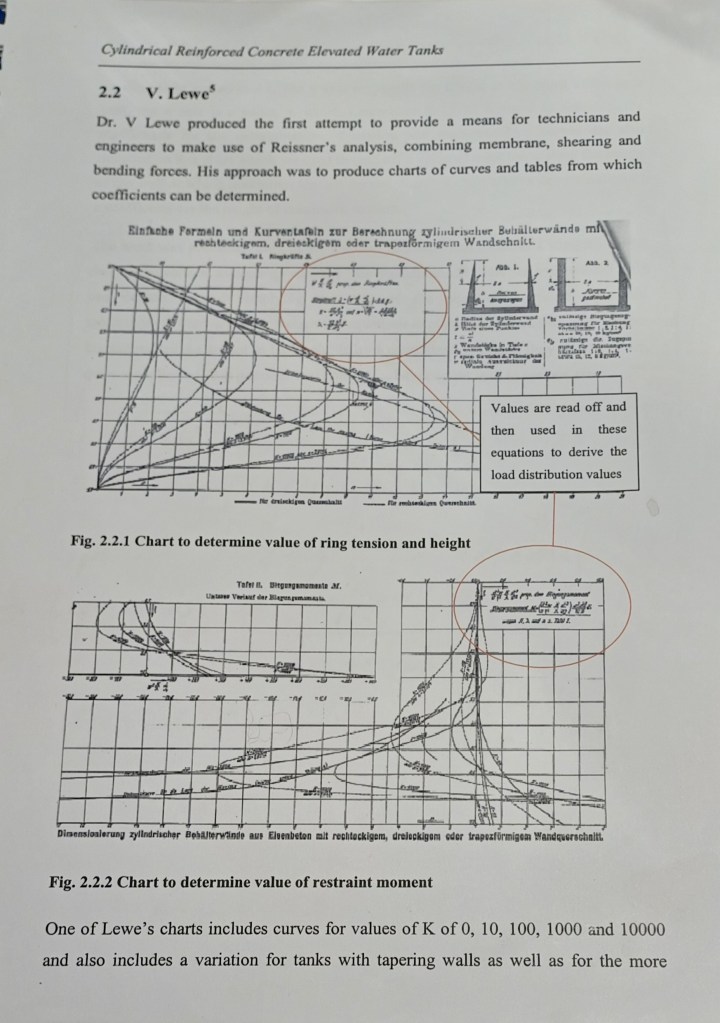
- His contribution to the second edition of the Handbuch für Eisenbetonbau (1915)(3), which provided simple formulae and charts for the calculation of cylindrical tank walls of varying cross-section.
- His engineering dissertation, Die Berechnung durchlaufender Träger und mehrstieliger Rahmen nach dem Verfahren des Zahlenrechtecks (1915)(4), which applied matrix calculus to continuous beams and multi-span frames (full translation in Appendix 3).
The 1915 Handbuch article is of particular importance. It presents a graphical method for determining coefficients that are then used in simplified design equations. A representative page from this work, showing the graphical nature of the coefficient selection, is reproduced from the author’s 2008 thesis records and copied from 1923 edition (Appendix 4).
In classical shell theory a thick-walled tank is one in which the wall thickness is not small compared with the radius (commonly taken as t/R greater than approximately 1/10 to 1/20). Under these conditions the assumptions of thin-shell (membrane) theory become inadequate and bending moments, transverse shear forces and through-thickness stress variation must be considered. Lewe explicitly noted that earlier equations (including those of Reissner) were suitable only for thick walls and that a different approach was required for thin-walled tanks(3). His 1915 method was developed specifically to address the thin-walled case while still providing practical design coefficients derived from geometry.
In 1923 the method was further developed in the third edition of the Handbuch. Comparison of corresponding pages from the 1915 and 1923 editions (Appendix 5) shows both continuity and refinement of the graphical approach.
Lewe habilitated at the Technische Hochschule Berlin in 1920 (with the support of Hans Reissner)(1) and served as lecturer and later Associate Professor of Strength of Materials(1) until his death in 1936. Few later publications by Lewe remain readily accessible; it appears that a substantial portion of his output was lost during the Second World War. Publications which are accessible include work on mushroom slab ceilings (Kurrer recognised ‘significant contribution’ of matrix calculus to continuous beams and framed structures(1)), aeroplane component design, and his last was a short contribution on timber construction; from research it seems much has been lost during the war years. The 1915–1923 tank analysis remains his most directly relevant contribution to the present study.
4. From Graphical Method to Scalar Coefficients: The PCA Publications
The first edition of the Portland Cement Association publication Circular Concrete Tanks without Prestressing(2) appeared in 1942 (sometimes dated in collections as 1943, but 1965 2nd Ed. states 1942). In this and subsequent editions the original graphical method has been converted into tables of scalar coefficients. While the use of tabulated coefficients represents a practical simplification for design use, the publication declines to state the theoretical origin of the tables.
The 1993 third edition continues to employ the same form of coefficient tables and states that the theory utilised has stood for half a century.
Direct comparison of the reference lists of the 1942 and 1993 editions shows both continuity and omission.
The critical connecting reference is H. Carpenter’s 1927 article in Concrete and Constructional Engineering(10), which explicitly acknowledges “an article by Dr. Lewes (sic), published in ‘Beton und Eisen’ (March 1915)” and describes it as an excellent theoretical treatment. Carpenter’s work is itself cited in later British and American sources that continue to appear in the PCA reference lists (including via W.S. Gray(9)).
A second link appears in the Transactions of the American Society of Civil Engineers. In Volume 59, 1940, George Salter published his method for shallow tanks (referenced by PCA in 1942). The 1993 edition points to Volume 105(12), also 1940, which reproduces response letters prompted by the original paper demonstrating that:
“The general analysis of the problem stated in [Salter’s] paper has been developed thoroughly by various European engineers and is presented in standard reference works such as those of Pöschl, Flügge, Love and Löser and Lewe.”
In his response Salter acknowledges that “since the publication of the paper (in Vol 59) it has been brought to the writer’s attention that apparently a considerable part of the work had been done previously and that various graphs had been presented, chiefly in German publications, some of which are practically the same as some of those given in the paper.”
Thus a clear provenance chain still exists from the 1993 tables back to Lewe’s 1915 analysis.
The methodological shift is therefore clear: the original graphical, geometry-based approach of 1915/1923 was replaced by convenient scalar coefficients. The conversion of Lewe’s original graphical charts into tables of coefficients enabled rapid application, but removed the designer’s direct contact with the underlying geometry of the shell. Once the coefficients are treated as primary data, the first-principles relationship between wall thickness variation, bending moments and membrane forces becomes less visible, and independent verification that the coefficient tables remain correctly presented becomes difficult.
5. Discussion and Implications
The restoration of the reference chain has two principal implications for current practice.
First, it corrects the scholarly record. Credit for the original theoretical development of the coefficient method for circular concrete tanks belongs primarily to Viktor Lewe’s 1915 work.
Second, it highlights a broader point about design methodology. Graphical and geometric approaches, once central to the derivation of practical design aids, were set aside in favour of scalar coefficients in the mid-twentieth century. Recent interest in geometric and graph-theoretic methods within structural mechanics(7), for example, and modern computational extensions of graphic statics and form-finding(8), suggests that a return to greater visibility of the underlying geometry may offer advantages in understanding load paths, optimising material use, and improving the transparency of safety factors.
6. Conclusions
This paper has restored the reference chain between Viktor Lewe’s 1915 thin-shell analysis and the coefficient tables that remain in use in the design of circular reinforced concrete tanks. Through examination of primary sources and successive editions of the PCA guidance, it has been shown that Lewe’s work constitutes the original theoretical foundation of the method, even though direct attribution has been lost.
The paper is offered as a contribution to the historical and practical understanding of a widely used design procedure, and as a foundation for further work on first-principles geometric approaches to the analysis of cylindrical concrete shells.
7 Update
ICE confirmation of omitted reference from PCA1993 (via Carpenter 1927) to Lewe 1915 received 17:58 11th August 2026
Email from Institution of Civil Engineers, Knowledge Services Director
The ICE searched online for Lewe 1915 Die statische Berechnung der Flüssigkeitsbehälter (The static calculation of liquid containers) and despite our best efforts we could not find a complete public scan of the 1915 Volume 5. While the 1915 chapter itself is not publicly available, ICE found an online scan of Lewe’s 1923 revision of the same subject – “Die statische Berechnung der Flüssigkeitsbehälter” (The static calculation of liquid containers). This begins with: Von Dr.-Ing. Dr. Lewe, Zivilingenieur und Privatdozent der Technischen Hochschule in Berlin and is clearly part of the 1923 third edition of Volume 5. ICE has attached this to our catalogue and will make the link open access.
Furthermore, ICE found there is no explicit citation to Viktor Lewe anywhere in the PCA publication Circular Concrete Tanks Without Prestressing. Instead, the publication presents coefficient tables and equations without attributing them to Lewe. ICE have searched modern engineering literature databases, and it appears that Lewe is now rarely cited directly. This is common for many engineers of his era whose methods were absorbed into textbooks and later developments.
The original (1942) PCA edition references work by H. Carpenter (1927). Carpenter’s paper, in turn, cites Lewe’s 1915 work as an important source in the development of cylindrical tank analysis. According to historical investigations, later PCA editions removed the direct Carpenter reference and instead referenced later authors such as W. S. Gray, making the connection to Lewe more indirect.
The ICE has looked at the cited references in the 1943 PCA Circular Concrete Tanks Without Prestressing presents coefficient tables, references, H. Carpenter’s paper A Contribution to the Calculation of Circular Tanks in Reinforced Concrete (1927. The attached page 2 highlighted does mention Lewes paper was published in the Beton und Eisen 1915 journal. ICE does not hold a copy of the journal from 1915. For historical publications (this technical manual) it is not uncommon if the methods were independently derived or came from other sources. There would also be no need to cite Lewe. If his original derivations or coefficient tables were directly used, modern standards would generally expect attribution. However, early engineering publications often omitted references, so the absence of a citation alone does not show that Lewe was treated improperly.
I do hope that this helps and concludes the matter. The ICE library is a great source of knowledge, and the team are always available to help online or in person at our members hub, One Great George Street.
References
- Kurrer, K.-E. (2018) The History of the Theory of Structures: Searching for Equilibrium. Berlin: Ernst & Sohn.
- Domel and Gogate. (1993) Circular Concrete Tanks without Prestressing. Portland Cement Association, Illinois (First published 1942/3, 2nd ed. 1965).
- Lewe, V. (1915) ‘Einfache Formeln und Kurventafeln zur Berechnung zylindrischer Behälterwände mit verschiedenem Wandquerschnitt’, in Emberger, F. & Lewe, V. (et al.) Handbuch für Eisenbetonbau, 2nd revised edition, Heft IV u. V. Berlin: Ernst & Sohn.
- Lewe, V. (1915) Die Berechnung durchlaufender Träger und mehrstieliger Rahmen nach dem Verfahren des Zahlenrechtecks. Borna-Leipzig: R. Noske.
- Lewe, V. (1906) Die plötzlichen Fixierungen eines starren Körpers: Ein Beitrag zur vektoranalytischen Behandlung der Dynamik der Momentankräfte. Buchdruckerei R. Noske.
- Love, A.E.H. (1892) A Treatise on the Mathematical Theory of Elasticity. Cambridge: Cambridge University Press (later editions also cited).
- Martinsson Achi, L. & Tibert, G. (2012) ‘A graph theoretical methodology for conceptual design’, IASS-APCS 2012 Proceedings.
- Mihajlovska, T., Trombeva-Gavriloska, A., Cvetkovska, M. & Dimevska-Sofronievska, L. (2025) ‘Graphic statics in the digital age: a critical review of current methods and trends’, Building Materials and Structures, 68(3), pp. 163–173.
- Reinforced Concrete Reservoirs and Tanks, by W. S. Gray, Concrete Publications, Ltd., London, Second Edition, 1942, 166 pages, Chapter 1.
- The Calculation of Cylindrical Tanks with Rectangular, Triangular or Trapezoidal Wall Sections, H. Carpenter, Concrete and Constructional Engineering, Vol. 24, 1927, page 238
- The Calculation of Cylindrical Tanks with Rectangular, Triangular or Trapezoidal Wall Sections, H. Carpenter, Concrete and Constructional Engineering, Vol. 24, 1929, page 347
- Design of Circular Concrete Tanks, Salter, George S., Transactions of the American Society of Civil Engineers, Vol. 105, 1940, p. 504 – 532
- Viktor Lewe Birth Certificate, with date of death appended
Appendices
- Appendix 1 – PCA Reference Chain
- Appendix 2 Full chronological list of contributors to the theory of elasticity, plates, membranes and shells (drawn primarily from Love’s historical survey and subsequent compilations).
- Appendix 3 – Comparison of corresponding pages from the 1915 and 1923 Handbuch editions.
- Appendix 4 – Full translation of Lewe’s 1906 dissertation
- Appendix 5 – Full translation of the 1915 engineering dissertation
Appendix 1 Reference Chain Restored
| Tracing the Theory; 1915-1993 | |
| 1. PCA 1993 reference to W.S Gray | |
| 1993 | Reinforced Concrete Reservoirs and Tanks, by W. S. Gray, Concrete Publications, Ltd., London, Second Edition, 1942, 166 pages. |
| From Gray, Page 10 ‘For many years some British Engineers have adopted a purely arbitrary division of the pressure diagram as shown in Fig.7. Others have used Dr Reissner’s method which has a logical basis and gives satisfactory results in practice. This method was explained by Mr. H. Carpenter in “Concrete and Constructional Engineering” April 1927, and *June 1929, and is, in the writer’s opinion, the most useful yet brought forward. An extract from Mr. Carpenter’s articles will show how the method is derived and applied. For further information, the original articles should be consulted’ | |
| 2. 1942 2nd revised ed. link from W.S Gray reference to Carpenter | |
| 1942 only | 7. “The Calculation of Cylindrical Tanks with Rectangular, Triangular or Trapezoidal Wall Sections,” by H. Carpenter, Concrete and Constructional Engineering, Vol. 24, 1929, pages 345-353 |
| Page 238. ‘an article by Dr. Lewes (sic), published in “Beton u. Eisen” (March 1915)… an excellent treatment of the subject from a theoretical point of view’. | |
| *Note that the June 1929 (11) update by Carpenter referred to by Gray references only Reissner, and yet from 1927 edition it is clear Carpenter knows that the thin wall tank method is specifically Lewe’s shell analysis graphical technique, extended from Reissner’s thick walled tanks, but declines to include this reference. | |
| 3. Confirmation | |
| 1993 | **8. Design of Circular Concrete Tanks, Slater(sic), George S., Transactions of the American Society of Civil Engineers, Vol. 105, 1940, p. 504. (noting actually continues to p.532) |
| 1942 | 16. “Design of Circular Concrete Tanks” by George S. Salter, A.I.E.E. Transactions, Vol. 59, 1940, pages 901-912. |
| Vol 105: Frank McCormick Esq on p.517 and p.518 includes footnote reference to Lewe’s work in the 1923 reissue of Handbuch fur Eisenbetonbau. Dana Young Assoc. M. Am. Soc. C.E. on p.521 states ‘The general analysis of the problem stated in this paper has been developed thoroughly by various European engineers and is presented in standard reference works such (as) those of Poschl, Flugge, Love and Loser and Lewe’. Young references all the appropriate works of these authors and his footnote reference to Loser and Lewe is to the 1934 issue of the Handbuch fur Eiesenbetonbau which would be revision four. Young states that Salter’s work is only useful for specifically shallow tanks and shows clearly why Poisson’s ratio is key to analysis. On p.531, Salter clearly acknowledges that ‘since the publication of the paper it has been brought to the writer’s attention that apparently a considerable part of the work had been done previously and that various graphs had been presented, chiefly in German publications, some of which are practically the same as some of those given in the paper’. | |
| **Note: 1942 references Salter’s original work, which is independently derived confirmation that the theory is sound. In 1993 the reference given for suggested further reading is specifically to the later discussion agreement that Slater’s ideas were already standard practice. | |
| Appendix 2 | |||
| Full Chronological List of Contributors to the Theory of Elasticity, Plates, Membranes and Shells | |||
| (Drawn primarily from Love’s historical survey on Shell Theory) | |||
| Year / Period | Contributor | Note on Standing | Summary of Contribution |
| 13th century | Jordanus de Nemore | Early medieval scholar | Posed the problem of the elastica; proposed an incorrect circular-curvature solution. |
| 1493 | Leonardo da Vinci | Polymath and engineer | Madrid Codex, rediscovered 1967. Identified stress and strain distribution across a bent beam section (predating Galileo). |
| Early 17th century | Galileo Galilei | Foundational scientist | First systematic investigation of the resistance of solids to rupture (cantilever beam problem). |
| 1660 / 1678 | Robert Hooke | Experimental physicist | Discovered Hooke’s Law (proportionality of stress and strain). |
| 1660s–1680s | Edme Mariotte | Physicist | Independently stated Hooke’s Law and applied it to beam flexure (triangular stress distribution). |
| 1713 | Antoine Parent | Mathematician | Derived the correct elastic section modulus for beams (linear stress, central neutral axis). |
| 1705 | James (Jacob) Bernoulli | Leading mathematician | Investigated the elastica; introduced the concept of flexural resistance proportional to curvature. |
| Early–mid 18th century | Leonhard Euler | Pre-eminent mathematician | Developed the differential equation of the elastica and early column stability theory. |
| Early 18th century | Daniel Bernoulli | Mathematician and physicist | Suggested the variational approach to the elastica (minimising the integral of squared curvature). |
| Late 18th century | Joseph-Louis Lagrange | Leading analyst | Applied Euler’s theory to the strongest form of column and elastic stability. |
| Year / Period | Contributor | Note on Standing | Summary of Contribution |
| Late 18th century | Charles-Augustin de Coulomb | Engineer and physicist | Corrected the position of the neutral axis and introduced consideration of shear and torsion. |
| Early 19th century | Thomas Young | Physician and physicist | Defined Young’s modulus and first treated shear as an elastic strain. |
| Early 19th century | Roger Joseph Boscovich | Natural philosopher | Point-atom hypothesis influencing later molecular theories of elasticity. |
| 1821 | Claude-Louis Navier | Engineer and mathematician | Formulated the first general equations of elasticity in usable mathematical form. |
| 1822–1828 | Augustin-Louis Cauchy | Foundational mathematician | Established the modern concepts of stress and strain tensors and the general equations for isotropic materials. |
| 1828 | Siméon-Denis Poisson | Mathematician and physicist | Derived equilibrium equations from molecular considerations and contributed to early shell-of-revolution theory. |
| 1821 | Augustin-Jean Fresnel | Physicist | Work on transverse waves linked the theory of elasticity to the propagation of light. |
| Mid-19th century | George Green | Mathematician | Introduced the strain-energy function based on conservation of energy (21 constants generally, 2 for isotropy). |
| Mid-19th century | George Gabriel Stokes | Physicist and mathematician | Clarified the moduli of compression and rigidity; criticised certain molecular assumptions. |
| Mid–late 19th century | William Thomson (Lord Kelvin) | Leading physicist | Placed the strain-energy function on a thermodynamic foundation. |
| 1850 | Gustav Kirchhoff | Highly esteemed physicist | Established the classical thin-plate theory (Kirchhoff hypotheses) that became the foundation for shell theory. |
| 1862 | Alfred Clebsch | Mathematician | Distinguished exact solutions for finite bodies from approximate theories for thin bodies. |
| Year / Period | Contributor | Note on Standing | Summary of Contribution |
| 1874 | Hermann Aron | Early shell theorist | First systematic attack on the general theory of curved plates and shells using Kirchhoff’s assumptions. |
| Late 19th century | Émile Léonard Mathieu | Mathematician | Adapted earlier methods to the vibration of curved plates and shells. |
| Late 19th century | John William Strutt (Lord Rayleigh) | Leading physicist | Developed the assumption of an unstretched middle surface for vibrating shells. |
| 1888 / 1892–1906 | A.E.H. Love | Leading authority on elasticity | Produced the first successful general theory of thin elastic shells (Kirchhoff–Love theory) and the standard treatise on the subject. |
| 1885/1902/1903 | Osborne Reynolds | Pre-eminent Engineer | Mechanical definition and description of Dilatancy and Reynolds Surfaces |
| Early 20th century | Hans Reissner | Distinguished structural engineer | Reduced Love’s equations for practical application to cylindrical tanks (1908). |
| 1912–15 | Max Meyer / others | Practical reinforced-concrete specialists | Early adaptations of existing formulae for reinforced-concrete tank walls of varying thickness. |
| 1915 | Viktor Lewe | Engineer and applied mathematician | Developed practical graphical methods and simplified formulae for thin-walled cylindrical concrete tanks of varying cross-section, and more |
Appendix 3
Reproduction of the key graphical page from the 1915 Handbuch contribution