
Rey.BEng 5th September 2026
This appendix accompanies Appendix C (Rest Time) and Appendix D (Earth Laboratory). It records one geometric fact as a theorem of involutions and places that theorem on the line Riemann isolated in 1859. It is groundwork. It is not a proof that every non-trivial zero of lies on Re(s)=1/2.
E.1 Riemann’s architecture (1859)
In Ueber die Anzahl der Primzahlen unter einer gegebenen Grösse, Riemann continues Euler’s product to a function \(\zeta(s)\) of a complex variable and constructs
ξ(s)=12s(s−1)π−s/2Γ(s/2) ζ(s)
so that ξ(s)= ξ(1−s).
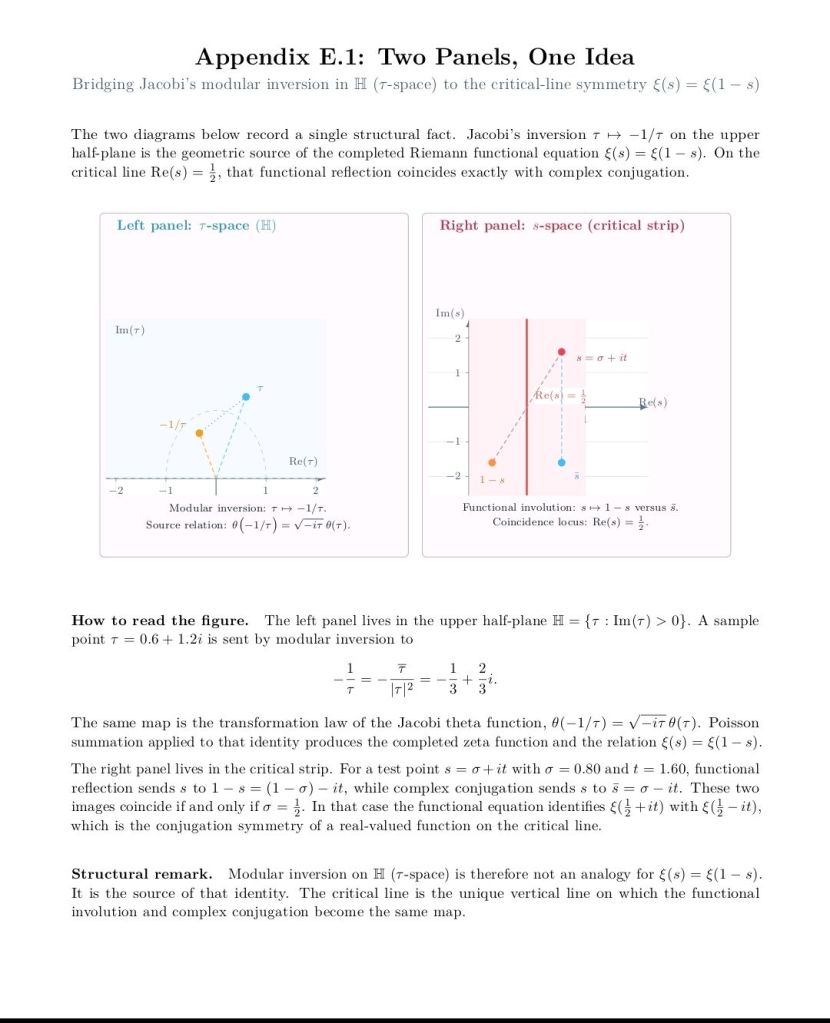
The identity is obtained from Jacobi’s modular transformation of the theta series, θ
(1τ)= sqrt.−iτ θ(τ),
by Poisson summation. The non-trivial zeros are then referred to the vertical line Re(s)= 1/2
That is the stated architecture: an involution coming from a modular move, and a distinguished line on which the non-trivial spectrum is to be read.
Figure E.1. Jacobi move and the induced involution
[note error missing -ve sign, should read -1/3+2/3i]
E.2 Lemma (parity coincidence)
Let
Then
Proof. Equate real parts of
and
. Then
hence
Imaginary parts agree for all (t). Off the line the two images are distinct.
The line Riemann isolated is therefore the unique locus at which functional reflection and conjugation are the same map.
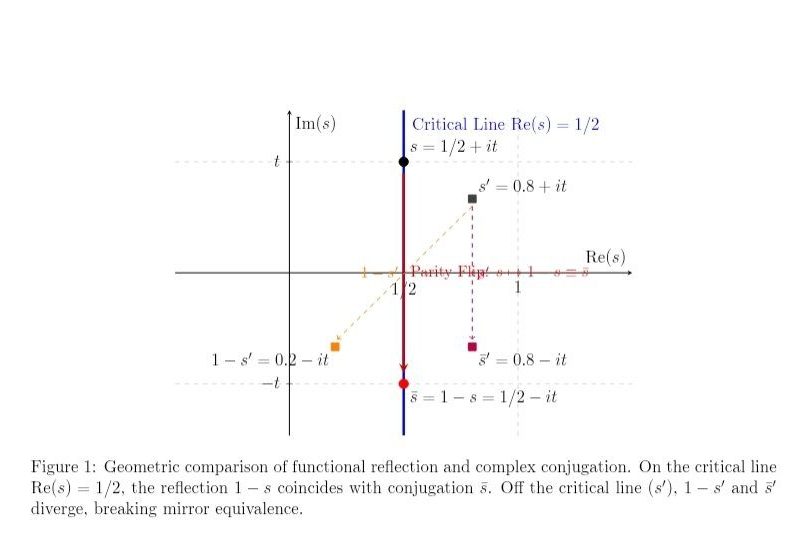
Figure E.2. Navrátil plane:
with
on the line; off-line split of (s’),
and
1-s'.

Figure E.5. Optional overlay: boxed nodes of E.4 aligned with the critical line of E.2, column (Z) marked as the residual. Place only if the two figures are printed on facing pages.
E.3 Theorem (joint operator)
At a rigid joint of three members with moments (X), (Y) and (Z), X-Y=Z
(Lewe 1915). If the joint is rigid, the three members rotate through one common angle (Abb. 10a). The exploded diagram (Abb. 10b) exhibits the same three moments as separate writings. (Z) is the difference taken so that (X) and (Y) share an angle.
A measure is that difference. Two writings exist; the third member is the act of measuring.
The same ratio-statement is the omer and the ephah: a portion is defined only against the vessel from which it is taken (Exod. 16:36). Both sides of the ratio, or no measure.
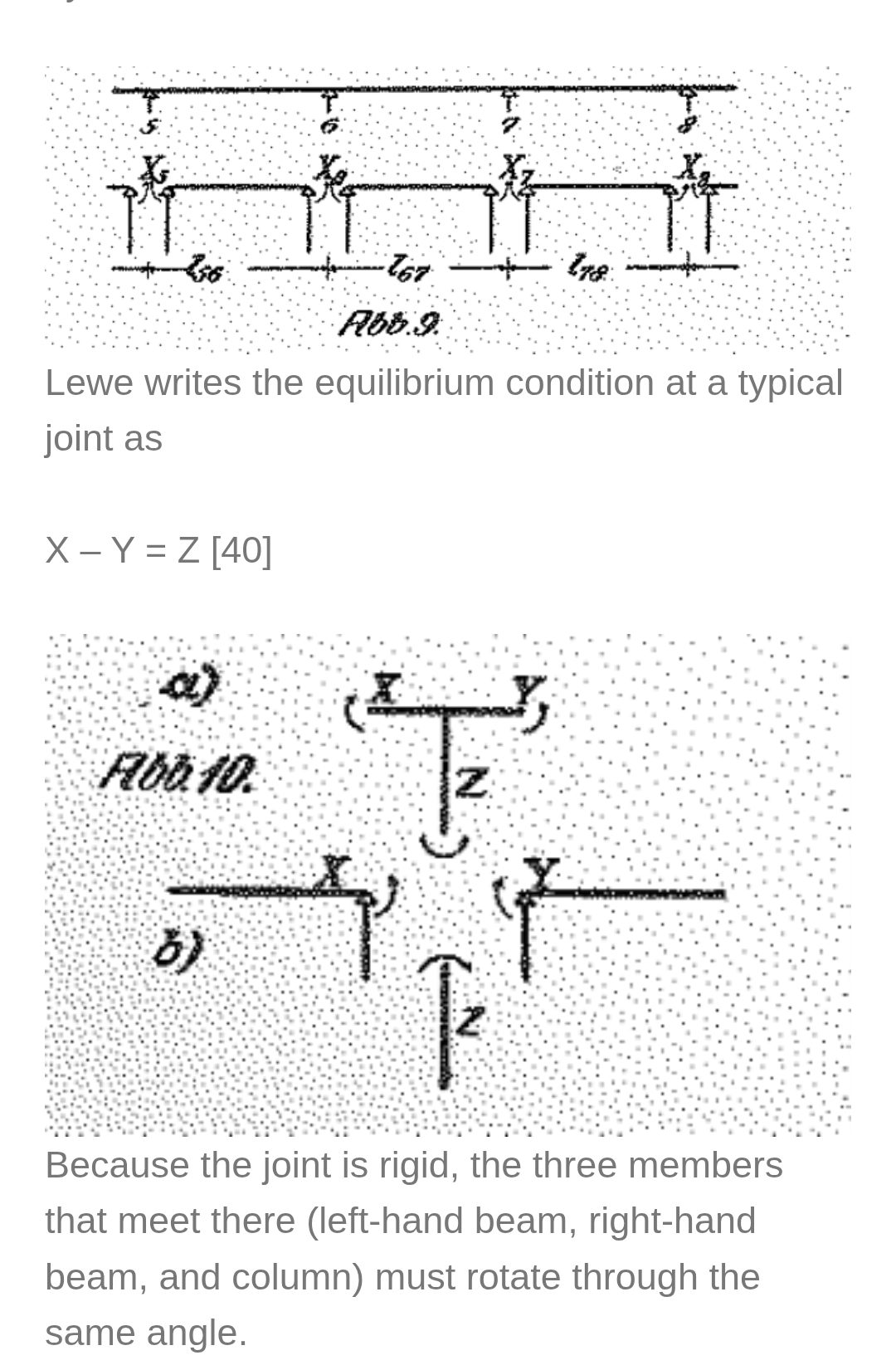
Figure E.3. Lewe Abb. 10a (assembled joint) and Abb. 10b (exploded joint), with X-Y=Z.
E.4 Correspondence
| Joint (E.3) | Plane (E.2) |
|---|---|
| Members (X), (Y) | Involutions , |
| Common angle | Coincidence of the two involutions |
| Column (Z) | Residual on Re(s)= 1/2 |
| Abb. 10b | Off-line split |
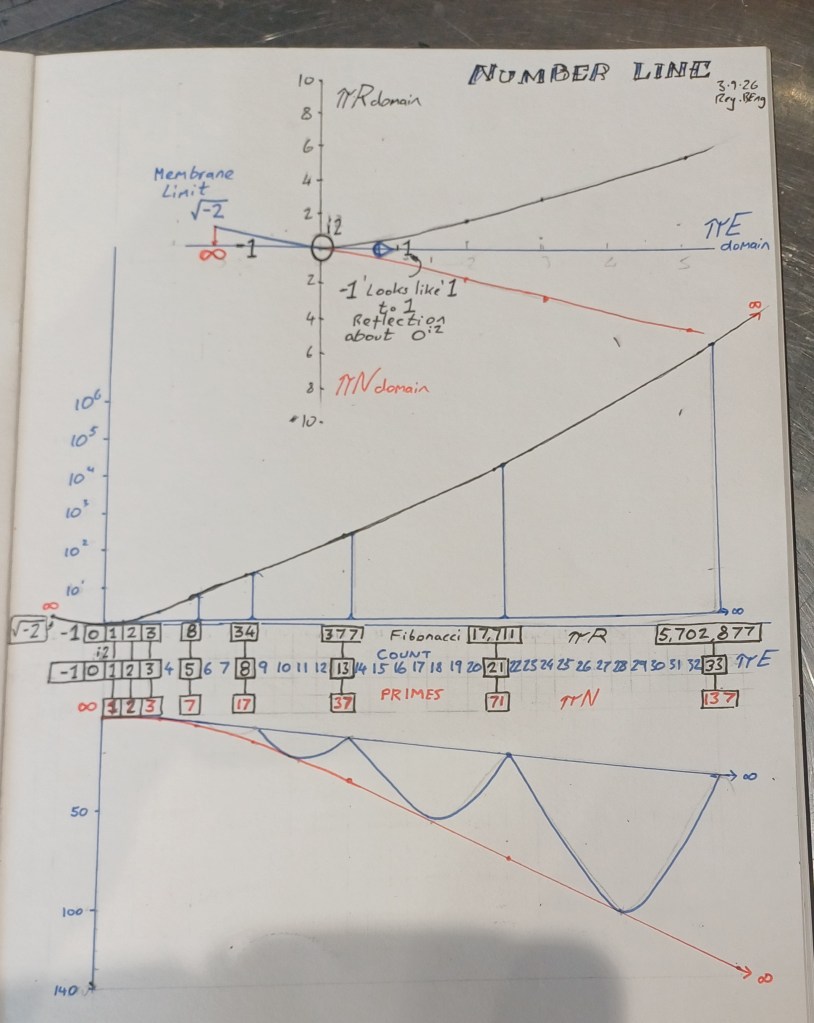
Figure E.4. Number line (Rey.BEng, 3 September 2026): three writings, boxed nodes, residual wave, is orthogonal not negative. Place after the correspondence table.
Under this dictionary the critical line is the joint operator: the set on which two reflections share one angle.
The number line of this thesis writes the same joint along a walk:
- : spring, anticlockwise bend;
- : material stretch, orthogonal prime writing;
- : the straight members both twists lean on;
- boxed nodes: places the three writings meet;
- residual that touches and does not close as (2): column (Z).
Chirality: bend and stretch push opposite ways against the same two straights. Dilatancy opens the gap; the medium that occupies it keeps the angle (Appendix D).
The hoop identity of Projects 2–4,
σθ = pr/t + σR, σR = F/ZR, is E.3 on a cylinder. is the column.
E.5 Limits
This appendix does not prove the Riemann Hypothesis. Lemma E.2 locates a coincidence of involutions. The Hypothesis asserts that the zeros of \(\zeta\) lie on that locus. Coincidence does not force vanishing.
It does not prove Collatz, and it does not rewrite the integers. The residual 2=1.999… is recorded as an open remainder of construction.
It does not derive the piTensor from digital roots or from F13. The tensor remains the continuum primitive of Appendices C and D.
E.6 Relation to Appendices C and D
Appendix C supplies the hub 0i2 at which the two writings are reflected.
Appendix D supplies the medium that keeps the joint’s angle.
Appendix E supplies the operator that places that joint on Riemann’s line.
If the residual (Z) vanishes identically, E.3–E.4 are withdrawn. That vanishing has not been shown.
References
Riemann, B. (1859). Ueber die Anzahl der Primzahlen unter einer gegebenen Grösse.
Lewe, V. (1915). Engineering dissertation, Abb. 10a, 10b.
Navrátil, D. (2026). Zeta, Zenodo 21974511, parity-coincidence lemma.
This thesis: Appendix C; Appendix D; Projects 2–4; Number Line figure, 3 September 2026.

