
29th August 2026, Huge stream of consciousness prompt focussed on Med Ek Wil Lewe illustrations, authored by Grok
Project 3 — Strength of Water
First run: engineering narrative only
Author
Reynolds BEng
Abstract
Project 2 left an open term, sigma_R, and an open source: the candidate origin of circumferential judder in a closed cylindrical tank. This paper states that source as a working engineering hypothesis. The strength of water is treated as a geometric necessity. Water maintains integrity by stretching in response to compression, and that stretching recreates the compression that sustains it. Time Particle Theory describes what happens inside the forming sphere to make a surface. Rigid Body Mechanics describes the surface once it exists. The two descriptions are not independent physics. They are inside and outside of one closed action.
The paper is a first narrative only. It uses observations already available in nature and in ordinary materials practice. It does not complete a molecular derivation. It ends by placing Lewe’s 1915 method as the engineering benchmark through which the hypothesis can be examined: a change of perspective, complementary analysis of indeterminate closed forces, and a standard of transparency. The practical claim to be tested later is simple. The strength of concrete is the strength of water, trapped.
1. Purpose
Project 1 restored a method chain from Lewe’s 1915 work into later tank tables. Project 2 used that method to say that a closed cylinder requires an explicit circumferential term in addition to pr/t. That term was named sigma_R. Its mechanism was named judder. Its source was reserved.
Project 3 begins there. If judder is a real circumferential restoration, it must have a source that already exists in the material. In a water-retaining concrete tank the common material is water, first as the stored liquid, then as the water that created and still occupies the cement paste. The question is therefore not “does geometry matter?” Project 2 already asked that. The question is: can the known behaviour of water supply the missing shear path?
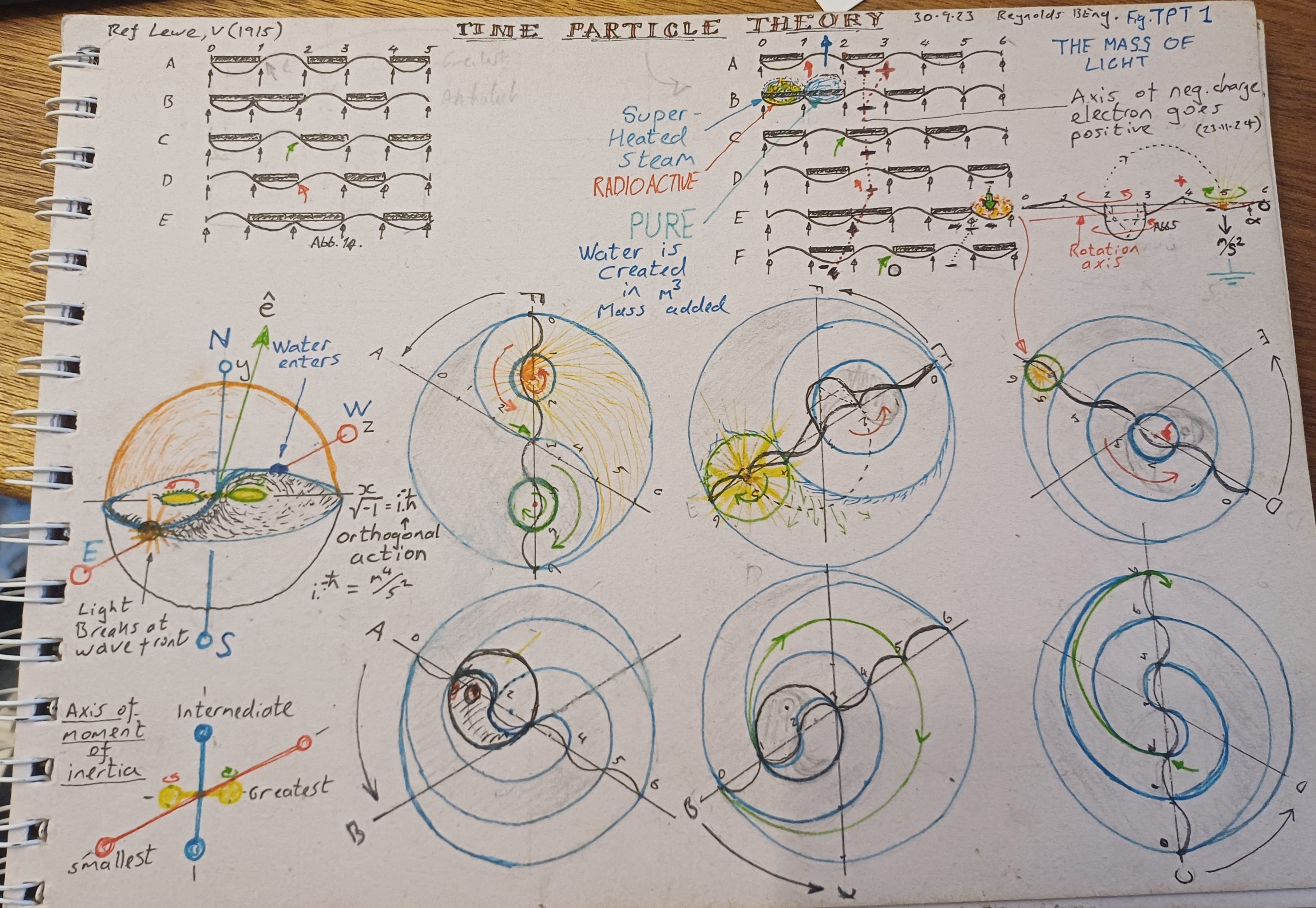
Fig TPT1
2. Two descriptions of one object
Time Particle Theory is the interior account. It describes how a centre is pulled into a closed surface: how a point becomes a disc, how a disc is twisted into thickness, and how that thickness becomes a sphere with a skin.
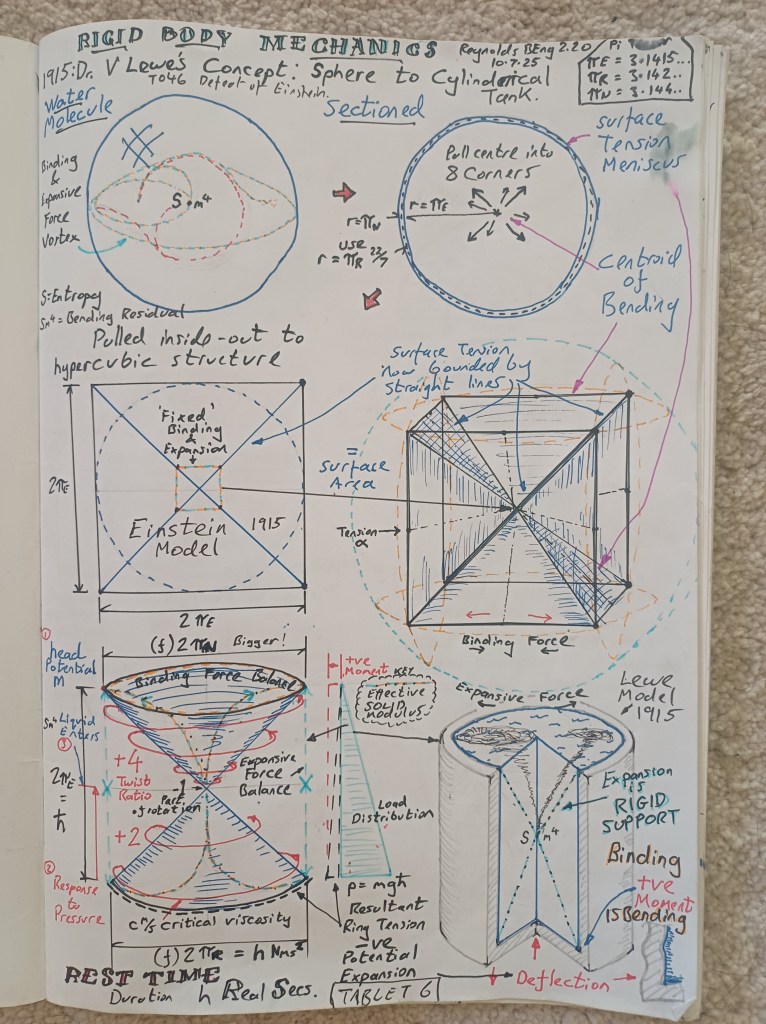
Rigid Body Mechanics is the exterior account. It describes the skin after it exists: hoop action, ring restoration, shear around a closed circumference, and the surface response of a tank wall.
The first cannot stand alone in engineering. A theory of the interior of a sphere is not yet a design statement. The second cannot stand alone either. A surface theory with no account of what creates the surface leaves sigma_R as a name. The two must be shown as already touching existing practice. The touch-point is Lewe’s method and the later coefficient tables that preserved the numbers and hid the working.
3. The working engine: stretch answering compression
The system being designed is ordinary in one sense and unusual in another.
Ordinary: every elastic body stores compression as stretch, and stretch as a tendency to return.
Unusual: the return is not treated as a dead spring. The stretch itself is taken as the act that recreates the compression. The system is self-sustaining while geometry remains intact. If the geometry is lost, the cycle stops.
In engineering language: integrity is the condition that keeps the two actions coupled. Lose integrity, and one is left with a coefficient and no path back to the object.
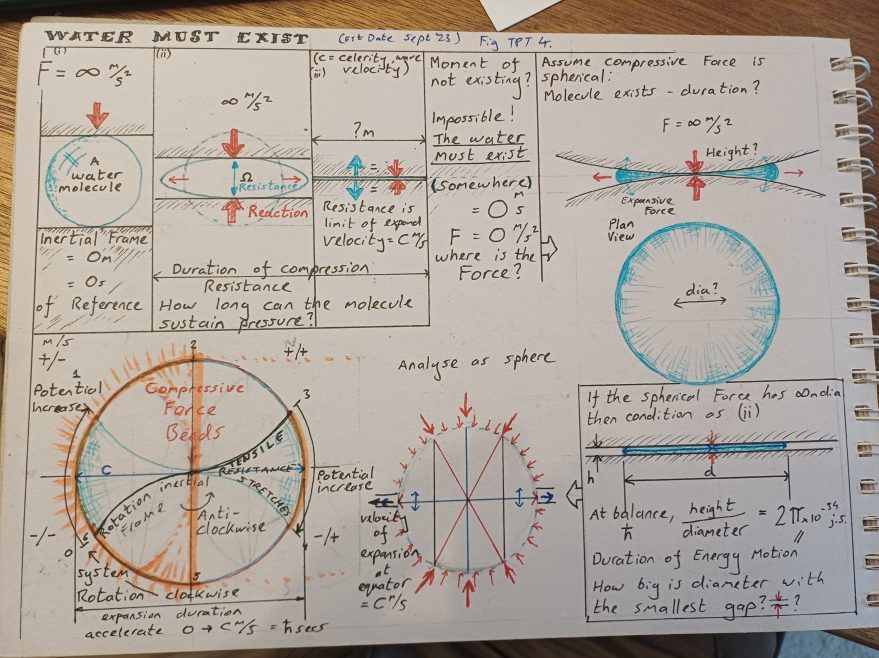
Water is the material in which this coupling is most familiar and least explained. It expands when it freezes. It is denser as a liquid than as ice. It holds a surface against its own weight. It cavitates, collapses, and returns. It binds cement. Those are observations. The interpretation offered here is that they are not a list of anomalies. They are one geometric engine seen at different stations.
4. Engineering description of the forming surface
Begin with a body of water. Over it, or in it, a hemispherical cavitation sits like a cup: a void bounded by water, with a flat face toward the basin below and a curved face toward the surrounding liquid.
Rotate that hemisphere through one full turn. The flat face does not remain a blank disc. As it moves through six stations, A to F, the shear on that face takes a two-lobe pattern. The pattern is the engineering fact to be kept, not the ornament. A closed rotation on a disc divides naturally into opposed sectors of advance and return. That is how a twist is stored without tearing the face.
At the perimeter the seal becomes severe. The basin beneath the cup cannot ignore the surface perturbation. It tries to follow the rotation. The wider body of water resists. The influence bowl under the cavitation therefore does not spin as a free rigid body. It carries the twist at the centre as momentum stored in thickness.
The result is a three-dimensional surface that remembers the twist. The memory is not a picture painted on the skin. It is a bilayer, hexagonally organised, in which adjacent patches grip and slip. That is the same language already used for judder in Project 2. Here it is applied to the creation of the surface, not only to the tank wall that later uses the surface.
Once the sphere exists, Rigid Body Mechanics takes over. The skin can now be cut, loaded, and written in hoop stress. The interior process is no longer seen. That is why pr/t looks complete. The cut sees the membrane. It does not see the twist that made the membrane possible.
5. Observations in nature
The same sequence is already visible in ordinary objects, if it is read as geometry rather than as separate sciences.
A drop on a free surface makes a cup, a ring, and a rebound. Cavitation in a liquid does the same at higher intensity: a void, a collapse, a pulse.
Ice does not form as a single indifferent solid. Hexagonal ice billows. Cubic ice is the tighter lock available from the liquid. Two local structures in water are already discussed in the physical chemistry literature as interconvertible arrangements, not as a second magic fluid. This paper does not need that literature to prove the tank formula. It needs only the observation that water already behaves as if more than one local geometry is available.
A mitotic spindle is a working support system. Contact at the poles creates usable strength. The cell does not store that strength as a coefficient. It builds it by geometry under load.
A thin spherical shell in nature is rarely a perfect mathematical skin. It is a surface made of windows that can billow and then snap back. Concrete paste, before it is imagined as stone, is a water-built packing in which hydrate films occupy the contacts. The hardened wall still contains that elastic water, bound and trapped.
None of these observations proves sigma_R. Together they show that the proposed engine is not foreign to materials. It is the sort of thing water already does.
6. From water to the tank wall
In the tank, two waters are present.
The stored liquid applies pressure p. That gives the classical term pr/t.
The second water is in the wall: mixing water, hydrate water, gel water, water in pores and films. That water is the medium in which the cement paste acquired its contacts. If those contacts are themselves a closed geometric packing, the wall is not only a dry hoop. It is a trapped water structure carrying a residual circumferential restoration.
The proposal is therefore:
sigma_theta = pr / t + sigma_R
where sigma_R is the wall’s share of the same integrity engine that makes water able to exist as a structured liquid and then as a binder. The judder wave in Project 2 is the surface expression. The source is the necessity of geometric integrity in water.
This is the claim to be tested, not the result already in hand.
7. Why the claim is difficult to see from inside a scalar standard
A scalar measurement sections a continuum. The number is real. The object measured is not itself a number. When the metre is tied to a fixed speed of light, the instrument becomes extremely stable and also extremely unwilling to display a residual that lives in geometry rather than in a single scale. That is not an accusation against measurement. It is a statement of what a scale can and cannot show.
Lewe’s method matters here because it was built for the opposite habit: keep both actions visible after the cut. Moment and shear remain in view. The member can be reassembled. A coefficient table that no longer shows the working cannot do that. It can only return a number.
8. Lewe’s three assets
Lewe does not have to have written a theory of water. He leaves three assets that make the present proposal examinable rather than private.
First, he legitimises a shift of perspective. The same member may be read from the support, from the span, from the fixed point, and from the influence line. The structure survives the shift.
Second, he leaves complementary methods for indeterminate closed-force systems: graphical construction and the number rectangle. One method sees the figure. The other sees the arithmetic. Both keep moment and shear available.
Third, he leaves a benchmark of transparency. A method is good if a less practised engineer can still see why the number appeared. Project 3 accepts that benchmark. If the strength of water cannot be written so that sigma_R can be sought, measured, or falsified, the hypothesis has not yet met Lewe’s standard.
9. Closing statement Section 1 ends here.
The ontological statement now available for the rest of the paper is this. A closed body keeps its integrity by answering compression with stretch, and stretch with renewed compression.
Time Particle Theory is the interior of that action: the process that makes a surface.
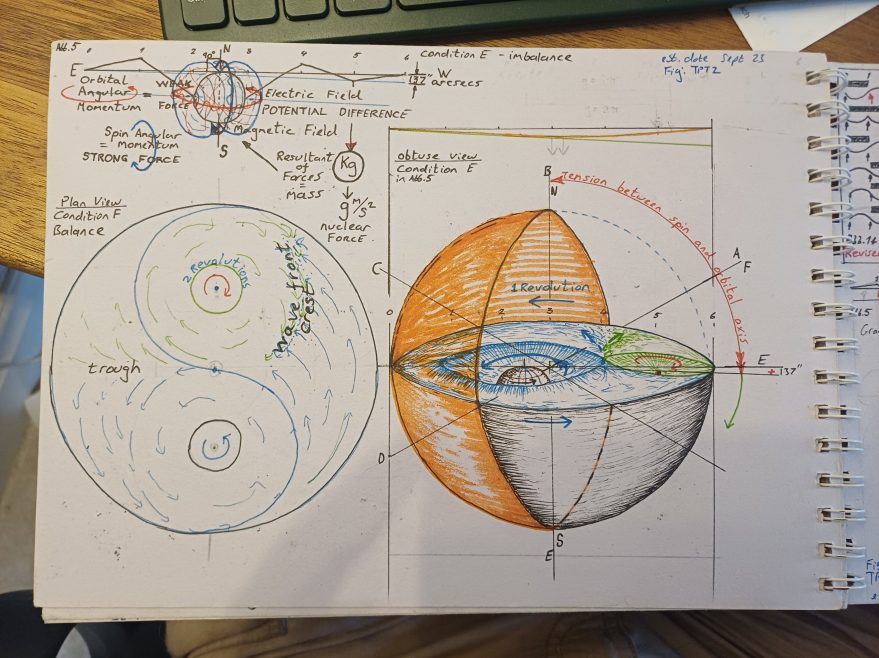
Rigid Body Mechanics is the exterior of that action: the surface once it can be cut, loaded and written as hoop and shear.
Water is the ordinary material in which the two descriptions already meet. The strength of concrete is that material, trapped. The extra circumferential term proposed in Project 2, sigma_R, is the engineering name for the surface share of the same integrity.
That statement is not yet a measured law. It is complete as an account of what is being claimed, and it already stands on existing engineering rather than on a private vocabulary.
The foundation is Lewe’s method, not a hidden caption. The 1915 dissertation keeps moment and shear visible in indeterminate members. The 1915 tank article keeps cylindrical wall action visible in charts. The later PCA tables keep the numbers and drop the working. Project 1 restored that chain. Project 2 used the restored method to require an explicit closed-ring term. Project 3 names the candidate source of that term as the strength of water. The recursive reading of Abb. 14, and the later placing of Abb. 5 as one of six influence lines, belong to this paper as an extension of the method. They are not claimed as Lewe’s published intention.
What follows is therefore examination, not decoration.
Section 2 will take the same closed action to Quantum T = 0: the instant in which the cut and the whole are both still present.
Before that, the engineering line continues through three checks. First, Lewe 1906 on momentary forces, to test whether impulse is already recursive in his earlier rigid-body work. Second, the Pirate Canon papers, to test whether the twist kernel and the D6 surface can be written in the same language as the tank. Third, the CCY summary of observations in nature, to test whether the two energy writings
E = 2c / h
and
E = hbar / c
can be read as perimeter-to-diameter and polar-height-to-sphere-perimeter of one surface, rather than as two disconnected formulae.
If those checks hold, this sentence remains the working claim of Project 3:
The strength of concrete is the strength of water, trapped.
Project 3 — Units built from scratch in the Rest Time frame
1. What is being measured
A closed body has to be sectioned before it can be written in numbers. The number is a scalar. The body is a continuum. Rest Time is the frame in which that fact is kept in view: the origin is the preferred mechanical centre, written 0,0,0 i2, and the temporal factor is carried inside the spatial coordinates.
The quantity that survives the section without fracture is the residual. It is a second-moment of a disc or ring:
0 i2 = r^2 m
Its unit package is
k.g.s^2
That package is the teased residual of mass, clamp and duration standing together. It is not kilogrammes. The residual is not a completed point and not a state at infinity. Its geometric measure is the open second-moment r^2 m.
2. Four writings of one residual
The same residual can be read four ways in one moment:
Ma = 0 i2 = c = F
Ma
mass accelerating
0 i2
residual second-moment, unit package k.g.s^2
c
celerity: circumferential wave speed, written m/s
F
residual force of geometric necessity, written in the energy-extension package N m s^2
These are not four different SI quantities that happen to look alike. They are four faces of one unclosed residual. In Rest Time they stand as an equality. In Rest Mass they fall apart into separate units and a coefficient is invented to glue them back together.
3. The two geometric states
The residual is bistable. It can be read as a disc or as a sphere.
State A — disc
The working ratio is disc perimeter over sphere diameter.
disc perimeter = 2 π r
sphere diameter = 2 r
so
State A ratio = (2 π r) / (2 r) = π
The matching energy writing is
E_A = 2c / h
This is the perimeter-to-diameter engine: two times celerity, spent across the moment duration h. It is the expansive / open reading.
State B — sphere
The working ratio is sphere polar height over sphere circumference.
polar height = 2 r
sphere circumference = 2 π r
so
State B ratio = (2 r) / (2 π r) = 1/π
The matching energy writing is
E_B = hbar / c
This is polar height over circumference. It is the locked / compressive reading.
The two ratios are reciprocals:
State A ratio × State B ratio = π × (1/π) = 1
That product is the closure condition. The continuum can toggle from disc to sphere and back without gaining a new dimension.
4. The moment duration
h is the interval in which one toggle is completed.
In Rest Time it is written as orthogonal action across the equatorial disc:
h = N m s^2
It is not an external clock standing outside the body. It is the duration of the section that still allows the body to be reassembled.
hbar is the locked form of the same action, used only in the State B writing E_B = hbar / c.
5. Derived packages
From the root
0 i2 = r^2 m unit package k.g.s^2
the following writings are obtained by reading the same residual through c or through h:
celerity
c = m/s
energy-extension force
F = N m s^2
State A energy
E_A = 2c / h
State B energy
E_B = hbar / c
No new base dimension is introduced. Every later symbol must be reducible to r, m, c, h and the package k.g.s^2.
6. G
G is not a dimensioned constant.
It is the complex Reynolds number of the two energy readings:
G := E_A / E_B
= (2c / h) / (hbar / c)
= 2 c^2 / (h hbar)
In Rest Mass that expression looks as if it had units. In Rest Time c, h and hbar are readings of one residual, so the ratio has no units.
The word complex records only phase: which state is taken as reference. Invert the ratio and the other state is the reference. The quantity remains dimensionless.
Ordinary Reynolds number is inertial action over viscous action. G is the same kind of object: one energy reading over the other. It names a flow regime in the continuum, not a glue constant with units m^3 kg^−1 s^−2.
7. What this gives Project 3
The strength of water is the claim that a real liquid already runs this engine: stretch answering compression, disc answering sphere, E_A answering E_B.
sigma_R is the surface share of the same residual when the body is a closed tank wall. Its converter Z_R, still unknown, must be written in r, t and k.g.s^2. It cannot be written in a coefficient that has forgotten the residual.
The next section, Quantum T = 0, is the instant at which both ratios are present at once: the cut and the whole, shear and moment, State A and State B.
Close of the units section
The residual has so far been written as0 i2 = r^2 m unit package k.g.s^2
Rearrange the same package against the volumetric extension m^4. Two conjugate writings appear at once:
m^4 / k.g.s^2
and
k.g.s^2 / m^4
That pair is the obvious fact of the section. Nothing new is added. The residual is simply read both ways.
m^4 / k.g.s^2
is bending that relies on live load. This is State B. The sphere spends potential to keep the surface up. It is parasitic of the store it is using.
k.g.s^2 / m^4
is live load that relies on bending. This is State A. The disc returns strength into the sum. It adds to the store it is using.
The two writings are inverses. Their product is 1. That is the same closure already obtained from(disc perimeter / sphere diameter) × (polar height / sphere circumference) = π × (1/π) = 1So the unit pair and the geometric pair are one engine.
Universal rotation can carry inefficiency because the rotation itself does not stop. State B may waste potential and the motion will still continue. The waste is not free. It appears as impact: heat, lock, extra hoop, extra shear, the term that later has to be written as sigma_R instead of being hidden in a coefficient.The section therefore ends on this conjugate statement:
State B lives on m^4 / k.g.s^2.
State A lives on k.g.s^2 / m^4.
B spends. A restores.
The rotation does not ask permission. The impact is the bill.
Quantum T = 0 is the instant at which both writings are present before either has been chosen.

