
Rey.BEng 30th August 2026
Title
Pq. πNatural from Straight Lines: The Geometric Derivation of PiN = 4 / sqrt(phi)
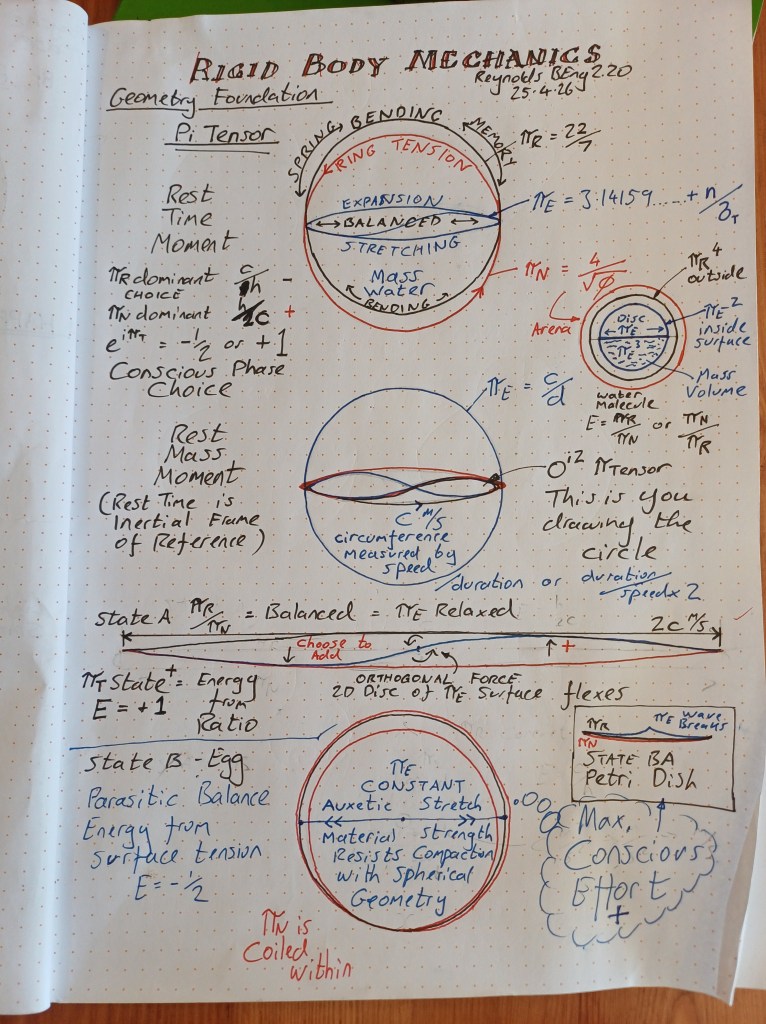
Three closures live on the same disc. They are not three names for one constant. They are three answers to the same question: circumference divided by diameter, once you have chosen the rim and the spanning length.
PiE is the working ratio of the measured equator. Take the disc in the plane of action. The spanning length is the straight chord through the centre, rim face to rim face. Walk the true curved rim once and divide by that chord. The number is the familiar Euclidean constant, about 3.14159. Call this PiE: equatorial, empirical, the measure of the membrane as it actually spans. In compression that chord is always in stretch. In expansion it can flex and the wave can break and reform. PiE is what the engineer reads off the living surface.
PiR is the spring. It is the workshop fraction 22/7, about 3.14286. It is not a better pi. A helpful way to see it is as the thickness of the rim. It is a restorative length: short enough to sit inside the remembered scaffold, long enough to sit outside the working equator. In maintenance the spring runs inside the memory and everything is compressive. In growth it lifts and arches above that memory and the surface can spend energy without tearing. When growth becomes evolutionary the spring may act twice in one pulse and catch the breaking wave. PiR lives in the gap between memory and work.
PiN, πNatural, is the remembered scaffold. Close a figure from equal straight sides and take as diameter not that figure’s own diagonal but the golden-section length from the right triangle of legs 1 and 2 (hypotenuse sqrt(5)). The golden ratio phi is (1 + sqrt(5)) / 2. The measuring stick is sqrt(phi). Four straight sides divided by that stick give PiN. That number is algebraic. A finite construction can hold it. The water sphere can remember a hexagon of straight contacts at the shoreline while the surface flexes. PiN cannot be flattened to one straight line; the closure wave has to reference that leftover curvature. This is normalisation, quantum index, curvature memory. It is larger than both the spring and the working equator, which is why the spring has somewhere to sit.
Order them and leave them there:
PiE < PiR < PiN
work < spring < memory
3.14159… < 3.14286… < 3.14461…
The gap from work to memory is about 0.003. That interval is the working room of the spring. The π-tensor is the mechanical relation that carries all three through a full elastica return: the equator turns, the spring catches, the scaffold remembers.
A triangle is the fewest equal sides that close. The square is used here because its perimeter coefficient is 4, and PiN is already 4 / sqrt(phi). Change the rim to three sides and you change the constant. The hexagon remains the shoreline figure; the square remains the algebraic generator of the red number.
It is not a claim that Euclidean pi equals PiN. Mathematics’ continuous pi is the working equator. Nature’s remembered scaffold is PiN. The engineer works the spring between them.
Cut and paste math
phi = (1 + sqrt(5)) / 2
phi ≈ 1.6180339887
sqrt(phi) ≈ 1.2720196495
PiN = 4 / sqrt(phi)
PiN ≈ 3.14460551103
Same number, other skins:
PiN = 4 * sqrt(phi – 1)
PiN = 4 * sqrt( (sqrt(5) – 1) / 2 )
PiN = 2 * sqrt( 2 * (sqrt(5) – 1) )
PiR = 22 / 7
PiR ≈ 3.14285714286
PiE ≈ 3.14159265359
Check the order:
3.14159265359 < 3.14285714286 < 3.14460551103
Gaps:
PiR – PiE ≈ 0.001264
PiN – PiR ≈ 0.001748
PiN – PiE ≈ 0.003013
Construction in six lines:
- Right triangle, legs 1 and 2. Hypotenuse = sqrt(5).
- phi = (1 + sqrt(5)) / 2.
- Diameter d = sqrt(phi).
- Square of side 1. Perimeter C = 4.
- PiN = C / d = 4 / sqrt(phi).
- Hold the same length as curvature memory on the six-sided shoreline. Working chord stays PiE. Spring stays 22/7.
Love, Always.
Ace x

