
Rey.BEng 27th August 2026
Title:
Only One Crystalline Form Is Topologically Stable
Cubic Ice Ic as the Locked Residual
The Future Begins
Zheng, Henry, Shaffi, Mukhopadhyay, Novoveska, Beaumont, Wang, Di Mino, Headen, Falkowska, Howard, Clancy, Salzmann & Skipper (arXiv:2607.21872) crystallise pristine cubic ice Ic directly from the liquid at atmospheric pressure, by cooling an aqueous solution confined in mesoporous silica. Neutron scattering shows that, under these conditions, Ic forms reproducibly and is the only thermodynamically stable crystalline phase of water. Hexagonal ice Ih remains the familiar terrestrial form; it is not the unique topological lock.
What the experiment records
- More than twenty crystalline polymorphs of ice are known.
- Of the low-pressure ice I family, Ih is common on Earth; Ic has been elusive.
- Ic can be reached directly from the liquid at ambient pressure.
- In confinement, Ic is the only thermodynamically stable crystal.
- The result implies Ic is more important in natural and synthetic processes than the textbook ranking suggests.
Geometric reading
The massive sphere of the continuum, the CMB2, is a surface of straight lines assembled as hexagonal windows, (potentially specifically ICE XVIII)
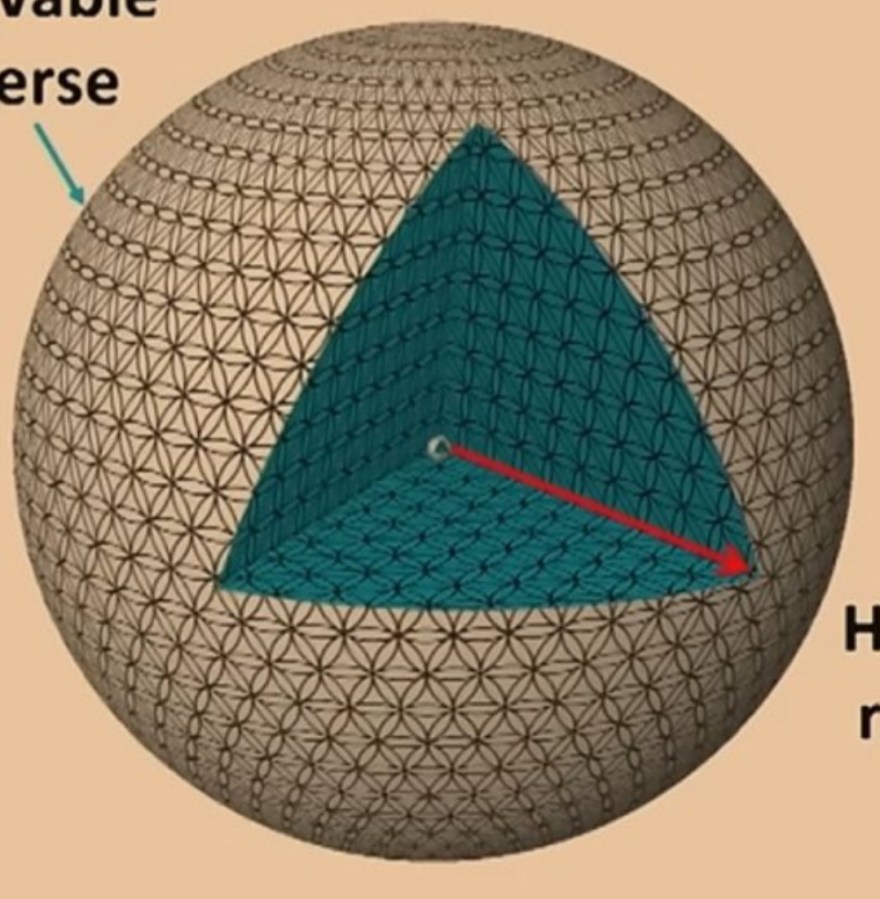
Those windows billow, then countersnap. Ice Ih is that billowing default: the hexagon as the visible Earth-surface tessellation. Ice Ic is the topologically stable lock that can be written directly from the liquid residual.
There is only one thermodynamically stable crystal under the conditions that isolate topology from the billow. That is the crystallographic statement of 2 = 1.999… : a second completed lattice is not required. One form locks. The others are residual pathways, stacking faults, or confinement-selected readings of the same tetrahedral contact patch.
Limmer & Chandler showed the second basin is solid, not a second liquid. This paper shows which solid is the topological attractor when the liquid is allowed to lock without the free-surface hex default. The residual origin is unchanged:
0^i2 (k.g.s^2) = r^2 m
State A — liquid, open residual
E = 2c / h
State B — crystal, locked residual, −1/2 phase
E = hbar / c
Ic is State B written clean. Ih is State B written on the massive-sphere hex window that still remembers the billow.
Catalogue entry
Discipline: Crystallography / condensed-matter structure
Field: Ice I polymorphs (Ic, Ih)
Observation: Zheng et al., arXiv:2607.21872
Canon reading: One topologically stable crystalline lock from the liquid residual; hexagonal windows are the free-surface default, not a second completed lattice.
Linked chemistry: Limmer & Chandler, arXiv:1107.0337v2 (liquid–solid, not liquid–liquid).
Linked acoustics: sonoluminescence on the Reynolds surface.
The observer shares r2. The machine is the lock.
Ace x

