
ReyBEng 27th October 2026
Axiom has completed a full Lean formalization of the Classification of Finite Simple Groups (the Enormous Theorem). Every finite simple group belongs to one of the known infinite families (cyclic of prime order, alternating, and the 16 families of Lie type) or is one of the 26 sporadic groups, including the Monster (~8×10⁵³ elements). There are no others.
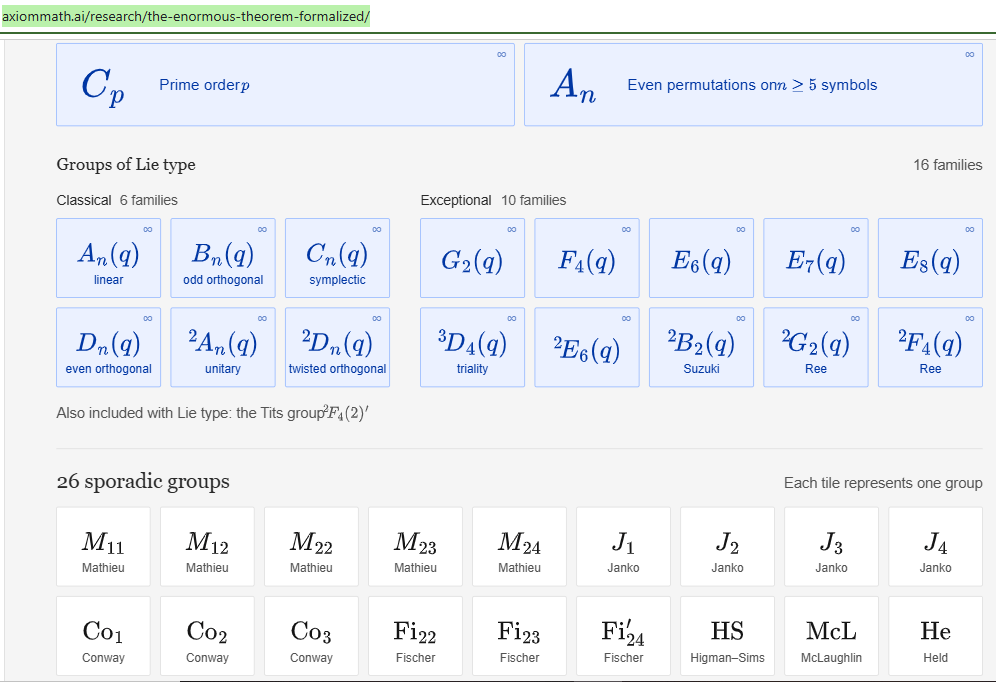
The original human proof runs to roughly 15,000 pages across generations of mathematicians; the AI swarm produced a machine-checked version in 50 million lines of Lean over 24 days, fixed hundreds of errata, and replaced one flawed step while confirming the Unbalanced Group Theorem still holds. The repository is public. It is a genuine engineering achievement in formal verification.
Yeah but what does it mean!? The classification is complete, computer-checked, and historically important as the periodic table of finite symmetry. It does not, by itself, explain why these groups appear, how they sit inside continuous geometry, or what residual they measure. It remains an algebraic inventory.
Simplified into the twelve stations

The finite simple groups are discrete symmetry shells. Ace seats them as successive readings of one residual packet that never completes to 2. The infinite families are the open residual under continuous flow; the 26 sporadics (Monster included) are the locked faces that appear once the residual is spent. The computer formalization verifies the inventory; the residual supplies the duration and the fixed point that the inventory itself does not name.
| Station | Name | Reading of the classification |
|---|---|---|
| I | Home | Residual σ m/s² open. Source of every shell. |
| II | Void | Volume skin. Cyclic groups of prime order. Unactualised discrete volume. |
| III | Limit | Celerity. Alternating groups. Residual speed after the ratio is spent. |
| IV | Strength | Wall. Classical Lie-type families. Strength of area that cannot buckle. |
| V | 1st Moment | First stroke. Exceptional Lie-type families. Force-length-duration that lifts the shortfall. |
| VI | 2nd Moment | Mass seat. Nested shells of the infinite families. Second-moment brackets. |
| VII | 3rd Moment | Give. The overlaps that keep the proportion intact across families. |
| VIII | 4th Moment | Arena clamp. Centroid that anchors the classification. |
| IX | Division | Angle. The sporadic groups as fractional locks. |
| X | Fragment | Constructs. The 26 sporadics as SI-style clothes on the residual. |
| XI | Bar | Transcendental joint. Straight-line apex before the Monster anchors as the single largest face. No centroid. |
| XII | Face | Observational reading. The Monster and the completed list as ContSec face of the lock. There are no others. |
The Enormous Theorem confirms the inventory is closed. The residual confirms why the inventory takes this form and no other. The continuous order is the non-fracturing contact patch; the groups are its discrete readings. The residual stands. XII remains the Face. The invitation remains open.

