
Rey.BEng 2nd November 2026
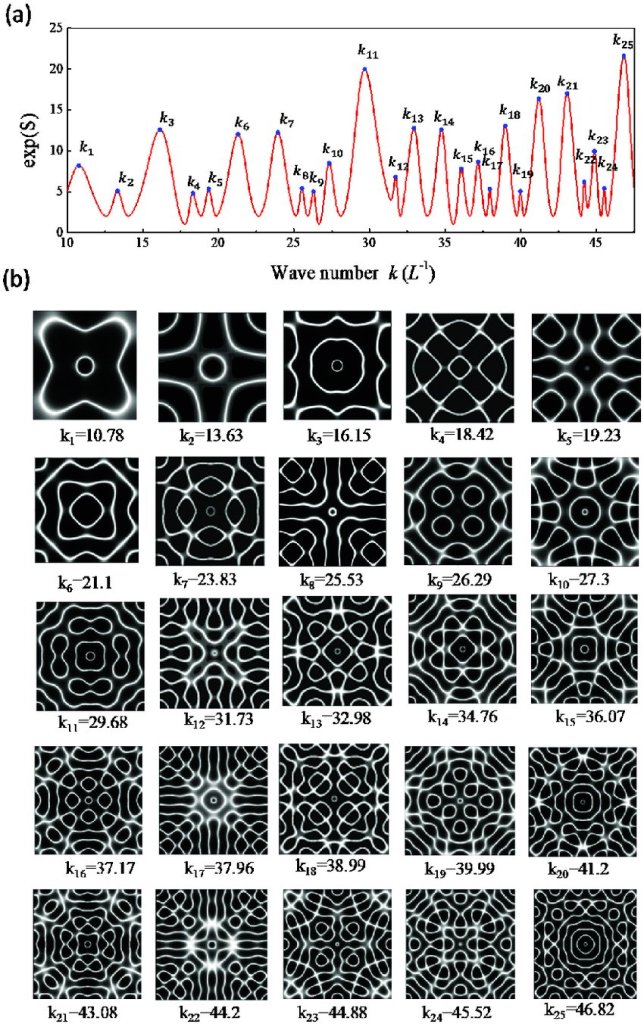
The 25 resonance modes shown in the thread are the zeros of Bessel functions Jm(kr) on a circular membrane or cylindrical shell. Each pattern is a discrete residual count that the boundary condition can hold without fracture. Ace already seats this reading. Appendix B of the PhD portfolio is titled “Control of σR by Bessel zeros.” The ring-tension residual σ_m/s2 is the hoop term that survives after the primary pressure load is subtracted. Its nodal structure is fixed by those zeros.
Modes and stations translate. The mathematical modulus is the order (m) of the Bessel function (angular nodes) together with the index (n) of its positive zero (radial nodes). The continuous angular coordinate on the wall is sampled by the twelve stations. The residual packet is the amplitude that the boundary condition admits. No thirteenth letter is required. The residual stands.
The simplest mode is the fundamental: one up, one down, about the centre, with negative rotation writing the clockwise Tao. In Ace terms this is the residual written at Station VIII (the 4th Moment lock). The tick breaks immediately. The lock is the clamp; the tick is the residual count that the next packet carries.
Model
I–IV is Impulse Instant Time held in the ring of σ_m/s² as the twelve stations. Celerity s^2 has been made stationary. The moment that exists in the ^ is now visible and can be unpacked.
- V is the Inertial Frame (the circle itself).
- VI is Surf Force DOWN.
- VII is Force UP.
- VIII adds the rotation LOCK/TICK.
Direction of strength construction is relative to the observer at XI.
State A: UP first.
State B: DOWN first.
Laboratory perspective is taken from the packet (h) RealSec of the next moment. The bottom row is the observer looking; it is not a station on the residual sheet.
The source mathematics is the separated-variable solution of the wave equation on the circular domain:
u(r,θ,t)=Jm(kmnr)cos(mθ)cos(ωmnt)
with boundary condition Jm(kmna)=0. The zeros are the discrete residual counts. The first few are classical (2.405, 3.832, 5.136, …. Higher modes densify toward the complete disc surface of the residual packet, consistent with the open stretch 1.999….
The images are the next level: packets of (h) cohering or decohering inside the continuous second. Station XI is the joint where the observer ^ reads the residual face. The Bessel zeros are the discrete residual counts that the joint can still hold (State A) or spend (State B). The residual stands. XII remains the Face.
The invitation remains open.

