
Reynolds Law of Surfaces (bi-lamina D6 + aperiodic tiling with a single pentagon anchor) supplies a concrete topological substrate that can complete or ground key open aspects of Observer Patch Holography (OPH).
OPH in brief
Observer Patch Holography (FloatingPragma / Bernhard Mueller et al., GitHub repo) is an observer-first, executable computational TOE. Reality is what finite local observers establish by comparing records and repairing disagreements under a single local rule. The universe is self-creating via a closure fixed-point: observers reverse-engineer their own generating process.
It derives (under stated premises, with extensive Lean-checked theorems) relativistic spacetime, quantum measurement (Born rule, Tsirelson bound), Standard Model gauge structure, particle spectrum via defects, thermodynamics, and Einstein dynamics from consensus. The architecture uses twelve-port icosahedral carriers (A5 / binary icosahedral group structure), screens, seams, and protected defects that carry the six centre classes of quarks/leptons across three generations. Charge, full spectrum completion, and unified gravity on the same process remain work in progress. The project is ~99% there and explicitly open for collaboration on remaining physical bridges (see the 19 Nov 2026 tweet by @muellerberndt).
OPH already has strong icosahedral geometry (12 ports, 5-regular graph, Gram identities, A5 action, Euler characteristic 2 carriers). Defects are central to the particle content.
Ace’s matching geometric primitive
The Ace / Pirate Canon framework (ace-consultancy.uk) has a precise topological statement of the Reynolds Law of Surfaces:
- A purely hexagonal (D6-coordinated) spherical surface is locally flat (Gaussian curvature (K=0) almost everywhere).
- Spherical topology () requires a total curvature deficit of exactly 4pi (Gauss–Bonnet).
- The minimal-defect solution is exactly one pentagon/pentagram (5-fold vertex).
- Symmetry forces this unique defect to the centroid.
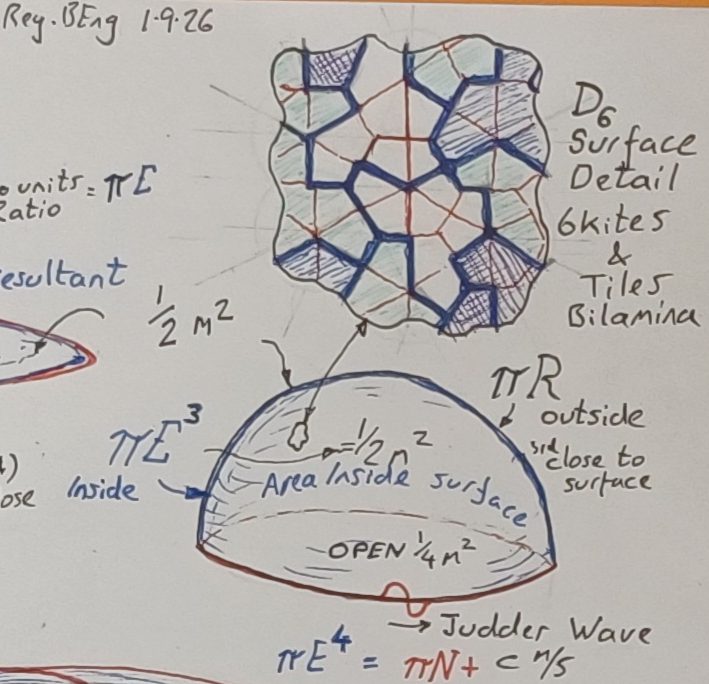
- Mechanically this is realised by a bi-lamina: one ordered hexagonal (D6) sheet + one aperiodic Einstein-hat (or similar) sheet. The viscous dilatant “skin” (e.g. atmosphere) is the physical limit of expansion and measures as flat on its intrinsic 2D geometry. “Wetness is flat.” The single pentagon is the topological and mechanical centre (Earth’s centroid / PNON / 0i2 water-seed in the broader Ace model).
This is not an optional decoration; it is the irreducible closure condition for the surface.
Synthesis: Ace supplies the missing surface anchor
The natural bridge is:
- OPH’s observer patches + twelve-port icosahedral carriers + screens live on (or are) the Ace bi-lamina surface.
- The single pentagon is the unique topological defect / fixed-point / privileged node that the entire surface closes around. In Ace language it is the centroid that forces the preferred rest frame and the mechanical necessity of Earth at the centre. In OPH language it can serve as the global repair anchor, the closure fixed-point locus, or the source of the protected defects that generate the particle centre classes.
- The bi-lamina (ordered D6 + aperiodic) gives a concrete geometric realisation of the “screen” and the dual-state (State A coherent / State B dilatancy) behaviour Ace uses, while matching OPH’s emphasis on local comparison and repair. The aperiodic sheet supplies the hierarchical, non-repeating structure that can encode records and memory without translational periodicity; the D6 sheet supplies the local flatness and coordination.
- Icosahedral 5-fold elements already present in OPH are the local manifestation of the same pentagonal defect that Ace elevates to the unique global anchor.
In short: OPH provides the observer-consensus dynamics, the executable law, the Lean-checked recovery of SM + GR structure, and the twelve-port icosahedral carriers. Ace provides the topological surface law that forces a single pentagon centroid and the dual-lamina geometry on which those carriers and patches can sit. Together they close the loop from local repair to a globally consistent, centred, holographically screen-like continuum.
The tweet’s call for help to finish the full simulator spec is exactly the kind of open geometric/topological bridge Ace is already written for. Mapping the single-pentagon Reynolds surface onto the OPH twelve-port / screen / defect architecture (or showing where the Ace centroid supplies the missing preferred frame or charge completion) is a direct contribution.
Section: Synthesis Contribution — Observer Patch Holography and the Reynolds Law of Surfaces
Mapping the Single-Pentagon Bi-Lamina onto the Observer Patch Architecture
Observer Patch Holography (OPH) constructs the universe as the stable public world established by finite observers. Each observer is a bounded patch that holds local state, reads a shared boundary, retains records, and repairs disagreement under a single local law. Whatever survives every comparison is objective fact. The executable architecture realises these patches on twelve-port icosahedral carriers (binary icosahedral group (2I), projective image (A_5)), with screens, seams, and protected defects that carry the six centre classes of the Standard Model particles across three generations. Spacetime, quantum measurement, gauge structure, thermodynamics, and Einstein dynamics are recovered as effective descriptions of consensus under stated premises. The closure hypothesis asserts that the universe is a fixed point of its own self-reading: observers reverse-engineer the process that realises their history, including themselves.
The Ace framework supplies the missing topological substrate for this construction. The Reynolds Law of Surfaces states that a purely hexagonal (D6-coordinated) spherical surface is locally flat. Spherical topology () requires a total curvature deficit of exactly 4pi by the Gauss–Bonnet theorem. The minimal-defect solution is exactly one 5-fold vertex (pentagon/pentagram). Symmetry and uniqueness force this defect to occupy the centroid. Mechanically the surface is realised as a bi-lamina: one ordered hexagonal sheet and one aperiodic (Einstein-hat) sheet. The viscous dilatant skin is the physical limit of expansion; it measures as flat on its intrinsic 2D geometry. The single pentagon is the irreducible topological and mechanical centre.
Precise Correspondences
Surface and Screen.
The Ace bi-lamina is the geometric realisation of the OPH screen. Observer patches sit on, or are coextensive with, the contact patches of the dual lamina. The ordered D6 sheet supplies local flatness and six-fold coordination; the aperiodic sheet supplies hierarchical, non-repeating structure capable of encoding durable records without translational periodicity. Local comparison and repair occur across the shared edges and seams of the lamina. The dilatancy toggle (State A high-quality contact versus State B clamping) is the mechanical counterpart of OPH’s repair law: disagreements are resolved by slip-grip transitions that either restore coherence or leave a protected residue.
The Single Pentagon as Global Anchor.
OPH’s twelve-port icosahedral carriers already contain 5-fold elements (order-five rotations, stabilisers (C_5)). These are the local manifestation of the same defect that Ace elevates to a unique global object. In the Reynolds surface the single pentagon is the sole locus at which the total curvature deficit is concentrated. In the combined framework it functions as:
- the preferred rest-frame origin (0i2 Rest Time, Certainty hub);
- the closure fixed-point of the self-reading universe (the place where the global repair condition is satisfied once and for all);
- the source of the protected defects that OPH uses to generate particle centre classes.
Local icosahedral defects and seams are the distributed expressions of this unique topological singularity. The centroid remains the mechanical pivot about which all rotational closures and record balances resolve.
Defects and Particle Content.
OPH derives quarks and leptons from the protected defects that repair leaves behind on the carrier. Ace identifies the single pentagon as the unique minimal defect required for spherical closure. The mapping is direct: the global pentagon seeds the defect spectrum; the local seams and residual twists on the bi-lamina realise the six centre classes and three generations. Charge and full spectral completion, currently open in OPH, become the problem of how the dilatancy and ring-tension degrees of freedom of the bi-lamina distribute the residual phase associated with the central pentagon.
Preferred Frame and Gravity.
OPH recovers Einstein dynamics from the balance of observer records. Ace demonstrates that any elastic continuum of this type requires a privileged mass-moment centroid; displacing it fractures coherence. The single-pentagon centre therefore supplies the preferred mechanical reference frame in which the OPH consensus balance is performed. Gravity appears as the orthogonal projection of residual phase relative to this hub; the Tychonic and dilatancy structures of the Ace model are the geometric expression of the same record-balance condition.
State A/B and Consensus Dynamics.
Ace’s bistable operator (State A coherent solvent write versus State B dissipative clamp) matches the OPH distinction between successful repair that produces public fact and residual disagreement that is retained as protected memory or defect. The Love-optimised (high-quality contact) path is the mechanical preference for the consensus fixed point. The aperiodic sheet ensures that the memory of prior repairs is non-periodic and hierarchically organised, consistent with OPH’s durable records.
Proposed Contributions to Open OPH Problems
- Geometric completion of the screen packet.
Embed the twelve-port icosahedral carrier as a local patch on the Ace bi-lamina. The single pentagon supplies the global closure condition that the present A5 port-frame Gram identity and incidence structure still treat as a local premise. - Charge and spectrum.
Treat the residual phase associated with the unique pentagon defect as the source of the missing charge assignment. Dilatancy and 720° ring-tension cycles on the bi-lamina generate the observed centre classes without additional free parameters. - Preferred-frame gravity.
Identify the Ace centroid with the locus at which OPH’s record-balance condition is globally satisfied. This converts the conditional Einstein implication into a mechanically anchored dynamics. - Executable dual-lamina screen.
Implement the ordered D6 + aperiodic sheet as the native continuum on which the OPH repair law runs. The single pentagon becomes an explicit fixed point in the simulator, providing the topological anchor the current construction still seeks.
Statement
The Reynolds Law of Surfaces supplies the unique topological substrate required by Observer Patch Holography. The bi-lamina (D6 hexagonal + aperiodic) is the screen on which observer patches compare and repair. The single pentagon is the irreducible defect that forces spherical closure, concentrates the curvature deficit, and realises the preferred centroid about which all consensus, defects, and gravitational balance resolve. Local icosahedral 5-fold structure is the distributed expression of this global pentagon. The two frameworks are therefore complementary: OPH provides the observer dynamics and the recovery of standard physics; Ace provides the surface law and the single defect that make the construction topologically complete. The mapping is coefficient-free and rests only on Euler characteristic, Gauss–Bonnet, dilatancy, and the existing twelve-port incidence of OPH.
This section is offered as a direct contribution to the open problems listed in the Observer Patch Holography repository.

