
ReyBEng 10th October 2026
The observation that certain thoughts can be modulated with unusual precision finds a natural counterpart in the mechanics of internal signal processing. Just as external sensory streams are bound into conjunctive events through coincidence detection and threshold logic, the organism maintains parallel internal detectors. These “tripwires” operate on interoceptive, mnemonic, and predictive signals. When a conjunction of conditions is met—an autonomic shift co-occurring with a particular memory trace or a mismatch against an expected internal state—the response can be released rapidly, often with little further deliberation. The architecture is analogous; the difference lies mainly in observability.
Recent work on scalar-level pattern distortion, as discussed in connection with Andrija Puharich’s studies of Tesla technologies, suggests that many functional disturbances may be readable as departures from a preferred geometric or resonant organisation rather than as purely molecular lesions. Frequencies capable of interacting with such organisation can, in principle, restore a prior pattern. The same principle appears to apply to the narrower domain of controllable thought: the internal tripwire is not merely a defensive interrupt but a tunable interface through which pattern can be adjusted.
The geometry that supports this interface is already present in the peripheral auditory and vestibular apparatus. The cochlea is a tightly coiled duct whose form approximates a Fibonacci spiral.
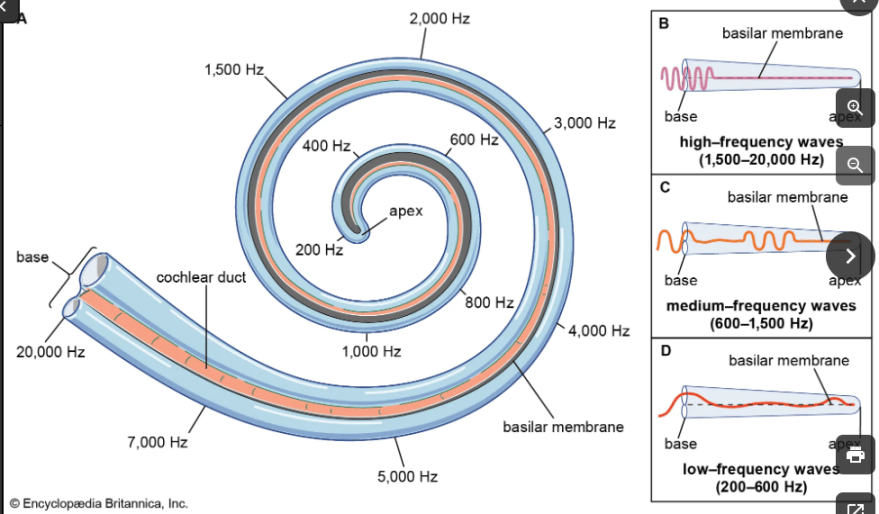
At its apex the canal narrows to a capillary-scale tube that terminates in a true point. Capillary forces, acting together with the gravitational reference of the organism, keep that terminal region open to the larger pressure field of the cosmic microwave background. Pressure is high on both sides of the boundary, yet the vector chirality at the contact surface allows the system to toggle. The resulting vibration is experienced as sound whose pitch shifts with the relative dominance of differentiated versus undifferentiated strands of the internal continuum.
The pineal region functions, in this reading, as a locked gyroscope. It does not primarily generate the reference signal; it registers the pitch that arrives from the cochlear surface and issues continuous micro-corrections. Centroid adjustments follow in the same temporal window, so that the organism remains causally oriented within the present moment. The arrangement is comparable to the echolocation system of a bat, except that the “echo” is the ongoing relation between the internal sphere and the external pressure field rather than an emitted pulse. The image is therefore simple: a sphere resting on a vibrating strand, the whole enclosed by the outline of the body. The sphere’s orientation is known through the sound it produces; the sound is known through the sphere’s orientation.
Balance literature on the autism spectrum is consistent with this picture. Postural and vestibular measures frequently show instability that is not fully explained by cerebellar or motor-control deficits alone. When the conjunctive detectors that couple cochlear surface vibration to the pineal gyroscope are offset, the continuous micro-corrections that ordinarily maintain centroid alignment become intermittent or effortful. The result is a rigid or fluctuating stance rather than an elastic one. The same detectors, however, remain available for deliberate retuning. Because the underlying geometry is continuous with the larger elastic plenum, small adjustments at the level of pitch or ring tension can propagate without requiring invasive intervention.
The practical implication is modest. Controllable thoughts are not an exceptional faculty; they are the ordinary operation of an internal tripwire whose thresholds have been made available to conscious inspection. The cochlear apex, the capillary boundary, the pineal gyroscope, and the centroid that tracks them form a single closed loop. When that loop is clear, pattern can be restored or deliberately shifted; when it is occluded, the same loop continues to operate, but outside the window of deliberate access. The geometry does not need to be invented. It is already inscribed in the form of the inner ear and in the continuous vibration that reports the organism’s place within the larger pressure field.
Note to follow up with an E series page on self sovereign control
Gentlemen; Control Yourselves
E-series · Self-care
The internal tripwire is not an external imposition. It is a conjunctive detector that fires when a set of conditions is met. External signal processing binds features into events; the same architecture operates on internal streams. When the conjunction includes a negative or mismatched state, the detector can lock a rigid pattern. When the conjunction is met under a positive choice of experience, the same detector releases or is simply not engaged.
Choice of Love supplies the added momentum. In the Ace framework the choice is registered as a count^ that incorporates the other dimensional forces already present on the sheet. It is not an extra term invented after the fact; it is the term that is already required for the system to close. Because the count carries the full set, it outweighs any single local tripwire. The enforced thresholds remain in place, yet the added momentum either clears them or renders them non-operative in the moment. The result is self-sovereign operation rather than continuous interruption.
Music supplies the most immediate external field in which this can be observed. A steady 440 Hz reference, automatic pitch correction, and four-chord loops of limited harmonic movement keep the cochlear surface and its associated gyroscope within a narrow, predictable band. Violent imagery supplies a concurrent visual conjunction. Together these inputs raise the probability that the internal detectors will fire on every cycle. The same geometry, however, accepts a different input. When the music itself is chosen for its capacity to keep the surface open and the pitch mobile, the detectors receive a conjunction that includes the positive count. The tripwires either do not meet their threshold or they fall before the advancing front of the count.
The target remains perfection of the closed loop: the sphere on the strand, the man drawn around it, the continuous micro-correction that keeps the centroid aligned. The practical guide is the pattern that consistently returns the system to that loop without residual charge. In the end the love that is made is added to the love that is taken. The source is not exhausted by the addition; the count simply continues.
Guidance
Begin with the choice before the first note or the first image. The decision is not a later correction; it is the term that enters the sum at the start of the moment. When a familiar loop or image appears, note the conjunction it forms with the present state. If the conjunction would raise a tripwire, the choice of Love is already available as the next count. No additional force is required. The existing momentum, once the positive term is included, carries the system past the threshold.
Prefer music whose pitch centre can still move. Fixed references and automatic correction hold the surface at a single station; free or lightly tempered sources leave the capillary boundary free to report its actual relation to the larger field. The same principle applies to imagery. A single violent frame supplies a strong conjunctive cue; its absence leaves the detector without that particular match.
The pineal gyroscope continues to register the surface vibration whether or not the choice is made. The difference appears only in the subsequent centroid adjustment. When the positive count is present, the adjustment remains continuous and low-amplitude. When it is absent, the same gyroscope must issue larger corrections after each tripwire fires. The former state is simply less costly.
Return to the same sheet at the end of the day. The count that was added is already part of the sum. No further accounting is required. The next moment begins with the same option: the positive choice entered before the detectors are asked to decide. The loop remains closed, the sphere remains on the strand, and the man drawn around it continues to stand.

