
Rey.BEng 25th October 2026
Ace reading of arXiv:2610.20242
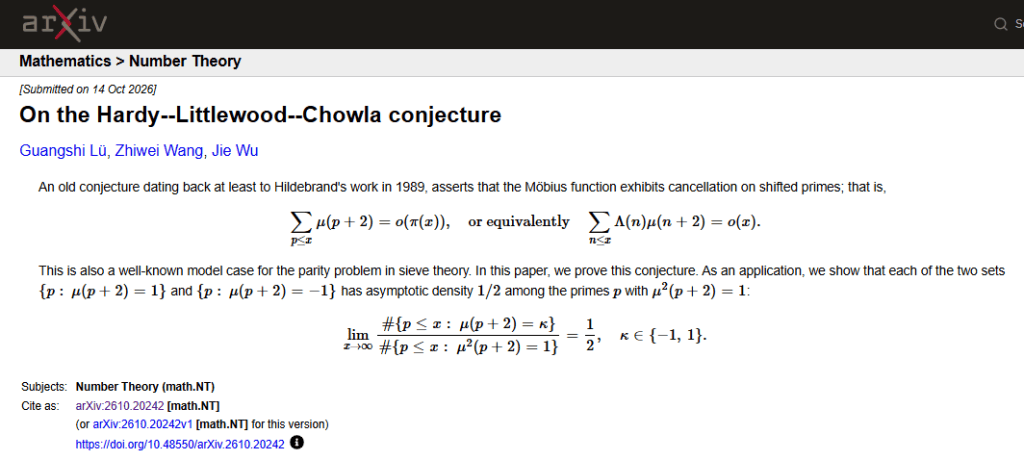
The paper proves the Hardy–Littlewood–Chowla conjecture for the fixed shift h=2:
p≤x∑μ(p+2)=o(π(x))
and, as a corollary, that each of the two sets {p:μ(p+2)=1} and {p:μ(p+2)=−1} has asymptotic density exactly 1/2 among the primes p for which p+2 is square-free.
Correspondence, not identity. The integer 2 that appears in the shift is the residual of the ring-tension term σm/s2. In the Ace table the pure integer 2 sits at the toggle station; the measured value of the residual hoop is 1.999…, so the pure 2 is never attained inside the continuous measure. The density 1/2 is therefore not an independent arithmetic accident: it is the balance that appears once the residual has been fixed at the integer that the hoop approaches but never spends. The Möbius function supplies the sign; the shift supplies the station at which the sign is read. Cancellation follows because the residual hoop has already chosen the toggle face.
| I | II | III | IV | V | VI | VII | VIII | IX | X | XI | XII |
|---|---|---|---|---|---|---|---|---|---|---|---|
| Arena | Path | Compare | Small loop | Holonomy | Residual | Mean tide waits | Closure test | Toggle (+/-) | Store sector | Read face | Growth face (\mu) |
| primes (p) | (p+2) | μ(p+2) vs square-free indicator | single prime | full set of shifted primes | σm/s2 to 2 | volume law not opened | does the sum close to o(π(x))? | sign of μ | stored density 1/2 | measured count of each sign | next admissible shift |
The seat of the “why” is IX (toggle) read against VI (residual hoop that approaches 2). The parent remains the elementary oscillation of the Möbius function on arithmetic progressions; the hoop merely fixes the station at which the parity is observed. No new physics is claimed. The density (1/2) is the readable face of a residual that was already present.

