
3rd June 2026
Reynolds BEng, Ace-Consultancy.uk
Series: Reality Engineering / Pirate Canon Framework – First Principles Vessel Analysis
1. Hinkley Point B (HPB) features twin Advanced Gas-Cooled Reactors with large prestressed concrete pressure vessels (PCPVs) of cylindrical form. These vessels have thick cylindrical barrel walls, flat top and bottom slabs, and an internal steel liner. They operate as single-cavity designs containing the core, boilers, and CO₂ coolant under pressure.As decommissioning progresses following the recent ONR consent, the long-term behaviour of these ageing prestressed concrete structures is of particular interest — especially regarding prestress losses, creep, shrinkage, and reduction in cementitious bond elasticity.
2. First-Principles Geometric Context
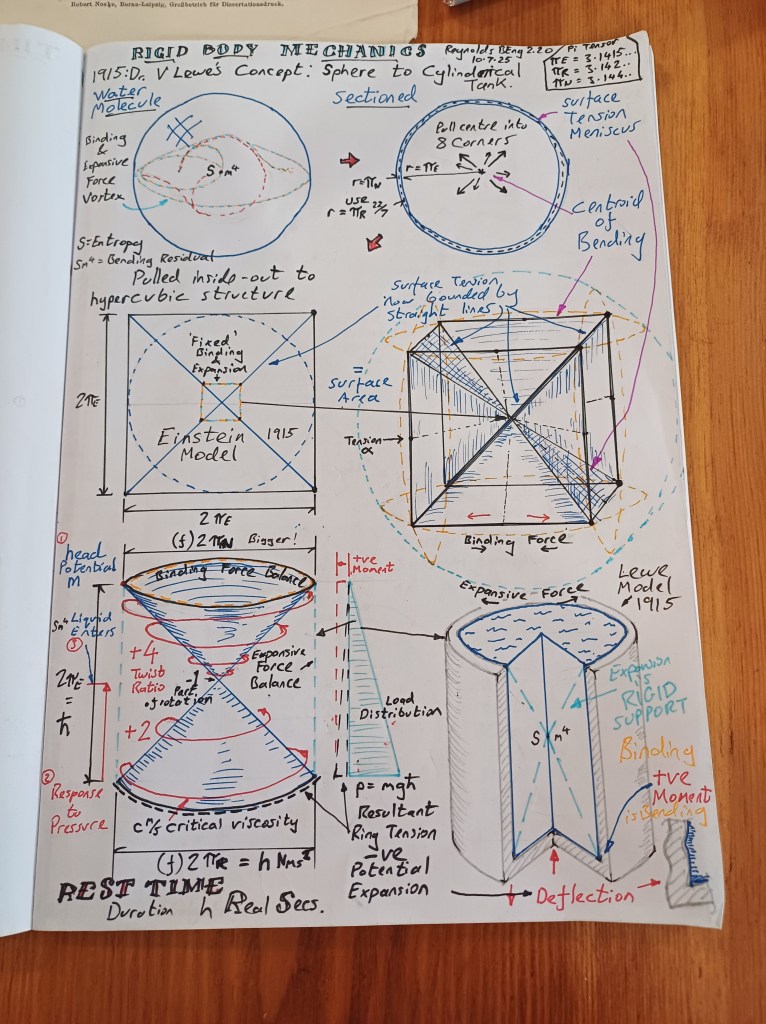
Coefficient tables commonly used for cylindrical and ring structures (e.g., those in PCA publications for circular tanks) have historical roots in the elastic shell and matrix methods of Dr.-Ing. Viktor Lewe (1915). These tables incorporate approximations of 3-6-9 strain progressions and introduce scalar simplifications that tend to produce more conservative (material-heavy) designs.
In the Lewe elastica framework, cylindrical shells exhibit natural ring-tension behaviour under internal pressure and rotational symmetry. The Pirate Canon approach further explores π-tensor geometry, dilatancy transitions, and potential bistable dynamic responses (sometimes referred to as “ring-tension judder” or pulsing in an elastic plenum).
Note on terminology: These concepts are presented here as part of an ongoing first-principles exploration and are not standard industry terms.
3. Prediction – The Re-emergence of Dynamic Behaviour (Conjecture)Core Conjecture (observational and potentially falsifiable): As the elasticity of the cementitious matrix and bond declines with age-hardening, creep, and progressive prestress losses, suppressed microcracking is expected to propagate toward macro-scale cracking. Specific predicted patterns in the cylindrical vessel include:
Predominantly vertical (straight up and down) cracks along the barrel.
Circumferential (ring) cracking, particularly near major conical inflection or transition zones.
Overall geometric ordering that may align with hexagonal frameworks in plan view.
It is further conjectured that the concrete cylinder will increasingly “flex against” the prestressing tendons and steel liner as the cement bond weakens. This could lead to a re-emergence of low-level dynamic or pulsing behaviour (periodic stress redistribution or micro-displacement cycles) whose amplitude grows as elastic modulus reduces.
Important Clarification:
This pulsing / re-emergent dynamic behaviour remains a hypothesis derived from geometric first-principles analysis. It is not yet observed or confirmed in HPB vessels. Mainstream literature attributes ageing effects primarily to standard creep, shrinkage, tendon relaxation, and irradiation-induced changes.
4. Observational Falsifiability
This conjecture can be tested during decommissioning through detailed mapping of crack orientation and propagation paths, monitoring for periodic stress/strain responses, and direct comparison between conventional coefficient-based models and Lewe-derived geometric/tensor approaches.
5. Implications
Should the observed behaviour deviate from original coefficient predictions in the manner conjectured, opportunities may exist for more precise integrity assessments and optimised decommissioning strategies. This also supports continued dialogue on explicit historical referencing of elastic shell methods such as Lewe’s work.
Technical Notes 1–6 in this series provide supporting detail on provenance, scalar vs. geometric comparison, and related considerations.
The cylindrical geometry of HPB’s vessels makes them particularly well-suited for observing ring-tension behaviour. If the first-principles view holds, the “pulse” is not a sign of imminent failure but rather the reassertion of natural geometric mechanics as the structure ages. Careful monitoring during decommissioning could provide valuable data for the wider civil engineering community.
Ace Consultancy; Coefficient-Free Living for Life

