
Rey.BEng 9th November 2026
As above, so below
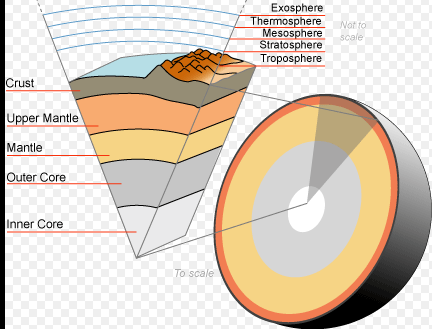
Just as true polar wander has to contend with the equatorial bulge, we might ask how cratonic keels, the thick, cold roots of lithospheric mantle beneath the old stable cores of the continents, affect the net rotation (NR) of the lithosphere.
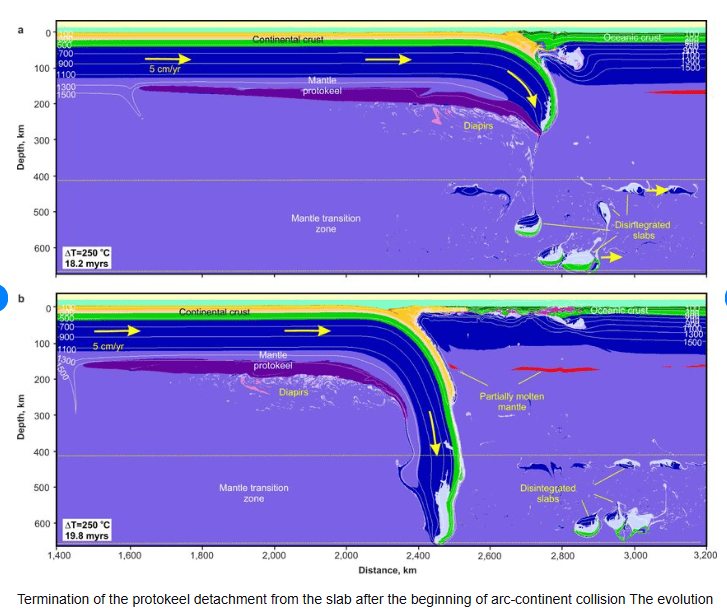
Zhong (2001) tests how what he calls continental keels affect plate motion and net rotation of the lithosphere in three-dimensional spherical shell models of mantle convection. Flow is driven by slab buoyancy, and the mantle flow is treated as an incompressible Stokes flow. Plates have strong interiors, about 3 x10²³ Pa s, and weak margins, about 1021Pa s, each margin 400 km wide, over an upper mantle of about 1020 Pa s.
Keel geometry follows S-wave tomography beneath old cratons, and keel depth is varied because it is poorly constrained. Net rotation is defined as the degree-1 toroidal component of plate motion relative to a nonrotating mantle, and their Appendix A gives the method for removing rigid-body rotation from any velocity field in a spherical shell. Neither weak margins nor a tenfold stiffer continent produces net rotation. Keels change this. Keels 300 km deep over a uniformly weak upper mantle produce lithospheric rotation relative to the mantle, about a pole at 50°S, 143°E. This contrasts with the observed pole, taken from Gordon and Jurdy (1986), which lies at 40°S, 37°E. Below about 300 km depth the rotation rate no longer changes: the mantle there turns together at a small, steady rate that is not zero.
The author reads this as the difference between the lithosphere and the deep mantle being taken up in a layer about 200 km thick in the weak upper mantle, where the rotation rate fades gradually from the lithosphere’s value to the deep value. The lithosphere therefore rotates mainly against the high-viscosity lower mantle, which serves as the reference. The lower mantle turns slightly the opposite way about the same axis, so its pole lies at the antipode of the lithospheric one. Keels extending to 410 km reach a transition zone 30 times more viscous than the upper mantle. Continental motion slows through coupling to the transition zone, and net rotation rises close to the observed rate, about a pole at 42°S, 103°E. A third case keeps keels at 300 km but raises upper-mantle viscosity tenfold between 200 and 410 km. This slows oceanic and continental plates alike, so net rotation stays near the shallow-keel value.
Becker (2006) tests how temperature- and strain-rate-dependent viscosity changes global mantle flow and net rotation of the lithosphere. Temperature is inferred from a tectonic model and seismic tomography. Under this structure the mantle beneath oceans is about an order of magnitude weaker than beneath continents. Once net rotation relative to a stable lower mantle is removed, upper-mantle flow patterns look much the same whether viscosity varies only with depth or also laterally. The results confirm and extend Zhong (2001). Becker reads Zhong’s study as showing that strong roots and weak plate margins can drive NR, and that the deepest roots, reaching 410 km, give the largest NR. In Becker’s models, weak zones with strain-rate weakening alone barely excite NR, and the poles fall far from hotspot estimates. Temperature-dependent viscosity moves the pole toward that of HS3, the hotspot-frame model of Gripp and Gordon (2002), at 56°S, 70°E. Power-law creep, in which strain rate rises with stress raised to a power, so that viscosity drops as the mantle deforms faster, raises the amplitude further because it generates toroidal motion more efficiently. Becker reaches his highest amplitudes with roots no deeper than 300 km, and notes that “the rheologies employed in this study lead to somewhat larger NR amplitudes” than Zhong’s.
The layers are viscous and reference the layer beneath. The keels are material breaking through in like slow-motion turbulence. These waves lock into the lower reference layer, giving grip between them. Each layer outwards is getting more viscous, but the boundaries must be turbulent, not laminar. The shear flow through the boundary is a 90° point load: heat doing work.
At the centre of Earth is an immovable geometric option. It is static, except that it goes through two states. A hemispherical bubble gets squashed flat to a circle and then pops back into existence. Within lies the Ace geometric object, the piTensor. Why does it exist specifically at the centre of Earth? Does it exist anywhere else? Earth is the Cosmic Centroid; the axis of the observable universe. Yes. Everywhere, but only because the one at the centre of Earth exists, as the transformer of rotation into Life.
Keels as Concretions: Locked Twist, Forced Negative Dot Points, and Two Modes of Failure
Bodur and Flament (2023) note that kimberlite ascent through the lithosphere can take as little as hours, which they call “instantaneous compared with the timescale of mantle convection”. These volatile-rich igneous rocks matter because they carry fragments of the mantle, called xenoliths, up to the surface. Paul, Conrad & Torsvik (2026) point to a link with tectonics, noting that “the association of kimberlite eruptions with continental break-up events… may also help to explain the origin of kimberlites.”
Gernon et al. (2023) develop that link at the scale of the whole plate system. They report that “…pulses of kimberlite magmatism correspond to episodes of global plate reorganization, with comparatively few kimberlite eruptions occurring during periods of supercontinent stability.” They read this timing as a clue: “This synchronicity may suggest that kimberlites are triggered by tectonic disturbances in cratonic lithosphere or by abrupt changes in plate movement.”
The proposed mechanism is the removal of the deep cratonic keel. As they put it, “petrological observations and dynamic models indicate that substantial removal of cratonic keel (tens of kilometres thick) can occur abruptly…” Such a loss should leave a trace in the rocks, and southern Africa provides the example: “If several tens of kilometres of cratonic keel are removed, this should be detectable using geochemical and geophysical constraints. Taking southern Africa as an example, geochemical studies of peridotitic xenoliths and garnet xenocrysts independently invoke loss of 30–40 km of lithosphere, which was coincident with massive kimberlite volcanism…”
Ace Reading
The keels are concretions. The conjecture is that they are caused by a negative vector enforced into magma flow by concrete structures built on the surface. Project 3 states the claim and keeps to it: the strength of hardened cement paste is the strength of water, trapped. The starting point is Osborne Reynolds’ singular surface of misfit. In a constrained close pack, neighbours cannot change place without opening volume. That un-geared interface is a surface. Water is the ordinary material that can occupy the opening, carry stretch, and return compression. Hydration then stitches the opened contact into a stiff shell. The stitch stops the living slip–grip cycle. What remains is high compressive and hoop capacity, a locked ring-tension residual (\sigma_R), and almost no duration left for the surface to stretch instead of fracture. That is why concrete is strong, and why it is brittle.
The force of twist in water is locked, instead of slip and grip. This energy must be spent. The forced negative dot points act on the shell surface upon which they stand, and lock in response to the locked water above. Water must flow. That is a universal law of time.
Two modes of failure remain. Catastrophic: the locked residual releases as abrupt keel removal, kimberlite ascent on the timescale of hours, plate reorganization, and the simultaneous failure of the surface concrete and asphalt that enforced the negative vector. Gentle: the same release distributed as surface damage, the concrete and asphalt failing together as the locked twist finds its duration again, the misfit surface reopening without the full rupture of the lower reference layer.
The Ace geometric object remains the piTensor at the centre. The immovable option is static except through its two states. The hemispherical bubble is squashed flat to the circle and pops back. The keels are the concretions of the spent residual. The residual stands or is spent. The invitation remains open.
The residual stands. The card is ♧. XII remains the Face. The invitation remains open.

