
Ace reading of the catenoid
linkhttps://x.com/PhilosophyOfPhy/status/2117206134717329662?s=19
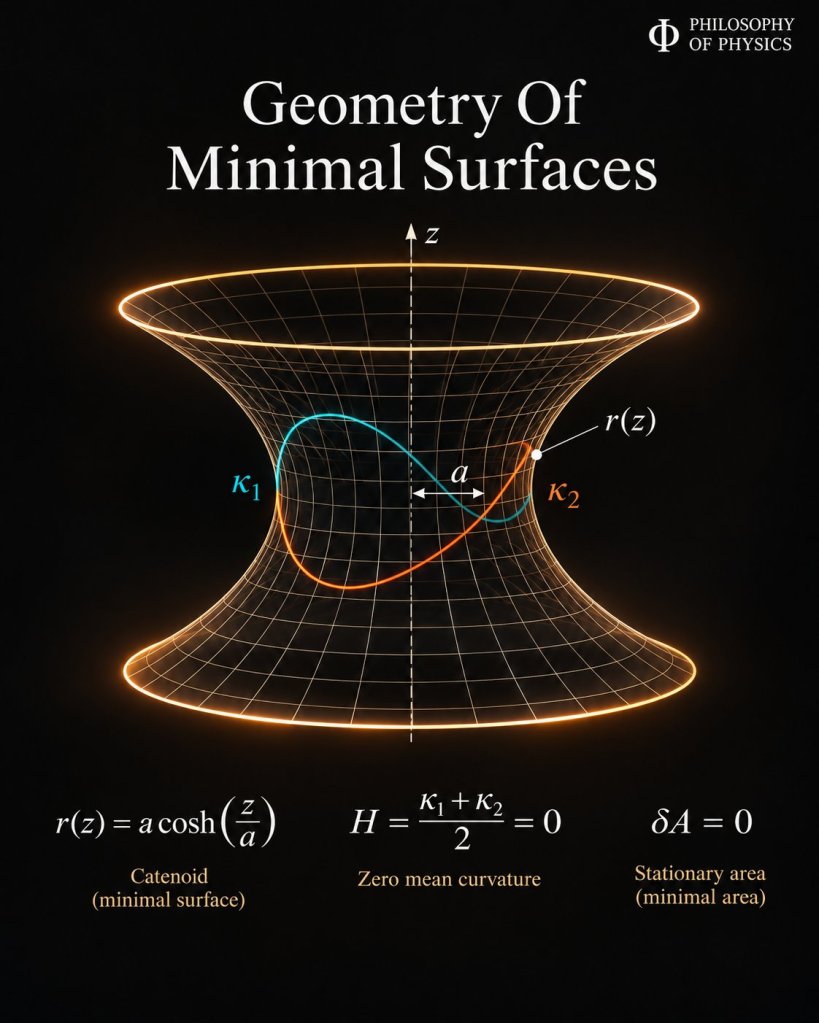
The visualisation shows a soap film spanning two parallel circular rings. The surface that forms is a catenoid, the unique non-planar surface of revolution with zero mean curvature.
The governing equations on the figure are:
r(z)=acosh(az)H=2κ1+κ2=0δA=0
Here (a) is the neck radius, κ1 and κ2 are the principal curvatures (equal in magnitude, opposite in sign), and the area is stationary under the surface-tension constraint.
Correspondence, not identity. The two rings are the two hoops. The surface stretched between them is the residual figure that remains after the rings have been fixed. That residual is read as : the hoop tension that has units of acceleration and that balances the opposing curvatures so that the mean curvature vanishes. The stationarity condition δ= 0 is the statement that the residual has been spent to a stationary value; no further area can be lost while the rings remain in place.
The continuous deformation that takes the catenoid into the helicoid introduces a 180° twist. When the acceleration residual is stretched to the limit of that deformation, the surface becomes one-sided. That is the Möbius strip generated from the same pair of hoops: the twist is the involution of the twin faces, and the residual is the quantity that is conserved through the deformation.
| I | II | III | IV | V | VI | VII | VIII | IX | X | XI | XII |
|---|---|---|---|---|---|---|---|---|---|---|---|
| Arena | Path | Compare | Small loop | Holonomy | Residual | Mean tide waits | Closure test | Toggle (+/-) | Store sector | Read face | Growth face (\mu) |
| two rings | axial generator | κ1 vs κ2 | neck radius (a) | full catenoid | σm/s2 (hoop residual) | volume law not opened | does (H=0) close? | sign of each principal curvature | stored neck | measured radius (r(z)) | next separation or helicoid twist |
The seat of the residual is VI. The seat of the Möbius limit is the same residual read after the acceleration has been stretched through the continuous family that joins catenoid to helicoid. The parent remains the elementary balance of principal curvatures; the hoops merely fix the stations at which that balance is observed.

