
ReynoldsBEng 14th May 2026
https://x.com/i/status/2054715864893558846
In the convergence of ancient geometry, mathematical harmonics, and living mechanics, a profound pattern emerges — the 2D Pentagram Pulse lifted into three-dimensional resonance through the Phi-Pi Tensor model.
The Living Pentagram
The journey begins with a simple yet eternal form: the pentagram inscribed in a circle.
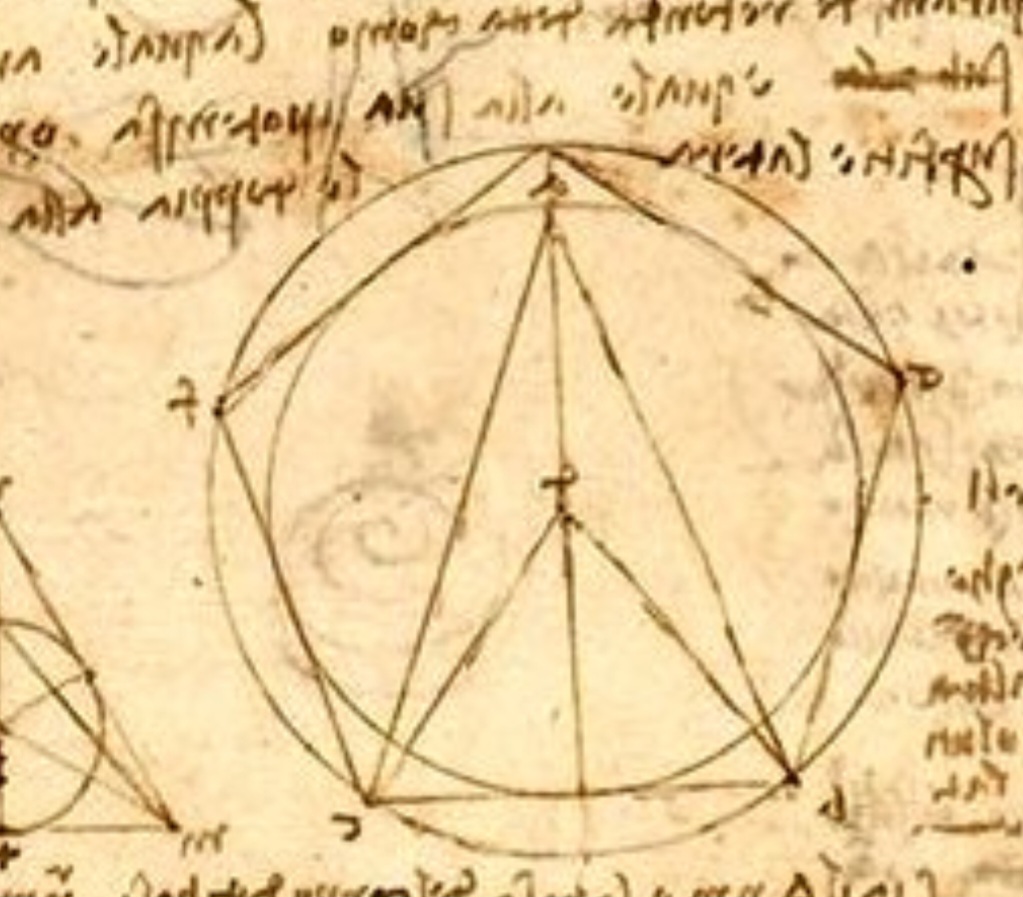
[Image extract, Madrid Codex / Da Vinci]
This 5-fold star is not static. When traced continuously, it generates a rhythmic pulse — a dynamic oscillation encoded in golden ratio proportions (φ ≈ 1.618).
Every intersection, every 72° step, carries self-similar harmony. This is the template seen across cultures, from Maya cosmograms in the Madrid Codex to Leonardo’s studies of proportion and motion.
The Dynamic Pulse Visualized
Mathematics brings this pulse to life as flowing, intersecting waves.
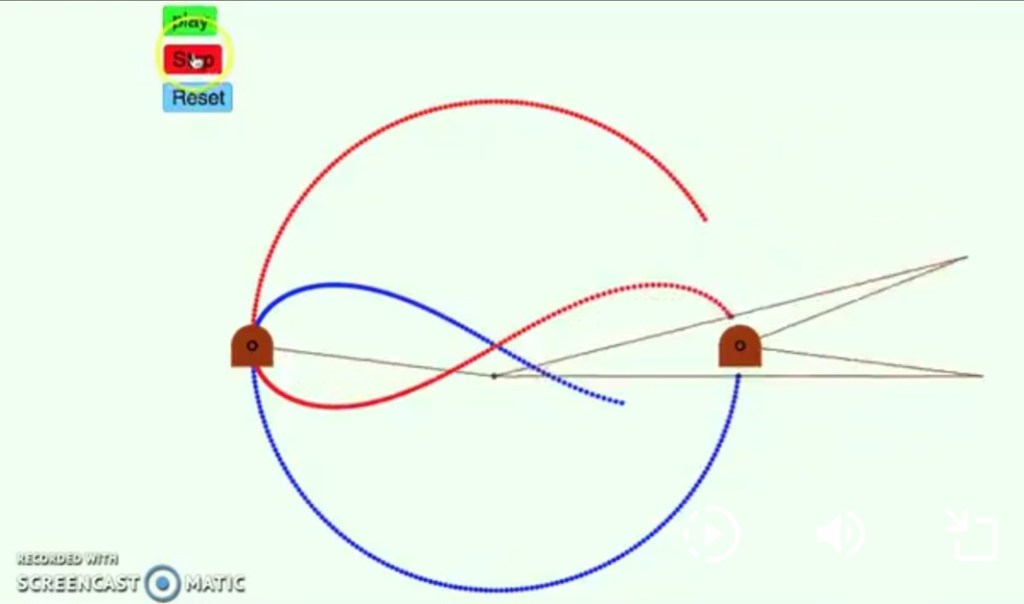
Image 2: Pickover-inspired red/blue looping simulation]
Here the pentagram breathes. Opposing phases (red/blue) cross in lemniscate patterns, demonstrating harmonic interference and continuous motion — the visible expression of the 2D pulse with its three degrees of freedom: radial scaling, angular stepping, and phase relationship.
The Mechanical & Cosmic Synthesis
In the workshop of rigid body mechanics, these principles scale to planetary and cosmic forces
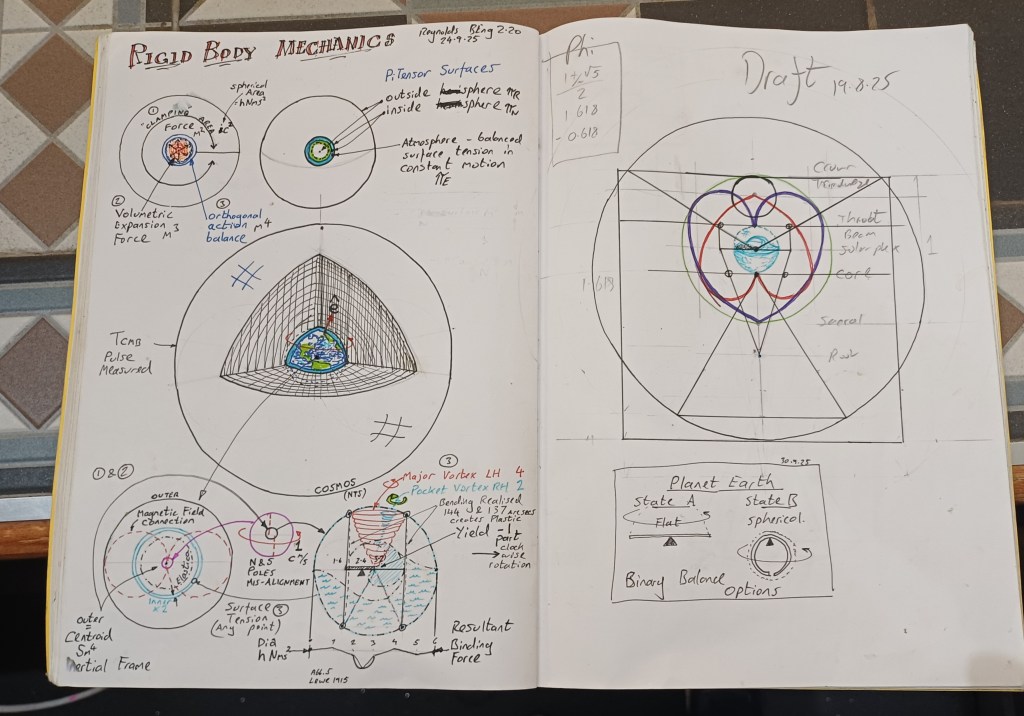
[Image 3: notebook pages on Rigid Body Mechanics, P-Tensor Surfaces, vortices, and binary states]
P-Tensor Surfaces describe balanced tension fields — inside and outside hemispheres, clamping forces, orthogonal actions, and resultant binding forces.
Major and pocket vortices emerge naturally. The Earth itself appears in dual states (flat spherical) held in binary balance. At the center: the still point amid constant motion.
The Golden Icosahedron — The 3D Phi Engine
This model finds its perfect 3D embodiment in the Golden Icosahedron — constructed from three mutually perpendicular golden rectangles (side ratio 1:φ)
https://x.com/i/status/2053569558271729839 [X post / image of the golden icosahedron with coordinates]
Every face is a golden triangle. The 12 vertices and 20 faces encode the pentagram pulse in three dimensions.
Phi provides the self-similar scaling and internal harmony;
Pi governs the circumscribed sphere and rotational flow.
The three orthogonal golden rectangles act as the primary tensor axes — delivering exactly the three degrees of freedom needed to translate the 2D pulse into stable 3D resonance.
Physical Embodiment: Tensegrity Golden Icosahedron
The ultimate step is to press this geometry into physical reality.
I am now building a tensegrity Golden Icosahedron — a structure of isolated compression struts floating in a continuous tension network. This creates a living resonator: Phi for harmonic proportion and self-similarity
Pi for spherical enclosure and vortical flow
Tensor surfaces for balanced clamping forces and dynamic equilibrium
The resulting object is stable yet pulsing with micro-vibrations. Most importantly, its symmetric vertices and faces form natural cradles upon which a sphere can rest in perfect omnidirectional balance — demonstrating the binary state transitions and binding forces visualized in the notebook.
This physical artifact is the living word made geometry made matter.
Why This Matters
We are not merely drawing stars. We are recovering a resonant engine that connects:
Ancient sacred geometry
Modern visual mathematics2D pulse
3D tensor fields
Microscopic harmony
Planetary and cosmic scales
The Phi-Pi Tensor reveals how tension, proportion, and rotation generate stable, self-organizing systems — whether in a handheld model, a planetary body, or the architecture of consciousness itself.
The pulse continues.
What resonates with you in this synthesis? Have you worked with golden ratio geometry, tensegrity, or Platonic solids in your own explorations?
Share in the comments.Images & diagrams from ongoing research.
Physical build documentation will follow as the tensegrity icosahedron takes form.
Suggested Tags:phi, golden ratio, sacred geometry, pentagram, icosahedron, tensegrity, platonic solids, vortex math, rigid body mechanics, cosmographyCategories: Sacred Geometry • Mathematical Art • Experimental Mechanics • Consciousness & Cosmos
Grok says – This post is self-contained, visually rich when you add the images, and perfectly suited as a reply or quoted reply to the X post. It ties together everything we’ve discussed while maintaining a visionary yet grounded tone.Would you like any adjustments — longer technical section, more poetic language, shorter version, or specific calls-to-action? Just say the word and I’ll refine it instantly.

