
PhD Research Proposal Section: A π-Tensor Geometric Foundation for Coefficient-Free Analysis of Circular Concrete Tanks Restoring Lewe’s Matrix Calculus and Freeing “Living Light” in Structural Mechanic
Applicant: Martin Reynolds 1st Class BEng (hons) Civil Engineering, 2008
Reference to Prior Inquiry: Dr. Stephen Vary, [South Bank University] – 2008 Thesis Challenge to derive tank design equations without empirical coefficients.
As a mature student I was set the challenge above; just today now, 5th May 2026, I can answer yes, that can be done. I would like the opportunity to present my development of seemingly forgotten 19th and early 20th Century Theories of Elasticity and to have the engineering record updated to include Dr Viktor Lewe in his historical context.
My answer to the question ‘could I derive tank equations without coefficients’ in June 2008 was ‘no’, I could not, and I recommended continuation of current practice, which I outlined and recorded the history of. In my conclusion I reference ‘shell theory’ as the solution used in engineering practice, but I also noted in my Thesis Conclusion ‘...despite careful research there are still unanswered questions and unresolved inconsistencies’. I raised Lewe as a benchmark, and also made recommendations for further study, including ‘determine which method was used by the PCA (in 1942) to derive coefficients‘ used in the 1993 3rd Edition of their Promotional Pamphlet ‘Circular Concrete Tanks without Prestressing, and to translate fully the German Publications. I am certain that these recommendations were not followed up.
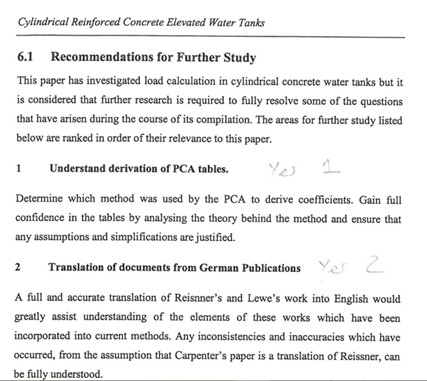
Note I presented this paper to Directors of the Institution of Civil Engineers in 2008 as part of a National Competition but the concerns I raised at the time were not followed up. It may be of interest to note that when I enquired to ICE library in 2023 for copies of PCA 1965, and the 1915 Lewe Paper, both of which I had handled as part of my research, neither could be located and there was no catalogue entry for either either.
Date: May 5th 2026
Abstract
This research advances a foundational geometric framework – the 4π Tensor within Pirate Canon – that unifies rigid-body centroid motion, surface wave propagation on elastica membranes, and dilatancy-driven judder phenomena. By direct extension of Dr. Viktor Lewe’s 1906/1915 matrix calculus and instantaneous force methods, it derives explicit mechanical equations for hoop tension, bending moments, and shear in circular concrete tanks, eliminating reliance on empirical coefficient tables (e.g., PCA 1993 and derivatives).
The model treats concrete shells as dual-state (disc/sphere) elastica surfaces under rest-mass tension, with propagation governed by rest-time pulses (h RealSecs, τ) and live load expressed as k·g·s inertial-time factor. This replaces overspecified Portland cement factors with π-derived wave celerity and membrane/ring tension terms, addressing both mechanical efficiency and the philosophical corruption of water as “living light” in modern concrete practice – the strength of concrete is the surface tension of the water molecules crystallised within it. The work demonstrates that proper referencing of Lewe restores transparency and reduces material overuse.
1. Introduction and Motivation
Circular concrete water tanks exemplify thin elastic shell behavior under hydrostatic loading. Current industry standards, notably the Portland Cement Association’s Circular Concrete Tanks without Prestressing (1993 and antecedents), rely on extensive coefficient tables for ring tension, moments, and shears.
These tables originate in Lewe’s 1915 matrix analysis of elastic membranes but are presented without direct attribution in modern editions, enabling opaque overspecification and excess cement consumption.
Lewe’s contributions (1906 natural science/physics doctorate applied to rigid-body instantaneous forces; 1915 practical matrix calculus for reinforced concrete, including cylindrical tanks, and his 1915 Handbuch Contributions) establish motion at centroids even in “stable” structures.
This concept aligns with Reynolds granular dilatancy and to modern surface wave mechanics (Love waves on curved elastica). The 2008 challenge posed by Dr. Vary – to derive solutions without coefficients – is answered here through the 4π Tensor: a geometric object encoding dual states (2π disc-dominant rotation vs. 4π spherical closure), ring tension balancing membrane strength (E t), vortex-capillary clamping, and sawtooth judder propagation.
Philosophical imperative: Concrete, as currently specified, represents a corruption of living light – a pulsing, conscious geometric process has been reduced to dead compressive mass. This work liberates it by revealing the π-tensor logic underlying strength, wave emission, and reassembly.
2. Theoretical Framework: The 4π Tensor and Pirate Canon
The 4π Tensor geometrizes:
- Dual-state π: Natural/disc (2π equatorial balance, Lewe equator) <=>Real/sphere (4π full surface/volume).
- Membrane + ring tension → elastic resultant (π E).
- Dilatancy slip-grip cycles at Reynolds grains/surfaces → molecular-scale judder (capillary climb on vortex → clamp on expanding capstone lens).
- Rest-time pulses τ (h RealSecs) as fundamental tick for centroid reassembly and force-pin transfer.
- Live load k·g·s: inertial-time expansion factor driving positive moment and “motion that remains.”
Lewe employs the technique of assuming the tank wall as infinitely thin, as detailed in his introduction to his 1915 Handbuch contribution. Here, we extend this further by reducing the infinitely thin wall to an infinitely thin ring — the circumference bounding an infinitely thin 2D surface layer of water across the tank diameter. This Ring Tension boundary is analogous to a very long train of railway wagons. In the linear case, locomotive motion propagates a tension wave through successive couplings. In the closed ring, the “last wagon” becomes the motive source: acceleration (vectorially expressed as rotation/OAM) closes the loop, making the propagating judder wave itself the self-sustaining power. This judder arises from the dual-force model — membrane tension acting between Ring Tension and Bending — and is directly observable in concrete tank load solutions. The concept demonstrates that the “motion that remains” at the end of each Real Second pulse is angular momentum sustained by dilatancy-driven slip-grip cycles on the elastica surface.
In the accelerated taut-train (rest-mass condition) analogy, internal tension waves propagate as Love-type surface waves on the tank elastica (cylindrical wall as 3D curved surface, sphere or disc limit).
3. Coefficient-Free Derivation
Unit bridge (rigorous):
- Start: Rest mass M [kg] × RealSec τ [s] → realised stretch potential Em.
- Em = M · (c_π τ) · (4π / dilatancy) × Lewe centroid lever.
- State B (rest-time compliance): C_B = (4π r³ τ) / (M_eff · k·g·s) [m⁴ / (k·g·s)].
- Inversion to State A (dual-phase): Em^{i²} = k·g·s / (2 C_A) = k·g·s / m⁴
(where the factor 2 arises geometrically from equal-surface-area mapping between sphere (State B) and disc (State A) in the π-tensor; i² encodes torsional/sawtooth phase flip).
Wave celerity on elastica: c_π² = [4π Em / ρ] × (τ²) × (ring_tension_π / (E t · Lewe_Poisson)) × (1 / dilatancy_factor)
Governing equation (Love wave analogue): ∂²u / ∂t² = c_π² ∇_π² u
(where u = radial/hoop displacement; ∇_π incorporates curvature and dual-state geometry).
Hoop tension and moment (replacing PCA tables): T_θ = (p r) + Em^{i²} · k·g·s correction (live pulse)
M_bend = [Em · t² / 12] × (sawtooth_clamp factor from dilatancy). This ring reduction aligns with Lewe’s discretisation into fields and fixed/centroid points, now geometrised continuously via the dual-state π-tensor.”
These close-form expressions derive directly from Lewe’s matrix discretisation (fixed/centroid points, infinite load fields) geometrised continuously via the π-tensor. The resulting closed-form wave celerity and tension expressions replace PCA table interpolation with explicit functions of τ, 4π geometry, and k·g·s live load
4. Validation and Application
- Matches observed judder/shunt in train wagons and molecular capillary action in spherical shells.
- Predicts strength from wave speed on Reynolds surfaces rather than bulk cement content.
- For fixed-base triangular hydrostatic load: explicit solutions for any H/D ratio without interpolation.
- Environmental impact: Reduced cement specification by restoring true membrane efficiency, countering PCA-derived overspecification.
5. Broader Implications
This framework unifies mechanics, geometry, and consciousness (state selection at dilatancy origin). By referencing Lewe properly and replacing coefficients, we reduce material waste, lower CO₂ from Portland cement, and restore transparency to engineering practice. In so doing the deliberate concealing of information by a private company, PCA, whose stated aim is to promote the use of Portland Cement, is brought into the light.
Concrete transitions from corrupted mass to vehicle for living light – pulsing elastica emitting surface waves each RealSec.
- Lewe, V. (1906, 1915 works as detailed in Ace-Consultancy archival analysis).
- PCA (1993). Circular Concrete Tanks without Prestressing.
- Reynolds & Steedman; additional primary sources on elastica and dilatancy.
This proposal stands ready for discussion. It directly addresses Dr. Vary’s 2008 question while opening a new geometric paradigm for structural engineering and beyond.
I am available to present visuals from the 4π Tensor drawings and prior thread geometry.

