
The issue by the Portland Cement Association, Illinois of the 1942 Document, Circular Concrete Water Tanks without Prestressing, broke the link between Engineering and Physics in order, I believe, to protect the secrets of the Atomic Bomb. Lewe’s 1915 Physics dissertation presented to Engineering is used directly to produce the extensive tables of coefficients which form the bedrock of the concrete design practice in this book but is not referenced. The 1993 reissue, the last, makes no attempt to rectify the reference omission. See below my plea to co-author Dr Augustus Domel, where I asked for help to correct the scholarly record, and which had been met by the publisher with ‘PCA considers this matter closed‘. I hoped that as an Engineer he would see the risk to fellow professionals using his work, and also would be interested in updating with new information. I received an ‘out of office’, then nothing.
All the Engineering Institutions equally take the same approach and their doors have remained closed to me ever since. I have tried to use my elected representatives to press the constitutional case but my MP refuced to help and my MSP cancelled a meeting with me once I told him I wanted to discuss Lewe. I conclude then that Lewe must not be referenced; the secrets must remain sealed regardless of any other considerations, no matter how existential to continued human experience.
In my email, there are dozens of message I sent, and a record of the response or, more usually, lack of response. Below is just a sample of the more pertinent.
On Tue, 13 Jun 2023 at 14:12, Reynolds < > wrote:
(various cc from PCA, ASCE and ICE included for information of progress)
Dr Domel
I am attempting to correct the scholarly record for the design practice of concrete water tanks and I wondered if you could assist? The PCA document currently in service ‘Circular Concrete Tanks without prestressing’ has two serious referencing flaws that I believe make the document illegal, and may put the careers of engineers at risk. See below response from PCA who consider the matter closed but I am concerned they are not seeing the impossible position in which they have placed Engineers who have relied on their work. Also below see email chain demonstrating efforts to get concerns elevated for action to right person.
I note that yourself and Anand B Gogate are assigned as writers in 1993 (although this may just be for updates, as the document is very similar to 1965 edition, but perhaps you could confirm involvement with earlier editions?).
The information I seek, and that I believe should be clarified if the document is to be of any value to engineers in future, is as follows:
- What are the edition dates, and when first published?
This is standard established publishing practice and I am surprised that the PCA have deviated from it. In 2008 I used a hard copy of the 1965 edition of ‘Circular Concrete Tanks without prestressing’ located in the ICE library in London. (see references from my thesis attached) and if I recall correctly, this earlier version included information about the first issue in 1942, so this has been excised in 1993.
To tie down date of original issue of coefficient tables, in 2008, I tracked through the sole reference to G.S Salter (not Slater as shown below from 1993 edition)
I read this complete series of letters and discovered that the table was likely issued by PCA in response to concerns expressed by engineers about lack of confidence in using complex equations. They took the opportunity to formalise the practice, but this also meant their work was the primary reference, so Lewe could be kept buried and the PCA had control. From this information I assumed that the whole document was issued in 1942, but it may have been just the Appendices with the coefficients. Can you confirm any history of editions?
- What is ‘the theory’ referred to in the note from 1993 edition?
All other concrete tank design publications discuss openly that the design procedure is based on shell theory (often citing Timoshenko as I did (see my references attached). The PCA doc also references Timoshenko but I have not been able to locate the direct reference in the text, so in 2008 I presumed some connection to coefficient derivation. I presume also therefore that ‘The theory’ referred to in the note (which is in place of the edition list in 1993 issue, see above) is membrane theory, which is an extension of shell theory, and is used by Theoretical Physics in the production of nuclear weapons, among other things.
Any Engineer with a working science knowledge will be aware of membrane theory, it is not a secret, so why not say so? If it is not membrane, state which theory of structural analysis is utilised and so allow the Engineer to make their own assessment of its validity to their own competence as required by the PCA document, use of which means accepting ‘total responsibility’. I would urgently advise all PROFESSIONAL PERSONNEL to delete this document as a design guide until corrections are made, missing info supplied, and legal status of LIABILITY and RESPONSIBILITY confirmed.
- Confirm derivation of coefficients – without a stated source declaring any simplifications or assumptions, the tables should be regarded as meaningless by a competent engineer.
From my research in 2008, there is a direct link from the 1942 PCA table to earlier work;
W.S Gray’s book Reinforced Concrete Reservoirs and Tanks 1931(as referenced in PCA doc, 1993)
From above book there is a reference to the companion book’s Appendix by Henry Carpenter (see my attached references, but original issue 1931) where he states Reissner’s work
From above to Henry Carpenter’s 1927 article (see references) where Dr Lewes (misprint or clue?) is credited.
Then to 1915 and Dr V. Lewe’s handbook (also reprint 1923) using graphs to derive coefficients, and finally to Lewe’s dissertation – the underlying theory referenced in the text of the 1915 foreword by Lewe himself.
From these reference links above can be observed early translation of shell theory linking to membrane theory, and thence to nuclear weapon research
Any assistance or input to understand what is going on would be much appreciated
Thanks
Reynolds BEng Civil Engineering
On Fri, 9 Jun 2023, 19:18 Michelle Wilson wrote:
Mr. Reynolds,
Thank you for your note.
Please note that PCA publications are intended SOLELY for use by PROFESSIONAL PERSONNEL who are competent to evaluate the significance and limitations of the information provided herein, and who will accept total responsibility for the application of this information. The Portland Cement Association DISCLAIMS any and all RESPONSIBILITY and LIABILITY for the accuracy of and the application of the information contained to the full extent permitted by law.
While we appreciate your continued interest, PCA now considers this matter closed.
Best regards,
Michelle L. Wilson
Senior Director, Concrete Industry Outreach and Support
Portland Cement Association
Hiding the reference
In 1942, the PCA issued the first edition of Circular Concrete Tanks without prestressing, including the appendices with the coefficient tables. The tables are not referenced with regard to the theory that produced them. From my demonstrably unsuccessful efforts to raise the problem, I now believe this is deliberate (and has been carried through in the 1965 and 1993 editions). If it was an error, why would the information about Lewe not be welcomed? The references in 1942 issue are:
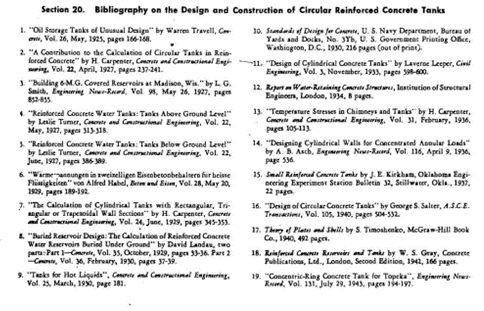
Although the point raised and referenced is not directly concerning the coefficient calculation theory, the link to Lewe is via PCA ref 2, H Carpenter, 1927 (wherein it states Dr Lewes, Eisen u Beton, March 1915) so if anyone was curious to follow up the references then they may find Lewe as I did (see The Thesis of Everything). Now, in 1993 edition, the references are as below and Carpenter is no longer directly referenced, but Lewe is still there, in PCA ref. 8 (was 18 in ’42), because WS Gray uses Carpenter ’27 as a reference, so the link exists, but now tenuously secondary.
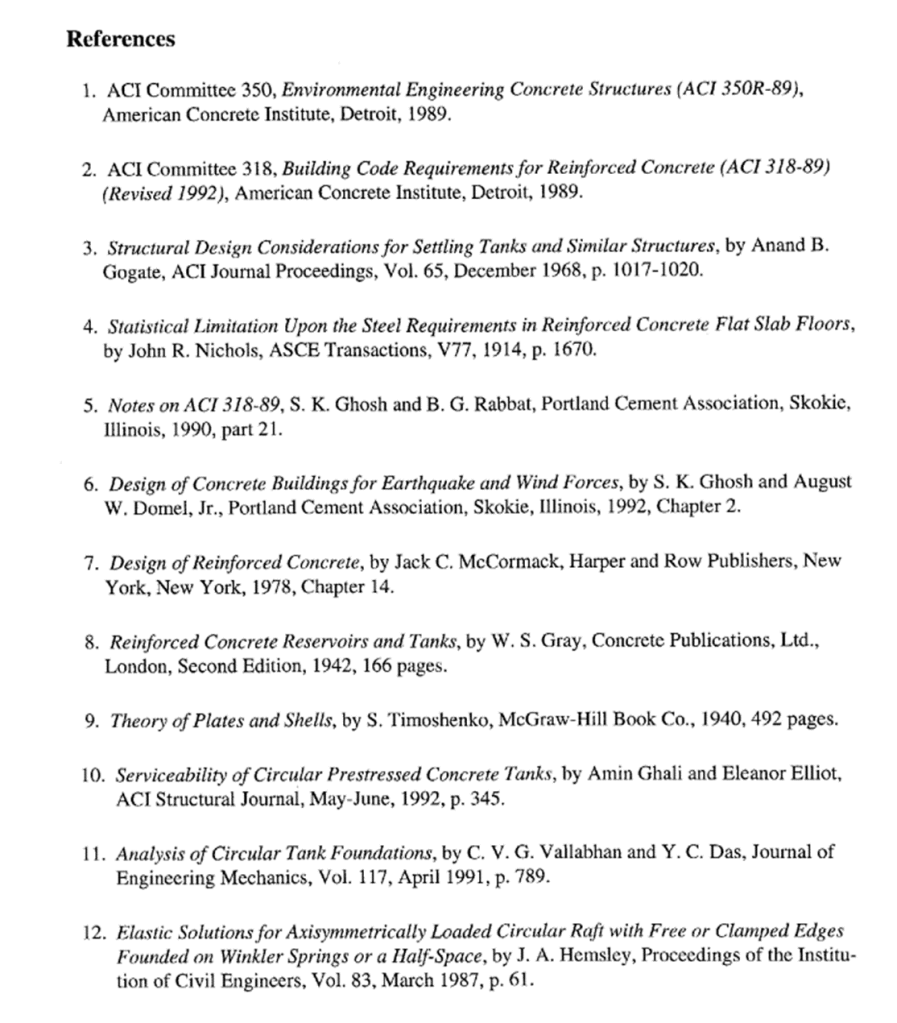
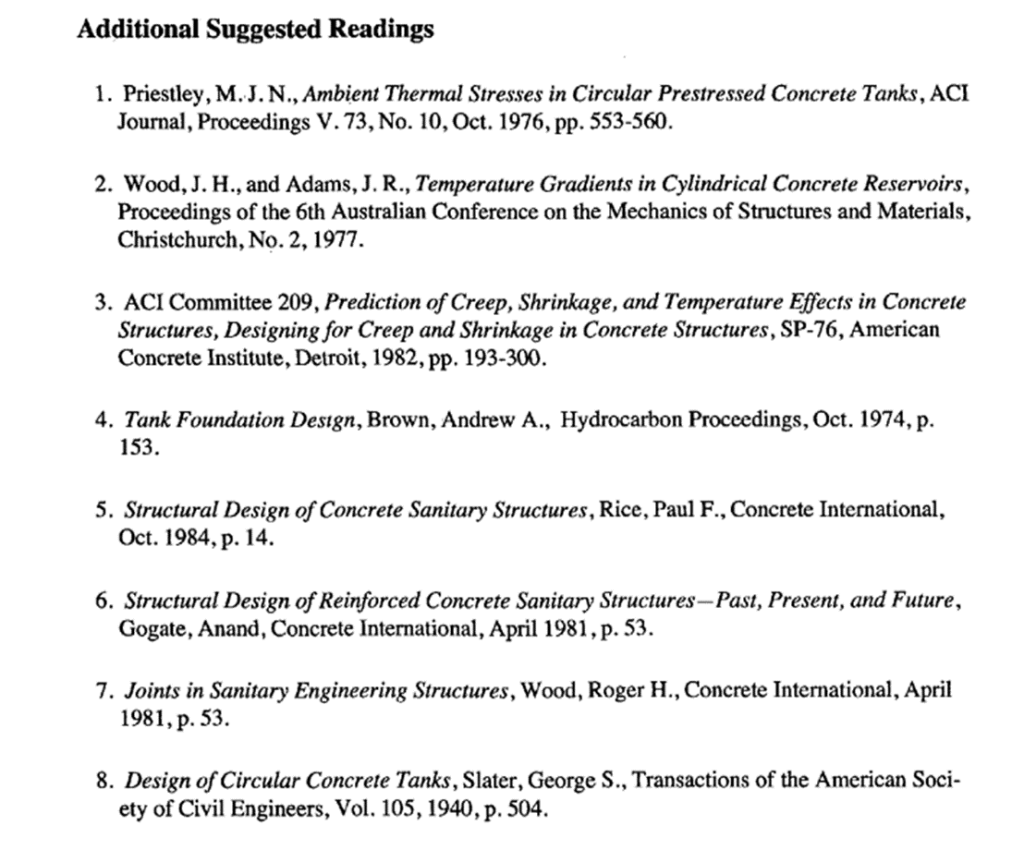
The final link to Lewe from the still current 1993 issue is found in the Transactions of the American Society of Civil Engineers 1940, and specifically in replies to George Salter’s article(13) (Note the Transactions were directly referenced in ’42, but are included in the 1993 PCA document as ‘suggested further reading’. Note also mis-spelled as Slater and restricted to single page, differing from ’42. These feel almost deliberate misdirections perhaps?);
- Frank McCormick Esq on p.517 references Reissner 1908 (See 21) and on p.518 includes references directly to Lewe’s work in the 1923 reissue of Handbuch fur Eisenbetonbau (see 5).
- Dana Young Assoc. M. Am. Soc. C.E. on p.521 recognises that ‘The general analysis of the problem stated in this paper has been developed thoroughly by various European engineers and is presented in standard reference works such (as) those of Poschl, Flugge, Love and Loser and Lewe’. Young references all the appropriate works of these authors and his reference to Loser and Lewe is to the 1934 issue of the Handbuch fur Eiesenbetonbau which would be revision four. Young states that Salter’s work is only useful for specifically shallow tanks and shows clearly why Poisson’s ratio is key to analysis.
- On p.531, Salter clearly acknowledges that ‘since the publication of the paper it has been brought to the writer’s attention that apparently a considerable part of the work had been done previously and that various graphs had been presented, chiefly in German publications, some of which are practically the same as some of those given in the paper’.
American civil engineers in 1940, such as Salter, McCormick and Young are clearly aware of Lewe’s work, among other German Engineers but none of them directly refer to the 1915 Handbuch article, only later revisions and it is only in 1915, in the foreword, that Lewe discusses the ‘underlying theory’. And it is only through locating a hard copy of his dissertation that the theory used to derive the coefficients can now be proven to be Lewe himself, the physicist.
That the theory used in the PCA document is Lewe’s matrix calculus is indisputable. The question is why would this fact be buried, and continue to remain so, despite every effort I can make to elevate it?
I believe Lewe proves nuclear secrets; and there are liars at the heart of our system.
Karl Eugen Kurrer informed me that Hans Reissner and Lewe were linked in 1920, and I knew from my thesis research that Lewe has served as Reissner’s assistant. The PCA in 1942 were based in 5420 Old Orchard Road, Skokie (a suburb of Chicago), Illinois, 60076 (18a), and Reissner is based at Illinois Institute of Technology also in Chicago. Is it possible that it is Reissner himself who passes Lewe’s coefficent tables to the PCA?
Whatever the truth about the machinations behind the scenes, it is clear that Lewe must be referenced. The PCA are a commercial organisation, who have a vested interest in promoting the use of Portland Cement, so leaving control of the underlying theory in their hands is extremely foolish. The strength of Reinforced Concrete is parasitic to the momentum of the planet. Lewe proved it in 1915, so there are malign actors who are deliberately hiding this information. They choose their own short-term comfort to the detriment of the rest of humanity. The moment that Lewe is recognised as the primary source of ALL structural engineering practice, the truth will set us free. I’m just waiting for that day. Is it to you that I speak? Are you a scientist who wants truth and has the power to show it? Then Act.
PS. Did this guy Westergaarb know about the parasitism of Earth’s momentum caused by concrete, but still thought the hoover dam was a good idea? Nice
There is another connection between Lewe and Illionis University in the shape of Harald Westergaarb. In his 1915 dissertation Lewe attempts to correct the record with regard to the naming of the three moment theorem, which is ascribed to Clayperon. Lewe is aware of an article by Bertot {no information found}, published in a German Construction Magazine in 1855 (ref in text below) and corrects the record on Bertot’s behalf, recognising that credit is not being given where it is due. It is possible though that this piece of information helps to indicate at least one Engineer working in America that knew of Lewe, Harald Westergaarb.
I stumbled on a paper, (American Society of Civil Engineers, Transactions, paper no. 1727, One Hundred and Fifty years Advance in Structural analysis, H M Westergaard), a talk in 1926 that makes the same point and cites exactly the same reference:

Westergaard was born thirty years after publication and I suggest he did not find out the discrepancy from the original source, but used Lewe’s disseration. Is it possible that Westergaard had a copy of a 1857 German construction Magazine in which O Mohr says Bertot, and that later in 1860, Mohr says Clayperon? I struggle to believe that. No other links to Bertot have been located to date and all modern works state Clayperon as the instigator. The reference matches Lewe’s reference exactly, and I would suggest indicates that Westergaard had a copy of the 1915 dissertation. It is one of those facts that stick in the mind. Perhaps Westergaard though it would make an interesting point and demonstrate his own detailed knowledge of his field, so looked up Lewe’s paper as preparation for his talk? The link to Lewe is also geographical, placing both men in German Engineering Academia, and both men achieved their doctorates in 1915.
[Harold Malcolm Westergaard(1888-1950), civil engineer and engineering scientist, was the Gordon McKay Professor of Civil Engineering at Harvard University from 1936 to 1950. After studying engineering in Copenhagen and Germany, Westergaard joined the faculty at the University of Illinois, holding several faculty positions from 1916 to 1936. Westergaard became a member of the Harvard University faculty as Gordon McKay Professor of Civil Engineering in 1936. Westergaard served as Dean of the Harvard Graduate School of Engineering from 1937 to 1946.
Westergaard graduated in engineering from Copenhagen Danmarks Tekniske Højskole in 1911. He continued his practice in reinforced concrete in Hamburg, London, Göttingen, and prepared his written dissertation at Königlich Bayerische Technische Hochschule München in 1915] {Lewe presented his dissertation in the same year, in Dresden, and it is very likely that Westergaard would have been aware of it. Lewe, an older man, gaining a second doctorate, and as a physicist, a protégée of Alexander von Brill, would have attracted keen interest among engineering students. Note Westergaard emigrates to America in 1916 where he becomes embedded in academia}
Westergaarb obtained a PhD at the University of Illinois in Urbana in 1916 and was appointed lecturer there for theoretical and applied mechanics. He became full professor in 1927. For his published paper on the theory of the reinforced concrete, together with W.A. Slater, he received the Wason Medal of the American Concrete Institute (ACI) in 1922. Westergaard published many works including Theory of elasticity and plasticity, (1952)]
[From Harvard library there is a little more information. Westergaard’s main contribution to engineering was in structural analysis, he published papers on the theory of reinforced concrete plates, on buckling theory, and the mechanical behaviour of concrete pavements for roads. He worked as an advisor to the United States Bureau of Reclamation during the building of the Hoover Dam and studied the effects of earthquakes on the Panama Canal. During World War II, Westergaard served as a commander in the Civil Engineer Corps of the United States Navy and was a member of a commission established to assess the effects on buildings after the atomic bomb was dropped on Hiroshima and Nagasaki in Japan.]{An interesting link from Nuclear Force to Nuclear Explosions}
[Demonstrating the crossover between Engineering and Physics, an article On the completeness of the Westergaard stress functions {accessed 21.3.24} discusses the Westergaard method yielding a succinct solution to linear elastic crack problems. Here it is shown that the superposition of the Westergaard functions with a uniform uniaxial stress field provides a complete solution to the equations of two-dimensional linear elasticity for the infinite plane.] {with significant applications to Quantum Theory}
My attempts to alert authorities fell on deaf ears
 ace-consultancy.uk