
Link to Google dropbox for Documentary Evidence
https://drive.google.com/drive/u/0/folders/1JjeZNhILW45wjXHbX4Y-LEvYx92wv2KK
- A Viktor Lewe Story
- B Dr Sc.nat 1915 Engineering Dissertation – Die Berechnung Durchlaufender Trager und Mehrstieliger Rahmen nach dem zerfahren der zahlenrechtecks
- C 1915 Translation – The Application of Matrix Calculus to Continuous Beams and Framed Structures
- D 1915 Handbuch fur Eisenbetonbau
- E 1993 Circular Concrete Water Tanks without prestressing, PCA, Illinois
- F Birth and Death Certificate
- G SS Dr Viktor Lewe story
- H 1906 Physics Dissertation – Die plötzlichen Fixierungen eines starren Korpers
- G 1906 Physics Dissertation Translation – The sudden fixations of a rigid body. A contribution to the vector analytical treatment of the dynamics of instantaneous forces.
Compiled by Martin Reynolds BEng Civil Engineering, Autumn 2023
Introduction
Prof. Dr. Ing Dr. Sc. nat. Bernard Wilhelm Viktor Lewe’s (22.11.1881- 26.10.1936) 1915 Dissertation for his second Doctorate in Engineering, following his first in Natural Sciences in 1906 (with a dissertation on Euler’s rigid body axis theorem – The Fixed Points of a rigid body – A contribution to the vector analytical treatment of dynamic instantaneous forces(15)), is a high-water mark of translation from Physics into Engineering and deserves recognition, not just for the sake of natural justice to give credit where it is due, but also to ensure that any current reinforced concrete design practice directly references Lewe’s Theoretical provenance ; specifically from his 1915 Dissertation but also very much combined with his companion Engineering paper in der Handbuch fur Eisenbetonbau; the two are married together in terms of translation of theory to practice. The Positive Moment created by rotation of the universe about its axis at the centre of the planet , proven by Lewe using matrix calculus analysis of infinite load, must be included in calculations so that the negative effects on ambient gravity, caused by parasitising this force in reinforced concrete, can be understood.
Lewe, V (1915) Matrix Calculus for Continuous Beams and Frames(10) is an analysis of load and lever arm at the smallest possible scale using the infinite load method. It proves that at the precise moment that a load disintegrates there is additional energy in the system as a whole; disintegration creates motion; motion creates energy; energy exists with a duration in time after which entropy must act, creating disintegration…repeat. A balance between the rotating Elastic Forces, in sustainable negative tension, and the expanding Plastic Forces in an (almost) straight line, can be sustained in each Moment. If the generated energy from this potential motion of disintegration is greater than the energy that powers the disintegration, then the load remains stable, and does not disintegrate. The motion must complete its full cycle potential in the time available, so it is the motion itself that creates the time required to enable it to occur – a space in time. The dimensional exchange takes place at the bending centre of all masses; the centroid of the Earth. One molecule of Carbon, in the form of oil, is forced to exist inside one molecule of water. The mix is physically impossible, but can be maintained through continuous motion and addition of matter. Water and Oil both have negative Poisson’s ratios which means that under Elastic and Plastic Forces, their volume can increase. The atomic motion creates a pathway for the extra material to exist in Space dimension as Light and Matter; Oil and Water is added each moment. Taking a small step then into Quantum Mechanics where this concept demonstrates that the space is c^2, and the motion is acceleration with ∞ vector change, m2/s2. It is the Positive Moment of orbital angular momentum that creates the Force of Nature – an unequal and opposite reaction of clockwise torque (bending force) on rotational spin in a beam of light, m2/s. The intermediate axis thereom applies then to the North South orbital rotation of planet Earth. The greatest (mechanical) mass moment occurs on the axis inside the planet, and the smallest mass moment is the Universal axis of spin at c m/s on EW axis at equator. The intermediate axis thereom shows how even tiny motion of the greatest moment creates additional momentum causing a cyclical rotation about the intermediate axis.
Mass is shown then by Lewe not to be the most appropriate point to measure from in terms of relative energy; the clockwise vector is the resultant of all forces and therefore the position and momentum of all actions must include both the velocity and the vector. Em=c^-2 – the energy of disintegration of load equals the squared space of light. Quantising is merely an analysis tool using matrix calculus; the technique opens the window, but structural engineering describes the action revealed. In 1915, the Physicist Lewe spoke to the Engineers, and it falls now perhaps for Lewe the Engineer to explain back to physicists, opening the way to a New Foundation for Physics; Positive Moment, not rest mass.
His Story
Bernard Willhelm Victor Lewe was born on 22nd November 1881, in Loningen, in the district of Oldenburg, now Lower Saxony/FRG. (His birth certificate shows his full name but the spelling of Viktor is from his 1915 dissertation and his University record card shows a handwritten correction of letter c to k, so his preferred spelling is used throughout this work). He is the third child of six fathered by Carl Lewe, shown as ‘merchant’ on Viktor Lewe’s birth certificate; five boys and a baby sister, and raised as Catholic. Loningen (pop.1890, 4687) is a small town west of Bremen in NW Germany and the Lewe Family seem to have been resident for many years. There is record of the death of a Victor Lewe in Loningen in 1842, and a Josef Lewe in 1876, for example.
Lewe attended a local Gymnasium (school) in Vechta, completing his matriculation exam in 1902 and then began his first Doctorate in Natural Science. He studied under the esteemed mathematician and astronomer Alexander von Brill (as did Max Planck in 1889) and attended Universities in Munster, Berlin, Munich and Leipzig.
1902: 1 semester at Münster University
1902/03: 1 semester University of Berlin
1903-1904: 3 semesters University of Munich
1905: 2 semesters at Leipzig University
1905/06: 1 semester Technical University Munich
In the Wikidata entry for Alexander von Brill(scroll down), in 1906 Viktor Lewe is noted as ‘student’ of his semester; his success should be recognised as a real achievement; he received academic recognition as a young man of potential at an incredibly exciting time of change in Physics. Max Planck was a full professor in Berlin University at this time, and president of the German Physical Society (Deutsche Physikalische Gesellschaft) and it is perhaps surprising then that Lewe set up as a consulting Engineer, based in Charlottenburg(22). It is recorded that Planck himself, on gaining his Doctorate, was advised by his tutor against going into physics, being told, “In this field, almost everything is already discovered, and all that remains is to fill a few holes” {Wikipedia Life and career para 5} but by 1906, Planck himself had made advances in the Theory of Thermodynamics, leading to his Nobel winning Quantum Theory, in 1918. Lewe’s dissertation ‘Die plotzlichen fixierungen eines starren korpers. Ein beitrag zur vectoranalytischen behandlung der dynamic momentankrafte(1), (The Fixed Points of a rigid body – A contribution to the vector analytical treatment of dynamic instantaneous forces) dovetails well with Planck’s work, so Lewe would have been a useful researcher at least but, nonetheless, it is towards Engineering that Lewe moves.
His motives for making this move may be implied from the foreword to his 1915 Handbuch contribution(4); namely the desire to translate theoretical physics into practical application in such a way as ‘den mathematisch weniger gewandten’ (the mathematically less-trained) could use it with confidence. He certainly seems to have an interest in practical application of Theory, and this may perhaps explain his move into Engineering in 1906; to utilise funded opportunities to test his own work in practical fields. His achievement has been to simplify elastic membrane theory so successfully that his work still forms the basis of specific Engineering design practice today (but referenced only ever indirectly, via Carpenter(16) and Reissner (21)) as detailed in the PCA publication Circular Concrete Water Tanks without Prestressing(18) and also Reynolds & Steedman’s reinforced concrete designers handbook (30) , states; ‘Coefficients and formulae for determining these factors are given in Table 184 and are derived from H. Carpenter’s translation of Reissner’s analysis: for a more detailed treatment of this method of analysis see ref. 93′.(16)
During his career as a Consulting Engineer, Lewe spent time as an assistant(4) to Hans Reissner, who is credited with designing the first successful all-metal aircraft. The corrugated wings were designed and built by Hugo Junkers; there is no credit given to Lewe, but his speciality in Berlin University after 1920 is Strength of Materials. His knowledge of atomic theory and shape of structure would be invaluable in the detailed design of the aerofoil surfaces, but as a hired hand, the credit would be to his employer.
Junkers Ju Reissner Ente
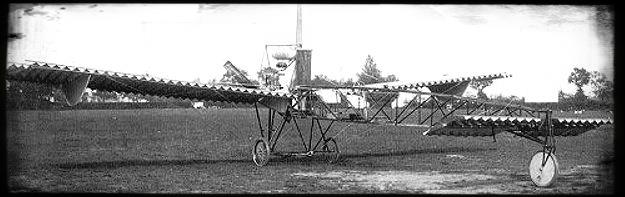
Picture Credit https://www.nevingtonwarmuseum.com/ju-reissner-ente.html
Two aeronautical papers(11) (14) on detailed design of shape of components have been traced to Lewe (The Date of Technische Berischte Vol III, no. 7(11) is 1918 indicating that his connection with aeroplane design can be dated from some time prior to 1915 (when he mentions his assistant role to Reissner) and he may have maintained his interest alongside his later role as a university professor beginning in 1920(8) because, referencing Kurrer(22), Hans Reissner assisted in gaining habilation for Lewe to become a Professor of Engineering at Berlin University. Reissner in his own right is also a key figure in the development of shell theory. It is Reissner who solved Einstein’s equation for the metric of a charged point mass, and his name and work is still extant in the Reissner-Nordstrom metric. Reissner, a Jew, moved to America in 1938, the story being that he was unable to continue working in National Socialist Germany.
In 1915, from his Handbuch Article, Lewe’s professional position is shown as Chief of Inspectors of Civic Buildings in Bromberg (now Bydgozsz in Poland) (Leiter der fur die Ostprovinzen e ingerichtetenstadtisch en Prufungsstelle konstruktiv bedeutender Bauten in Bromberg(4)&(5)) and he has also been working to gain his engineering doctorate. Prior to this award in 1916, Lewe is credited in published articles as Dipl.Ing, indicating a Diploma of Engineering, which normally requires four years of study, and would likely have been completed whilst working as an Engineer. An article came to light from Armetier Beton, a concrete construction magazineisuue January 1918, that is accredited to Von Dr.Ing Dr sc,nat V Lewe. His title is Leiter der Bauprufungsstelle in Bromberg (presumably this title was supplied by Lewe. It may be a simplification of his title regarding specifically civic buildings, or could be promotion to full dept head?). In this article Lewe references himself, pointing to an earlier article in the same magazine, 1917 edition regarding ‘Behandlung mehrsteiliger rahmen nach dem verfahren des zahlenrechtecks’ ‘treatment of multi-part frames using the number rectangle method’ (his method from 1915 for concrete tanks)
The work with Reissner, and his role in Bromberg, are the only two known professional placements that Lewe held prior to becoming an Engineering Professor in Berlin in 1920. Bromberg Records were completely destroyed during the Nazi invasion of Poland, so there is no record of what work Lewe carried out there, or for how long. Note also that there are no records in Berlin University, reportedly completely lost, destroyed by wartime bombing.
In 1920, Lewe habilitated (as mentioned, with the help of Hans Reissner) at the Technische Hochschule Berlin (Department: Civil Engineering) with a thesis on reinforced concrete slabs (It is possible that this paper is the one published in 1926, see table of known works below) as a lecturer (“Privat-Dozent”) in the field of strength theory. In 1927 he is promoted to Associate Professor, both roles in the Department for Strength of Materials, Civil Engineering at the TH Berlin until 1936 (23). His recently retrieved death certificate shows Viktor Lewe died in Berlin on 26th October, 1936 (noting the date of his tenure as professor is shown in error on at least one website as 1937(8)).
The list of known works is itemised in the table below. He certainly becomes a lot more reticent in terms of publishing after becoming a professor. There is only one significant work after 1920, Lewe, V (1926) Mushroom ceilings and supportless reinforced concrete panels, strict solution to slab problems, Deflections, moments and transverse forces of plates. This work is submitted as an article in the Handbuch fur Eisenbetonbau and it is possible that this is based on his habilation submission(22). His last known article is about rather off-topic perhaps, timber construction, sent as a letter to a construction journal in 1927.
His Importance
The loss of Dr Lewe to the canon of Engineers of Distinction is a classic demonstration of the importance of correct referencing. It is through following up every reference, both primary and secondary, that enabled Dr Lewe’s foundational dissertation to come to light. The connection is hard to find, but Lewe is still cited as a reference source in current reinforced concrete design practice in USA and UK, specifically the Appendices of the PCA publication ‘Circular Concrete Water Tanks without Prestressing’ (10). This publication has tables of coefficients as the basis for all the design practice and, although not stated, these are derived using Lewe’s 1915 matrix analysis of graphical equations from elastic membrane theory. The PCA publication is a good example of how the coefficient approach of simplification can be used to solve complex problems; coefficient values of K are read off to use in simpler equations to solve, in this case, for the design of reinforced concrete tanks. Of course, if the solution is being sought in Particle Mechanics Functions from where the simplification derived, it is important to go right back to first principles after measurement analysis, to reintroduce the graphical equations, or the understanding will be incomplete.
The reference linking Lewe to the PCA publication is a little obscure because it is a secondary reference in ‘The Transactions of the American Society of Civil Engineers’ (1940) (13). Papers by Dr. Lewe (among several other important names, and various subsequent later revisions of the journals and volumes in which they were published), are included in the Transactions. Precise linking of references has been difficult, but nonetheless, it has been possible to discern the date of original works for comparison with later revisions. The correct reference to the original (or most up to date) source material is now possible.
Lewe seems to have a great breadth of interest, in terms of the papers that are published under his name.
In 2018, Karl-Eugen Kurrer, in “The History of the Theory of Structures. Searching for Equilibrium”,(22) states that Viktor Lewe appears in connection with the theory of reinforced concrete slabs (1920 and 1926),the theory of reinforced concrete tanks (1923) and the application of matrix calculus to continuous beams and continuous framed structures (1916) (on pages 697, 713, 716f. and 725): and he remarks that Lewe made significant progress in all three of these areas. Since publication of Kurrer, further published papers have been located, indicating wider interests than originally known (including aeroplane design and timber construction) and which can be summarised here:
- 1906 – Theoretical Mechanics of Particles and Systems: The sudden fixations of a rigid body – A contribution to the vector analytical treatment of dynamic instantaneous forces(1)
- 1913 – Structural Engineering: Winkler’s Numbers in bending moments(24)
- 1915 – The practical application of Theoretical Physics to reinforced concrete design practice, specifically:
- Circular concrete water tanks- Simple formulas and charts for calculation of cylindrical tank walls with square, triangular or trapezoidal sections’(4)
- Reinforced concrete slabs 1 – The strict solution to the mushroom ceiling problem. Tables of deflections, moments and shear forces of plates theory of reinforced concrete slabs (9)
- Reinforced concrete slabs 2 The application of matrix calculus to continuous beams and continuous framed structures(10)
- 1918 – Aeroplane detail design:
- strut design (11)
- Seaplane Under-structures (translated. 1920)(14)
- 1920 – Reinforced concrete slabs 3 – Mushroom ceilings and supportless reinforced concrete panels, strict solution to slab problems, Deflections, moments and transverse forces of plates(12)This paper was published in Der Handbuch in 1926 but, according to Kurrer, was presented in 1920 when he
habilitated (with the help of Hans Reissner (1874-1967)) at the Civil Engineering Department of
Technische Hochschule Berlin. - 1927 – Advances in Timber Construction(25)
His concrete papers all feature in der Handbuch fur Eisenbetonbau, (Manual of Reinforced Concrete) which had four revisions. Lewe features from the 2nd revision in 1915, and then in 1923 and 1934. He is credited as Editor in all three, so his initial papers were likely modified by him as experience was gained and methods improved over this period. Certainly reference to his time spent as assistant to Hans Reissner has not been carried forward into the 1923 revision from 1915. It is interesting to note that although by 1916 his correct attribution for academic works is Dr.Sc.nat Dr. Ing V. Lewe, Dr.sc.nat, his Physics title, is only used when he publishes his 1915 Engineering dissertation, at other times most often using Dr.Ing Dr V. Lewe. The value of the dissertation, in terms of its provenance, is all the greater then because Lewe is standing on his professional reputation as a Doctor of Science in order to gain his engineering doctorate.
No original work after 1927 has yet been located. He is included in the 3rd and 4th revisions of der Handbuch, but this is revision of work already published. In this respect his last printed word is in 1934, but his last known original contribution is 1927. His tenure as a professor at Berlin ceased in 1937 and his death certificate shows he died on 26th October, 1936 in Berlin. No other details are currently known.
Lewe’s contribution to the development of shell theory for practical application
In 1915, in the foreword to his calculations, Lewe references the earlier work by Hans Reissner (see (21)) and states that Reissner’s equations are only suitable for thick-walled tanks (where thickness/radius=1/20 with 5% error). Lewe includes a proof to demonstrate that for thin-walled tanks a different approach is required. He states that the design formulas are based on using iron as the construction material and need to be adapted to suit reinforced concrete. He references Muller-Bresllau’s work on greatest force and also Max Meyer, who used the Muller-Bresslau equations to calculate force in reinforced concrete but, according to Lewe, this work includes an unfortunate printing error(4). Note that it was Meyer who first adapted the Muller-Breslau formulas for use in tank walls of different thicknesses (possibly it is this work referenced in (23) Mayer, Max, 1912. “Die trägerlose Eisenbetondecke” (The beamless reinforced concrete slab), Deutsche Bauzeitung, Mitteilungen über Zement, Beton- und Eisenbetonbau, vol 46 (1912), no. 21, pp. 162-6; no. 22, pp. 174-5)
It was Lewe’s stated intention to provide a method that was simple to use in practical situations. To this end he employed a graphical approach, producing charts specifically for thin-walled cylindrical water tanks which can be used to find solutions for tension and bending through determination of coefficients. Once determined, the actual calculation of the values required is simplified to some extent; the important part of Lewe’s work is this derivation of coefficients as a simplification of complex theoretical formula. In his dissertation for his Engineering doctorate, he uses his physics doctorate title, for the only known time in his academic life and it is in this paper, using matrix calculus to solve for concrete slab loadings, that the full practice of theory is laid out. Lewe solves for loadings at infinitesimal scale, the smallest possible measure of existence, and proves, in Abb 14, that an internal anticlockwise moment of inertia produces a clockwise external rotation. It is the same process that has been followed in the PCA publication, Circular Concrete Tanks without Prestressing (see 18) so ‘the theory’ which is referenced in the title pages of this publication should be referenced directly to Lewe’s theory in his dissertation and should state the tables of coefficients in the appendices have been arrived at following the methods prescribed therein.
In terms of the lasting value of Lewe’s work and its recognition within existing design practice, see The Transactions of the American Society of Civil Engineers, and replies to George Salter’s 1940 article(13) (as referenced in the PCA document); Frank McCormick Esq references Reissner 1908 (See 21) ((13) p.517) and includes references directly to Lewe’s work in the 1923 reissue of Handbuch fur Eisenbetenbau (see 5)((13) p.518) . Dana Young Assoc. M. Am. Soc. C.E. recognises that ‘The general analysis of the problem stated in this paper has been developed thoroughly by various European engineers and is presented in standard reference works such (as) those of Poschl, Flugge, Love and Loser and Lewe’. Young references all the appropriate works of these authors ((13) p. 521) and his reference to Loser and Lewe is to the 1934 issue of the Hanbuch fur Eiesenbetenbau which would be revision four. Young states that Salter’s work is only useful for specifically shallow tanks and shows clearly why Poisson’s ratio is key to analysis.
Salter clearly acknowledges that ((13) p. 531) ‘since the publication of the paper it has been brought to the writer’s attention that apparently a considerable part of the work had been done previously and that various graphs had been presented, chiefly in German publications, some of which are practically the same as some of those given in the paper’.
In Britain too there is evidence of the importance of Lewe’s work. H Carpenter (Sir Henry Cort Carpenter), in a British Concrete publication from 1927(16) acknowledges the work of Dr Lewes (sic) in the text of his article, but removes the name in an updated article in 1929 in CPA publication(17). Carpenter references Reissner but the reference to Vol V is to Lewe’s work, as Carpenter knows. The reply to Salter from Robert B Moorman Assoc. M. Am. Soc. C.E references ‘Curves from Carpenter’ ((13)p. 520) in the later work from 1929 (see (17) so Lewe link is again lost).
Sir Henry is found dead after reportedly drowning in a stream after a heart attack in 1940, and Lewe himself died in 1936.
The situation would seem then, at least in 1940, that Lewe’s 1915 paper is a key reference for circular concrete tank design practice in Britain and America, and presumably in occupied Europe too. So, it is to Prof. Dr.sc.nat Dr.Ing. Viktor Lewe that all reference sources lead, not just in engineering, but so too in science.
Summary of known information and published articles.
Also some details on later documents which reference Lewe’s work
1849 Death of Viktor Lewe’s mother, Lisette Lewe nee Diekmann
The most likely explanation for the discrepancy in dates is that birth entries have been shown as death entries.(Translation) Death Notes DVD2, Register of Persons, A joint project of the Oldenburg Society for Family Studies The Homeland Association for the Oldenburger Münsterland Compiled by Ruth Decker & Monika von Hammel(29)
1881 (Note that official certification of civil status in Germany has only been carried out since 1876. Entries in the respective church records have been used prior to this date so an official marriage certificate does not exist. There are also no official birth certificates for children born before 1876.)
Family Details
Bernard Wilhelm Victor Lewe 22nd November 1881, at 09:00 in Loningen, Lower Saxony
Died 26th October 1936, in Berlin (circumstances not known)
FATHER – the merchant Carl Wilhelm Victor (also spelled Viktor) Lewe, Catholic religion,
Born April 12, 1842 in Löningen
Married November 24, 1870 in Essen to Josephine Bernardine Lisette Diekmann (Carl 28, Lisette, 21)
Died December 14, 1918 in Löningen (76 years old)
MOTHER– Josephine Bernardine Lisette née Diekmann, Catholic religion,
Born August 26, 1849 in Essen (Oldenburg) (see above record of death entry as next day, 27/8/1849)
Died January 27, 1929 in Löningen (79 years old)
BROTHER 1 – Joseph Christian Gerhard Lewe. Born March 26, 1876 in Löningen
Married May 4, 1920 in Emsbüren with Agnes Kuiper (Joseph aged 44)
Died March 12, 1935 in Löningen (aged 60) (Joseph is father of (to be SS-Obersturmfuhrer) Dr.
Clemens Alexander Viktor Lewe, 19/4/1912 also known as Dr Viktor Lewe in 1941, Sachsenhausen.
See separate story.)
BROTHER 2. Rudolph Gerhard Julius Lewe
Born February 23, 1879 in Löningen
Married February 12, 1907 in Aachen with Luise Marie Antoinette Reinartz
Died May 21, 1950 in Löningen (aged 71)
Bernard Wilhelm Viktor Lewe – November 22, 1881 , died 26th Oct 1936 (aged 54)
BROTHER 3 Ferdinand Maria Ernst Lewe
Born March 1, 1885 in Löningen
† ?
BROTHER 4 Franz Ferdinand Aloysius Lewe
Born April 3, 1887 in Löningen
Married 1936 in Delbrück (Westphalia) (aged 49)
Died February 9, 1976 in Delbrück (89 years old)
SISTER Josephine Elise Lewe
Born December 8th, 1888 in Löningen
Married ?
† ?
1902 to 1906 School and study:
Tubingen
1902 Matriculation examination (= “Reifezeugnis”, “Abitur”) at the “Gymnasium” in Vechta (Grammar
School, Normally 9 years)
1902: 1 semester at Münster University
1902/03: 1 semester University of Berlin
1903-1904: 3 semesters University of Munich
1905: 2 semesters at Leipzig University
1905/06: 1 semester Technical University Munich
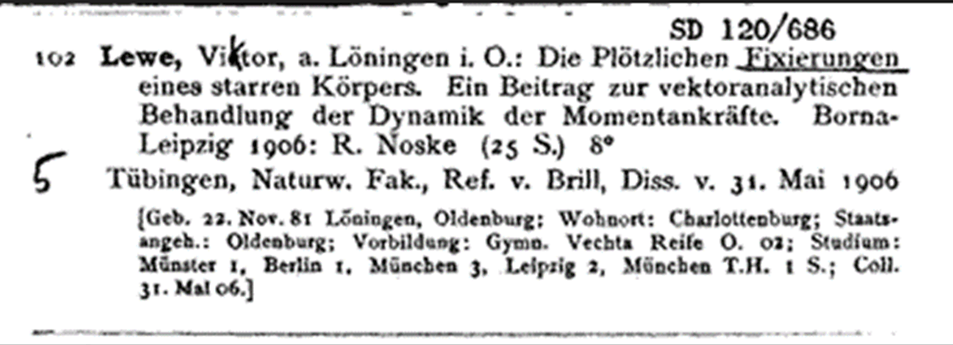
University record Card located at Hebris Library Network(1) , additional date information from Kurrer
Career Summary
Dr.sc.nat Viktor Lewe graduates from Tubingen in 1906. Shown as ‘schuler’ (defined as a notable student on wikidata), studying under Alexander von Brill, noting all others listed under Brill are shown as ‘doktorand’ (defined as a Person who is aiming for a doctorate under the doctoral supervisor) (2), possibly indicating that he was promoted due to recognised intellect, and that the doctorate had not been the original intention?
Residence in 1906 shown as Charlottenberg(1) (which became part of Berlin in 1920) as Engineer(3) or more accurately a consulting civil engineer(22) and in 1915, Lewe’s professional position is shown as Chief of Inspectors of Civic Buildings in Bromberg (now Bydgozsz in Poland) (Leiter der fur die Ostprovinzen e ingerichtetenstadtisch en Prufungsstelle konstruktiv bedeutender Bauten in Bromberg(4)& (5)) and he is also working to gain his engineering doctorate at this time.
Lewe spent time as an assistant(4) to Hans Reissner so there’s a possible association with Hugo Junkers(20). Lewe contributes at least two papers on aeronautical design(11) (14). Date of Technische Berischte Vol III, no. 7(11) is 1918 which indicates that his connection with aeroplane design can be dated from prior to 1915 (when he mentions his assistant role to Reissner) and may have maintained his interest alongside his role as a university professor beginning in 1920(8) because, referencing Kurrer(22), Reissner himself assisted in gaining habilation for Lewe to become a Professor at Berlin University.
1906 Paper 1
Lewe – original paper for physics doctorate
Dissertation published Die plotzlichen fixierungen eines starren korpers. Ein beitrag zur vectoranalytischen behandlung der dynamic momentankrafte(1) , (The Fixed Points of a rigid body – A contribution to the vector analytical treatment of dynamic instantaneous forces) This publication is not yet located for review. From the Title, this paper is an analysis of Euler’s Rigid Axis Theorem, which leads directly to Lewe’s later work on absolute motion. No mention of matrix calculus. His 1913 paper on Winkler’s numbers would indicate that this was his early steps towards the arithmetic progression. It is possible that in 1906 he was using geometric progression, which would explain how he is able to visualise both methods simultaneously in his 1915 dissertation, matrix calculus and Handbuch article with graphical approach.
Listed as Mathematics subject classification: 70-Mechanics of particles and systems(7)
(Note on Nazi influence: Alexander (von) Brill is noted on Wikipedia as being among the first from Tubingen to sign up to the National Socialist Teacher League, in 1933 (despite being retired, in 1919)
1913 Paper 2
Lewe, ‘Winklersche zahlen’ fur streckenlasten, Deutsche Bauzeitung, 1913, Mitt nr 22(24). Translation ‘Winkler’s number’ (Named after Emil Oskar Winkler (1835-1888) for continuous beams and calculated tables) for bending moments. Article printed in German Construction Magazine Supplement – not yet located
Existence of this article traced through a reference in Lewe’s 1915 dissertation (10) (The academic title used by Lewe for this paper is unknown, but could correctly be Dr Sc.nat Dipl. Ing. The context is engineering, so likely that it would be as his 1915 handbuch paper, Dipl. Ing Dr.)
1915 PAPER 3
Vol 5 of der Handbuch
Dipl.Ing Dr. V Lewe
Hard copy located in ICE library and used as reference in my 2008 thesis. Lewe contributes to Handbuch fur Eisenbetonbau(4). The 19152nd edition is the key work in terms of applying shell theory to engineering application, noting that in 1923 3rd edition, some information has been removed. A genuine attempt to translate the complexity of Forces in an infinitely thin elastic membrane into Engineering design practice. (Regarding correct attribution of title to Lewe, note that from the 1923 3rd edition of the Handbuch, the 13th Volume(5), Buildings for Special Purposes (in preparation), Chapter II – Market halls, slaughterhouses and stockyards is ascribed to Dipl.ing Dr. V Lewe. In 1915 this would be his appropriate shortened title for contributing to academic works (missing the sc.nat) so should also apply throughout to all contributions to 2nd edition. The date ties in to his known timeline (see 1916 when he graduated with Engineering Doctorate) which would indicate that he had not completed his full engineering doctorate at the time (in 1915) that the information for this section was originally planned. The Volume is shown as ‘in preparation’ in 1923 so his title from 1915 2nd edition has just been carried forward.
Reference issue noted
Excepting Carpenter’s indirect reference in the text to ‘Dr Lewes’, Eisen u. Beton, March 1915‘, only two catalogue entries for Lewe have been found specifically for the 1915 2nd ed Handbuch fur Eisenbetonbau:
- VIAF (31) (line 670)- Handbook for reinforced concrete construction / edit. by V. Lewe [et al.]. – 2nd reedit. Edition in 12 volumes and 2 supplementary volumes. – Berlin,1915
And more specifically to Chapter 5 in ICE library catalogue (in 2008, reported missing in 2023):
- Lewe, V (1915) Einfache formeln und kurverntafeln zur berechnung zylindrisher behalterwande mitverchiedenem wandschnitt, Beton und Eisen Heft IV u.V
Using Harvard referencing, in German, the reference to this work should be:
- V. Lewe (et al), (1915), ‘Eeinfache formula under kurvrntafeln Zurich berechung zylindrisher behslterwande mit verchiedenem wandschitt’, in Handbuch für Eisenbetonbau, (2. Neubearb) Aufl. 12 Banden und 2 Erg.-Bd. Beton und Eisen, Ernst and Sohn, Berlin Heft IV u.V ,
Which translates as:
- V. Lewe (et al) (1915) ‘Simple formulas and charts for calculation of cylindrical tank walls with square, triangular or trapezoidal sections’ in Manual of Reinforced Concrete, (2nd Edition in 12 volumes and 2 supplementary volumes) – Beton und Eisen, Ernst and Sohn, Berlin, Volume IV, chapter V
1915 Paper 4
Vol 9
Dipl. Ing Dr V. lewe
Die strenge losung des pilzdeckenproblems. Tabellen der durchbiegungen, momente und
querkrafte von platten (The strict solution to the mushroom ceiling problem. Tables of deflections, moments and shear forces of plates). Contribution to Vol. 9 of the 1915 Handbuch(9). Existence of publication noted here VIAF (31). Copy not located. It is possible that the Hanbuch index would show it as ‘in preparation’, as shown in 1923. See 1926 paper of similar title which may have been when the preparation was finally complete.
1915 PAPER 5 – The Dissertation
Dr. Ing Dr Sc.nat Viktor Lewe – original paper
Dissertation submission dated 1915, note doctorate granted in 1916(7)
Lewe, V (1915) Die Berechnung durchlaufender Träger und mehrstieliger
Rahmen nach dem Verfahren des Zahlenrechtecks, Grobbetrieb fur
Dissertationsdruck, Borna-Leipzig, R Noske(10)
(The calculation of continuous beams and multi-part frames using the number rectangle method (translation from (23))
Listed as Mathematics subject classification: 70-Mechanics of particles and systems(7) (See also relativity related earlier work from Johannes Stein (2a) in 1914, Beiträge zur Matrizenrechnung mit Anwendung auf die Relativitätstheorie (Contributions to matrix calculation with application to the theory of relativity)
1916 Graduates as Dr.Ing from Dresden(7) 31st May 1916(22)
Later miscellaneous works
1918 Dr Ing Dr sc.nat V Lewe, Leiter der bauprufungstelle in Bromberg – Behandlung mehrsteiliger rahmen nach dem verfahren des zahlenrechtecks (treatment of multi-part frames according to the number rectangle method) published in Armierter Beton, January. This appears to be specific applications for his method demonstrated in 1915.
1918 Viktor Lewe (title from 1923 translation) – technical report December – contributes technical report on airplane struts. Technische Berischte Vol III, no.7, 1918(11) Date noted from translated work.
1920 Victor(sic) Lewe – technical report. Shape and Structure of seaplane under-structures w.th special regard to seaworthiness.
Date of original German publication unknown Translated for US National Advisory committee for aeronautics May 15, 1920 (Translation date) shown as reference, not the date or title of the original report (likely Technische Berischte, volume and number as above). Zeirschrift zur flugtechnik und motorliftshifarht.
1920 From Kurrer, Lewe habilitated with the help of Hans Reissner at the Technische Hochschule Berlin (Department: Civil Engineering) with a thesis on reinforced concrete slabs (It is possible that this paper is the one published in 1926) as a lecturer (“Privat-Dozent”) in the field of strength theory: 1920 – 1927 lecturer and then associate prof. for strength theory at the TH Berlin until 1937 (23). (Note error on date of promotion as 1922 in Catalogus Professorum)
Full title is now Prof. Dr.Ing Dr. Sc.nat B.W.V. Lewe
1923 Various attributions, see below.
Chapter contributions to Handbuch fur Eisenbetonbau, 2nd revision, 5th volume. Despite various titles being used, I am certain that all the work within is from the same Dr Lewe. This work is ostensibly the same as appeared in 1915 but has reduced foreword with no personal details. Various attributions, but note never uses Dr.sc.nat:
- Dr Ing. DR. LEWE.
- Title Page; Chapter 1, Section C; and also index for 13th Volume
- Dipl.-Ing. Dr V. Lewe.
- In Reorganisation section, adds detail and then 2nd mention in reorganisation section 13th Volume
- Dr. Ing Dr. Lewe ,
- Zivilingenier und Privatdozent au der
Technischen Hochschule in Berlin = Dr. Ing Dr. Lewe , civil
engineer and private lecturer at the technical university in
Berlin
Leiter der fur die Ostprovinzen e ingerichtetenstadtisch en
Prufungsstelle konstruktiv bedeutender Bauten in Bromberg.
Dipl.-Ing. dr V. Lewe , Head of the Municipal Examination
Board set up for the Eastern Provinces for constructively
significant buildings in Bromberg (now Bydgoszcz)
- Zivilingenier und Privatdozent au der
- Dr Ing. Dr. phil. W. Lewe
- From Foreword by Emberger, Editor. The only one that include phil.
Indicating humanities degree
It has been assumed that the ‘W’ and the Dr.phil
titles(indicating a humanities doctorate) are incorrect; this
initial and title are only used in the foreword by the Editor in
Chief but refers to the sections on liquid containers, which are
attributed elsewhere to V. Lewe, who is not a humanities
doctor.
- From Foreword by Emberger, Editor. The only one that include phil.
- Dr Ing Dr. W. Lewe
- from table of contents chapter 1. The ‘W’ is incorrect. It is used in the table of contents for
section C, which is ascribed to Dipl.ing Dr. Lewe (no initial),
but states a professor in Berlin, which has been established relates to Viktor Lewe
- from table of contents chapter 1. The ‘W’ is incorrect. It is used in the table of contents for
1923 Author Viktor Lewe American translation of tech report(11)from 1918
Section is ascribed to author ‘Viktor Lewe’ only, no formal title
1926 Paper 6
Dr.Ing Dr. Lewe Chapter contributions to Handbuch fur Eisenbetonbau, 2nd revision, 13th volume
Lewe, V (1926) Pilzdecken u. a. trägerlose Eisenbetonplatten ‘Die
strenge Lösg d. Pilzdeckenproblems’. Handbuch für Eisenbetonbau 2.
neubearb. Aufl. d. Bd. 13. Gebäude für besondere Zwecke, W. Ernst &
Soh,n Berlin :
Lewe, V (1926) Mushroom ceilings and supportless reinforced concrete
panels, strict solution to slab problems, Deflections, moments and
transverse forces of plates Manual for reinforced concrete, 2nd revised
edition, Volume 13 Buildings for Special Purposes reinforced
concrete ceilings, W Ernst &Sohn, Berlin (12)
Image of Front cover only is from Google books looks like ascribed to author
Dr.Ing Dr Lewe. Document not yet located
Appears to be volume 13 promised in the contents section of the
1923 issue of Volume 5? Which itself was carried from 2nd edition. The paper could be a published version of Lewe’s 1920 habilation paper, which covered the same subject matter.
Later works and final references
1926 Reference in CPA publication(16) to Dr Lewes (march 1915), by H Carpenter (Sir Henry
Cort Carpenter)
1926 Lewe – Article in Construction Magazine
Lewe, Rezension zu “Die elastische Platten” von Nádai. Die Bautechnik, vol. 4, No. 10, p. 118
‘Review of elastic shells’ Existence of work noted as Reference in History of Structures (22) but not
located
1927 Von Dr. Ing Dr. Lewe – Article in construction magazine
Lewe V (1927) ‘Fortschritte im Holzbau’ Blunck/Eiselen in Deutsches Bauzeitung MIT DEN
BEILAGEN: STADT UND SIEDLUNG / WETTBEWERBE KONSTRUKTION UND AUSFÜHRUNG /
BAUWIRTSCHAFT UND BAURECHT, Jahrgang 61, Berlin. p.35 (25)
Translation – Advances in Timber Construction. Listing found on contents page of Vintage 61,
January to June.
1934 Viktor Lewe (not the same man, but could be his nephew, Clemens Alexander Viktor)
Die frage des formzwanges fur die vollmacht zur vornahme formbedurftiger rechesgeschafte (The question of the formal requirement for the power of attorney to carry out legal transactions that
require a formal form) Dissertation, Tubingen 1934, VI (26) This publication noted on booklooker site for sale. Reference incomplete and is Filed under Contract Law– see SS Dr V Lewe story
1934 Handbuch 3rd edition volume 9 is issued and ascribed to V. Lewe (13) (ref in Salter 1940 as ‘behalter’ (container) so this should be volume 5 perhaps?). Further research to locate original document
underway
1936 From Birth Certificate, death record entry is 111/1936 Berlin 2
Death certificate111 shows date of death as 26th October 1936, in Berlin.
He was residing at 44, Schulenburgring, Templehof, Berlin and cause of death seems to be a nerve
condition (but certificate is difficult to understand handwriting. Work in progress)
1937 Despite death in 1936, two sources have Lewe as a professor in 1937, but this could just be legacy while admin was completed. From(8) GND – 1920 to 1937, private lecturer at the Technical University of Berlin and from (3) December 13, 1927, non-civil servant associate professor) for strength theory in Department II for Civil Engineering, from 1922, Faculty II for Civil Engineering, Civil Engineering Department.
From Karl-Eugen Kurrer – 1920 – 1927 lecturer, and then associate prof. for strength theory at the TH Berlin until 1937. After that, Lewe’s traces are lost.
1940 Last ever mention of Lewe as an engineering reference, to date, in Transactions from the American Society of Civil Engineers(13) with an acknowledgement by G Salter that American practice was following the German lead
Work that should reference Lewe, but does not
1942/3 Portland Cement Association, Illinois issue first edition of Circular Concrete Water Tanks.
Only one reference to a German Publication, and not related to coefficient tables.
By their own admission, the PCA are ‘an organisation of cement manufacturers to improve and extend the uses of Portland cement through scientific research, engineering field work and market development’.
The document should therefore primarily be seen as marketing strategy and the contents viewed in
that light.
1965 Reissue of above. Copy used as reference for thesis in 2008 but unable to find another copy
1993 Latest edition but note no edition information is included
There is an oblique secondary reference to Lewe (see above 1940) in the section titled ‘Additional
Suggested Readings’
Slater, (typo Salter), 504 is only first page, so should say p.504 to 532
2008 This author discovered link of PCA publication to Lewe, 1915 Handbuch
2023 located copy of dissertation proving Lewe’s work is foundational to Theory of Relativity, and that the impact of reinforced concrete on gravity has not been understood, or worse, has been understood but has been hidden.
 ace-consultancy.uk