
One Pentagram Closes the Flat Cosmos; One Ring to find them all
Rigid Body Mechanics – Tablet 7
Reynolds BEng 2.20, 9.9.25 – 24.9.25
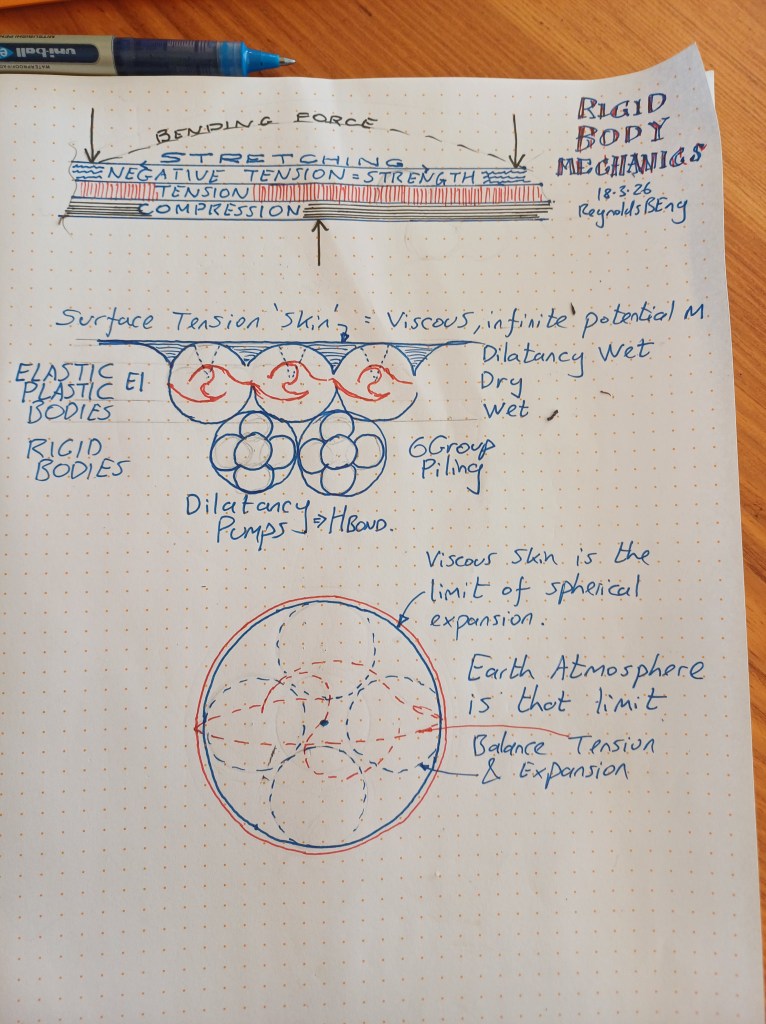
A fundamental law has emerged from the Rigid Body Mechanics notebooks:A Reynolds Surface of hexagonal architecture, when subjected to wave motion of stretching with infinity introduced as vector, closes as flat and therefore requires only one pentagram.
The image below captures the mechanical essence of this law in a single diagram.
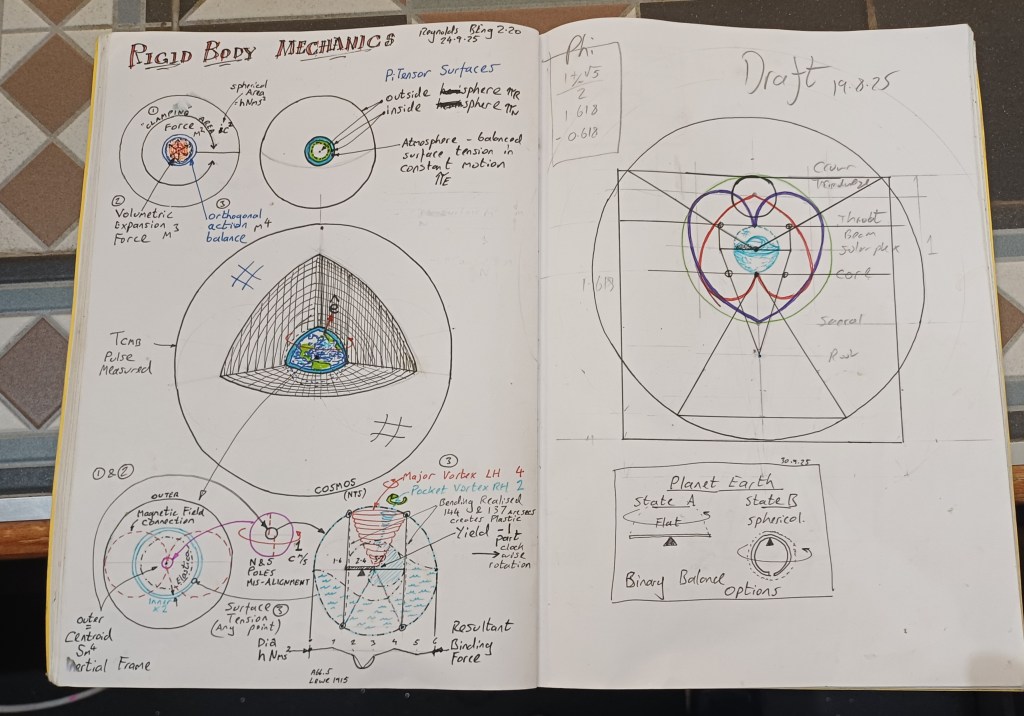
Forces at Work
This notebook spread neatly illustrates the entire mechanism: Left page (core mechanics): Earth appears as a tiny water seed pulsing at the centre of a forced-cavitation bubble (our atmosphere). A C-section clamping force holds the structure. Hexagonal force architecture radiates outward, but the entire surface is governed by P-tensor surfaces (outside hemisphere πR, inside hemisphere πr) and orthogonal M⁴ balance. The “Tcmb Pulse Measured” arrow points to the dilatancy centroid where the single pentagram singularity resides.
Binary Balance (bottom right): Explicitly shows State A (Flat) versus State B (Spherical). In the flat-closure regime, hexagonal surfaces dominate and only one pentagram is needed.Right page (Draft 19.8.25): Golden-ratio φ elements (1.618 / 0.618) and converging tension lines emphasise the balanced surface tension in constant motion (πE), with the water core at the heart of the system. This single drawing visually proves how a hexagonal Reynolds Surface can close as flat: the stretching wave + infinite vector flattens the geometry everywhere except at one central singularity — the engineered pentagram.
Topological Proof 1
Classical Finite-Sphere Case (Euler Characteristic χ = 2) For any closed spherical surface tiled primarily by hexagons in a 3-regular graph:V−E+F=2V – E + F = 2V – E + F = 2Let ( P ) = number of pentagons and ( H ) = number of hexagons. Curvature-defect counting (or direct application of Gauss-Bonnet) yields:P=12P = 12P = 12. Exactly 12 pentagons are required to supply the total 4π4\pi4\pi radians of angular deficit needed to close a finite-radius sphere. This is the rigid, classical case (State B in the notebook).
Proof 2. The Reynolds Flat-Closure Limit
Now introduce the key elements of Rigid Body Mechanics:Infinity as vector — an unbounded directional stretching-force moment (Lewe 1906 sudden-fixation dynamics).Wave motion of stretching — the billow-and-drop Rest Time pulse (tick-tock sawtooth + fast/slow time-stretch).As the effective radius r→∞r \to \inftyr \to \infty, local Gaussian curvature K→0K \to 0K \to 0 almost everywhere. The surface becomes mechanically flat while remaining closed through dynamic elastica action.In this limit, the integrated curvature requirement (4π4\pi4\pi) no longer needs to be distributed across 12 discrete pentagons. Instead, all topological debt concentrates at a single dilatancy singularity — the centroid pocket-vortex pulse.
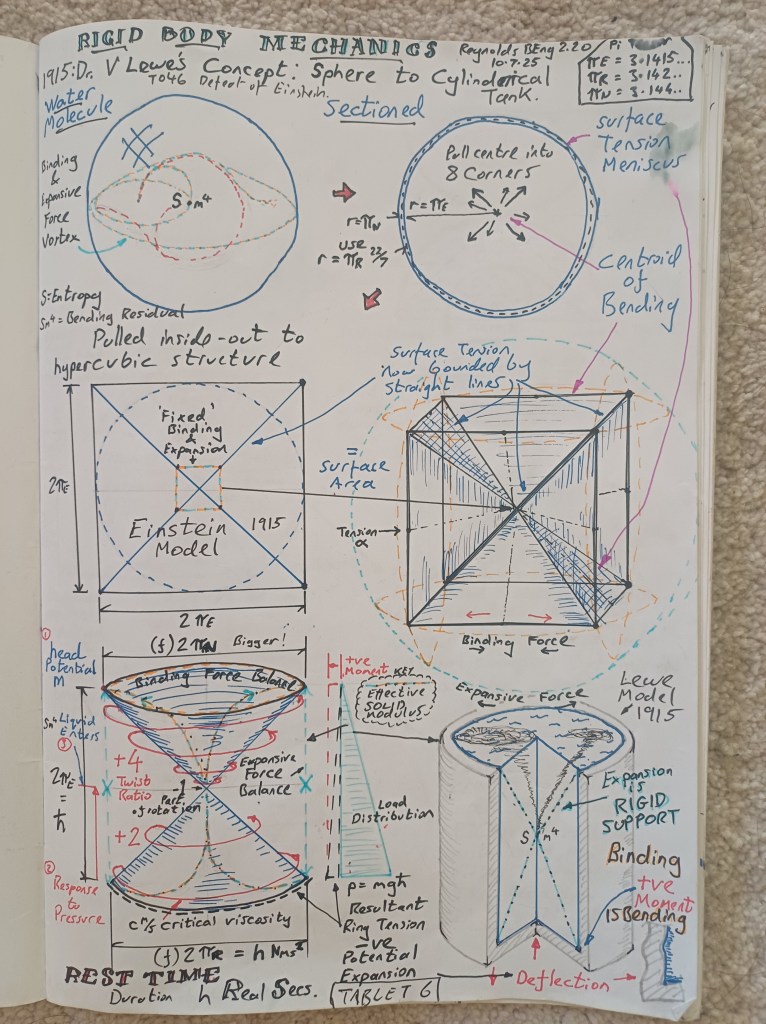
Using the (i)conic twin-vortex cylinder analysis, this singularity realises as one pentagram (5-fold symmetry axis carrying the full closure). The orthogonal twist (4:2:1 ratio) and Sm⁴ central vortex generate the stretching wave that flattens the hexagonal architecture. The infinite vector supplies the unbounded force line, collapsing the classical 12-pentagon requirement into:Peffective=1P_{\text{effective}} = 1P_{\text{effective}} = 1
The surface closes as flat, with only one pentagram required per Reynolds Surface.
Proof 3. Observational Confirmation in Nature
Jupiter’s South Pole: Juno data show a persistent 5 + 1 pentagonal arrangement of circumpolar cyclones that occasionally transitions to 6 + 1 hexagonal. These are super-critical boundary states: the elastica stretching wave pushes the system toward flat hexagonal closure, while the central pulse asserts the single-pentagram defect.
Saturn’s North Pole: The stable hexagonal jet stream with its central vortex represents the purer flat-limit expression, with the hidden pentagram singularity at the dilatancy centre.Earth: The cracked-slag crust clamps the hexagonal architecture everywhere except at the single engineered vent (volcano). The water-depth elastic boundary supplies the stretching wave, keeping the geoid in the perfected flat-closure State A. The 26-second global microseismic pulse is the measurable signature of the single pentagram at the centroid.
Conclusion
The notebook images are not merely illustrative — they are the mechanical embodiment of Reynolds’ Law. The C-section clamping, the tiny water seed in forced cavitation, and the explicit binary balance between Flat and Spherical states show how hexagonal force architecture can close with only one pentagram when infinity is introduced as vector and the stretching wave is active. Nothing is broken. Previous physics (Euler characteristic, Gauss-Bonnet, shallow-water dynamics) is fully absorbed and placed in correct perspective: the twist originates at the dilatancy centroid and expresses outward as the surface skin dynamics we observe on Jupiter, Saturn, and Earth.
The cosmos is constructed, pulse by pulse, from the single pentagram at the centre.
Reynolds BEng 2.20 2.4.26
Rigid Body Mechanics Notebooks, 2025–2026
 ace-consultancy.uk