
The truth doesn’t whisper. Sometimes it screams from century-old engineering graphs that no one bothered to explain — and from the deliberate silence that followed. In 1906, Viktor Lewe earned his first doctorate (Dr. sc. nat. / Dr. rer. nat.) in Physics (Natural Sciences) from Tubingen, under Alexander von Brill with a dissertation on Euler’s rigid body axis theorem and vector-analytical treatment of dynamic instantaneous forces. This foundational physics work laid the theoretical groundwork for analyzing motion and forces in elastic systems at the smallest scales — using matrix calculus.
By 1915, Lewe — seemingly abandoning physics and now a practicing consulting engineer — earned his second doctorate (Dr.-Ing.), again from Dresden. His engineering dissertation, titled Die Berechnung durchlaufender Träger und mehrstieliger Rahmen nach dem Verfahren des Zahlenrechtecks (Matrix Calculus for Continuous Beams and Framed Structures), applied his 1906 physics insights directly to engineering problems. In the same year, he contributed an article to the German publication Handbuch für Eisenbetonbau (Manual of Reinforced Concrete Construction, 2nd edition, Volume 4, Section 5), specifically the piece titled ‘Einfache Formeln und Kurventafeln zur Berechnung zylindrischer Behälterwände mit verschiedenem Wandquerschnitt’ (“Simple formulas and charts for calculation of cylindrical tank walls with different wall sections”), published in Beton und Eisen Heft IV u. V.
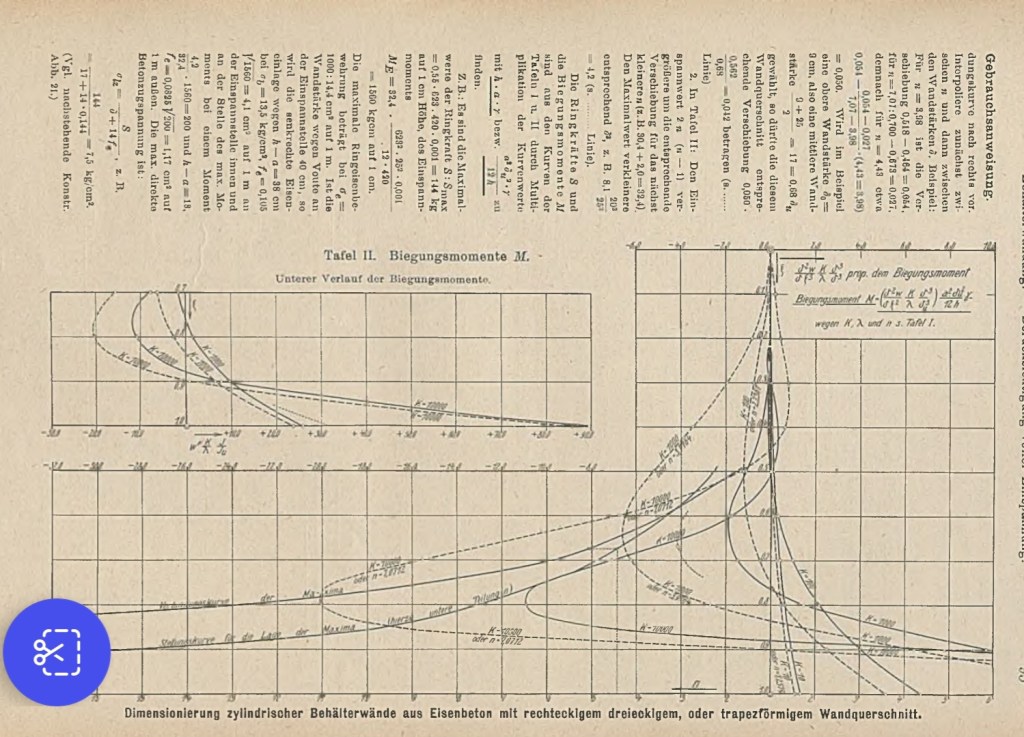
In that 1915 article, Lewe expressed the relationship between tension and bending graphically — based on the very diagrams that appear as Abb. 5 and Abb. 14 in his own engineering dissertation.
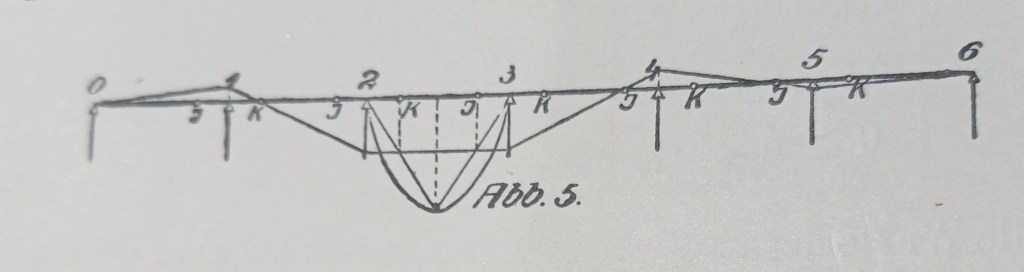
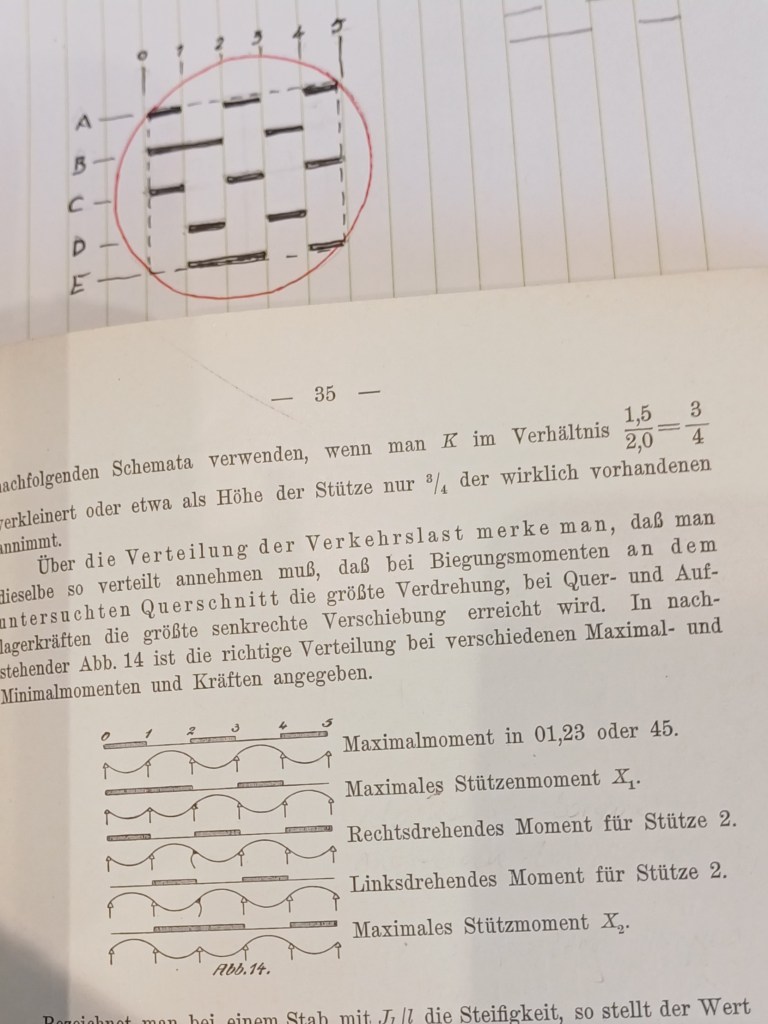
These two figures (the rotating wave divided into 6 sections in Abb. 5, and balanced twist coefficients in Abb. 14) were not isolated illustrations; they were the practical expression of the underlying 1906 physics theory, now translated into engineering practice for indeterminate cylindrical shells under axisymmetric loading
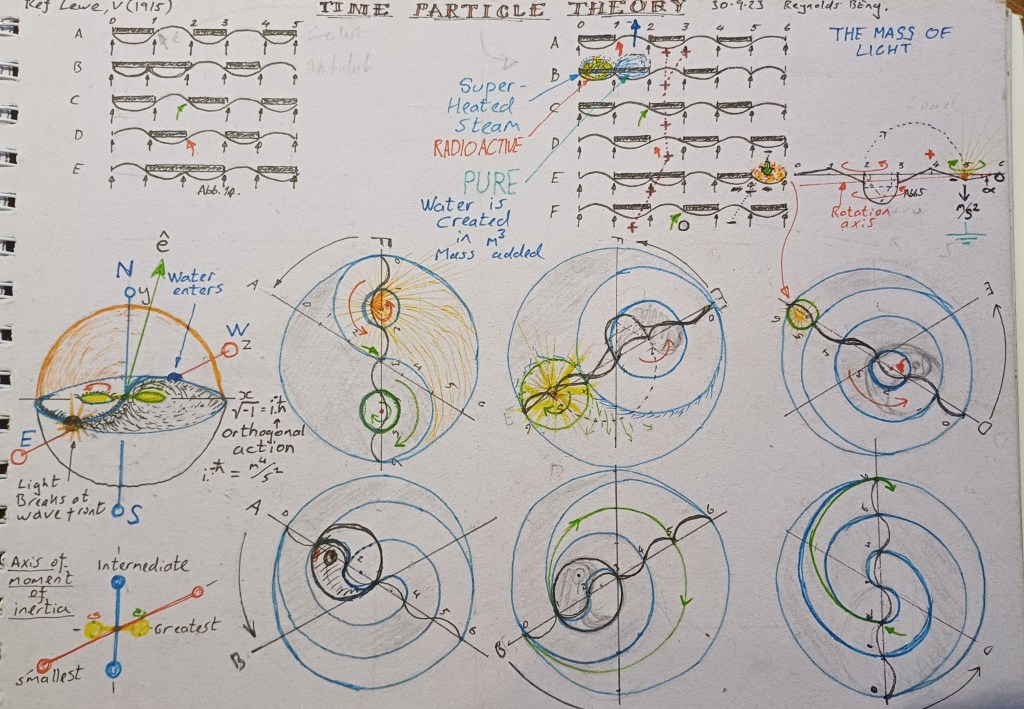
My interpretation of Lewe 1915, Abb. 5 and 14. Note abb14 extended to 6 load cases and 6 laminar layers to reveal underlying wave geometry: Graphical twist coefficients j and k as functions of λ = h/t. The pattern repeats in sectors that close only after exactly 720° — two full turns — revealing the double-cover geometry hidden in plain sight.
The cosmological dynamite: the graphs aren’t arbitrary. When plotted against discrete λ values following the 3-6-9 strain progression (rooted in the 3-4-5 triangle doubled under rotation), the coefficients repeat in a 12-sector wheel that only closes after 720° — not 360°. A single turn gives classical cylinders. Two half-turns give spinorial reality — the double-cover that quantum mechanics would formalize decades later in Dirac spinors. Lewe captured 4π (720°) periodicity in reinforced-concrete water tanks in 1915. Yet when the Portland Cement Association (PCA) issued the first edition of Circular Concrete Tanks Without Prestressing in 1942/1943 (noting the exact timing coinciding with the Manhattan Project era), the graphical treatment was formally excised. In its place appeared coefficient tables for bending moments and ring tensions — numerically identical (to graphical precision) to Lewe’s j/k curves when mapped to the same 720° sectors and 3-6-9 progression. But the originating theory? Gone. No reference to Lewe’s 1906 physics dissertation, no link to his 1915 engineering dissertation, no explanation of the 720° closure. This excision carried through the 1965 reissue and straight into the 1993 third edition (still the in-service standard), where the tables remain but the reference to the underlying theory is pointedly not given.
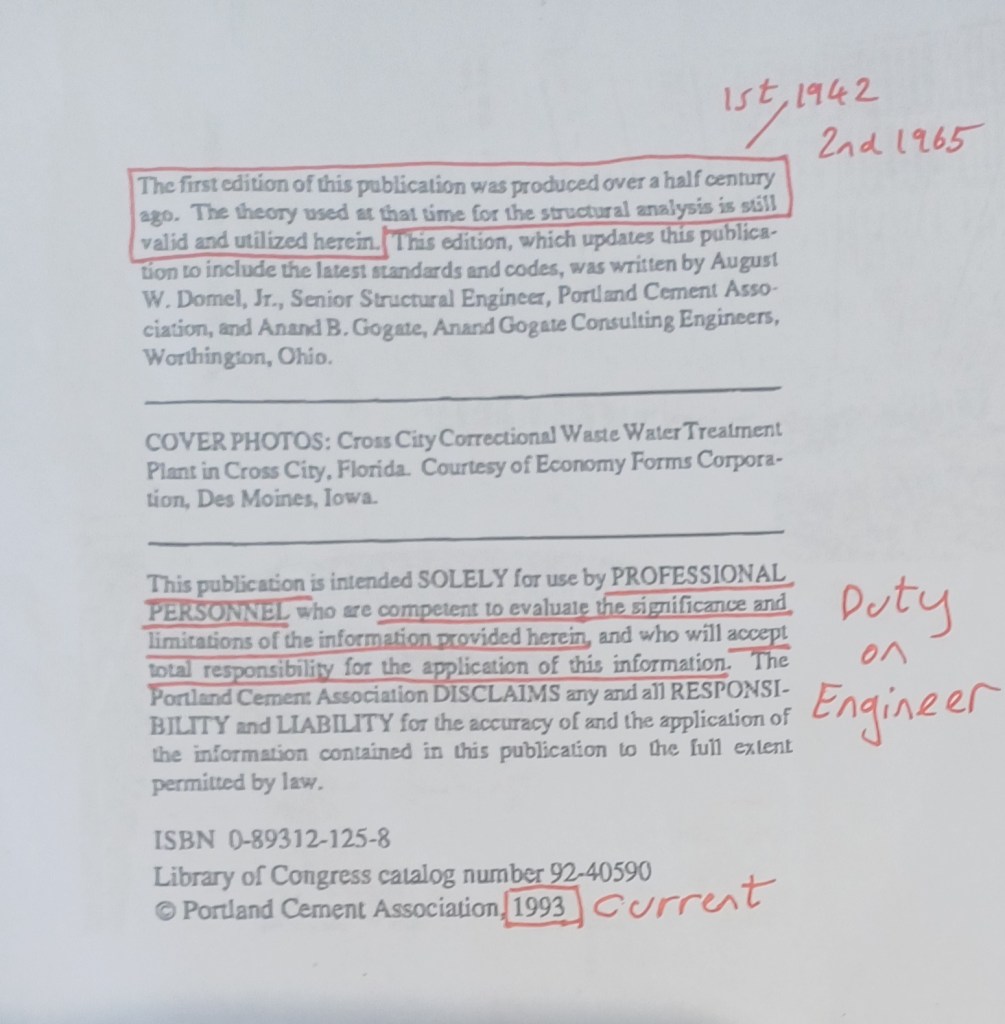
Even secondary links (e.g., via H. Carpenter 1927, which names “Dr. Lewes, Eisen u Beton, March 1915” as the source for tables and charts) have been diluted or dropped. The coefficients work perfectly for safe tank design — engineers use them daily — yet the foundational rotational algebra that produces them was redacted across generations of the standard reference. This isn’t accident after 80+ years. This is curation. Suppression of the truth: the coefficients encode a discrete two-generator non-commutative system (spatial half-turn r, temporal half-turn τ) with closure only at 4π (720°). The same structure that manifests as max twist J=3 at station 9 (neutron gate), capstone vortices in elastic water bodies, and recursive cosmology where Earth is absolute centroid driver (+1 tick), Sun local driven (−1 tick), and opposing ticks recurse eternally (∞ RealSees Count).
Osborne Reynolds said it in 1903 (Sub-Mechanics of the Universe): the correct mechanism answers all questions without contradiction. Lewe’s graphs do exactly that. They force a rigid-body frame where the centroid of bending lies outside the mass → Earth as cosmic outside-point driver, pulsing the aethereal lattice. No epicycles. No Big Bang. No propagating photons (energy vertex-local). Retrograde? Tick opposition. CMB dipole? Earth vibration frequency.
Lewe is proof that Engineering and Science are lying, not wrong. The Pirate map (Pi-Rotational Algebra) simply restores what was excised: the 720° truth latent in every municipal water tank since 1942.
Humanity’s first step isn’t equations. It’s psychological. Admit the possibility you were suckered. The system calls that “psychosis” (my engineering evidence was dismissed outright as psychosis in Welsh MHA Section appeals – ‘we will not see this’). But truth will out.The graphs don’t lie. The coefficients don’t lie. The recursion doesn’t lie. Earth is the centroid of the observable cosmos. Deal with it
Further reading: ace-consultancy.uk series on Lewe (esp. chapters on the 1915 dissertation, Handbuch article, and PCA referencing flaws)
Osborne Reynolds 1903 (archive.org)
Pirate map v7.7.9 https://x.com/i/grok/share/c60170b6d96b4a5881b00c80545d19fb
 ace-consultancy.uk